
Welcome to Modern Agriculture!

Cassava, one type of starchy tuberous bulb, a perennial tree grows in tropical and subtropical areas which are consumed by the people as a food. Basically, cassava farming is mainly done in South America and surrounding tropical countries. Cassava farming can be done with potato farming, rice farming, and maize farming.
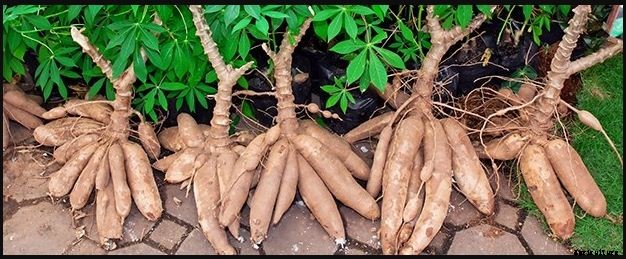
Cassava farming is mainly done to produce food items, solvents, alcohol, glucose, animal feed, energy, fertilizers, and some extra by-products. Nigeria tops the list of cassava production list, all over the world and Thailand tops the list of cassava production in the Asian continent.
Basically, they have originated from South Africa and the scientific name of cassava is Manihot esculenta.
Mainly, from cassava plant, leaves and tubers are the important part, which is used most by the people for cooking or in other forms. Roots of this commercial crops are mainly consumed because of these are an excellent source of starch along with vitamin ‘C’, calcium, phosphorus, etc. A good combination of all these nutrients have lots of health benefits. Roots are about 1 mm thick in size and have brown color outside. However, the commercial cassava plants have larger roots having a bigger diameter and larger length.
Commercial cassava farming can create a huge profit if a suitable variety of cassava is cultivated with good farm management skills. So, let’s learn how to how to grow cassava commercially? in the following article.

The following is the list of some of the health benefits of cassava.
कसावा, Sakarkand (India, Hindi), ات کٹ (Urdu), 木薯 (Chinese), Tarul (Nepali), Cassave (Dutch), Maniok (German), Moxog (Somali), كاسافا (Arabic), 樹薯 (Taiwanese), Kamoteng Kahoy (Cebuano), 카사바 (Korean), มันสำปะหลัง (Thai), Maniok jadalny (Polish), маниока (Macedonian), Маниока (Bulgarian), тропска биљка(Serbian), Kamoteng kahoy (Filipino), Mandi’o (Estonian), Maniok (Bosnian), Casabhaigh (Irish), Manyok or Mandioko (Turkish), Mandioca (Portuguese), Yuca (Spanish), Sắn(Vietnamese), Manihot esculenta (Italian), مانیوک (Persian), Маниок (Russian), Manioka (Latvian), キャッサバ (Japanese), Maniok (Norwegian),Manyokka (Sinhalese), Manioc (French), Tapioca (Czech), Maniok (Slovak), 木薯 (Cantonese), Maniok (Swedish), Ubi kayu (Malay), Kassava (Danish), Mogo (Gujarati).
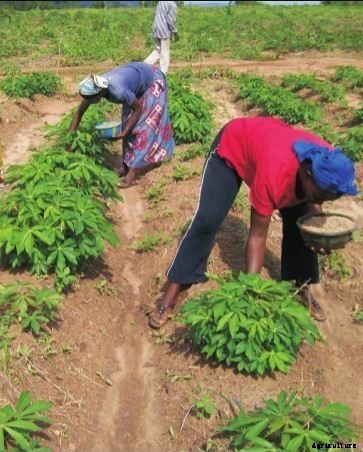
There are numbers of an improved variety of cassava for growing cassava commercially. Bitter and Sweet are two main kinds of cassava, from which the sweet variety is cultivated most because of it is capable of producing more roots and leaves than other varieties.
In the market, for commercial cassava cultivation, there are many kinds of varieties are available according to each specific the region. However, Katabang, Brasil, Golden Yellow, and Macan are some common varieties, which are capable of producing more yield.
Basically, cassava plant is tropical and short day plant which requires warmer atmosphere along with humid climate. In commercial cassava farming, the atmosphere temp. plays a vital role in the production.
This crop is very prone to the frost condition so try to grow cassava in a frost free area in a warmer region with moderate humid conditions. For growing commercially, a temp. ranging between 23 °C to 33 °C is considered as the ideal one for producing maximum.
Also, cassava can also grow well with moderate water availability. It is possible to cultivate cassava in a region having an annual rainfall about 500 mm to 35000 mm. Since farming this crop with good availability of water is helpful in obtaining higher production.
This crop can be cultivated, almost in all kinds of soils. However, a deep and sandy, loamy soil is considered as the best suitable for producing optimum through growing cassava. Note that, in the organic-rich soil, tuber growth is less than the vegetative growth. So, grow this crop in a soil having good organic content with proper drainage to obtain a higher yield from it.
Also, this crop produces the most in acidic soil. So, control your soil pH. This can be done by adding about 50 kg of lime per hectare. They can grow best in soil having ph, ranging between 5.5 to 6.5.
Land preparation in growing cassava plays an important role in yield. Your land should be in fine tilth form. This can be done by giving two or three normal plowing. The weed from the previous crop should be removed from the field. The friable soil is more helpful in producing more.
However, go for at least one soil test before starting cassava farming because they do not grow well in neutral soil. They thrive their best in saline soils. So, add about 50 kg of lime per hectare to bring your soil pH in between 5.5 to 6.5.
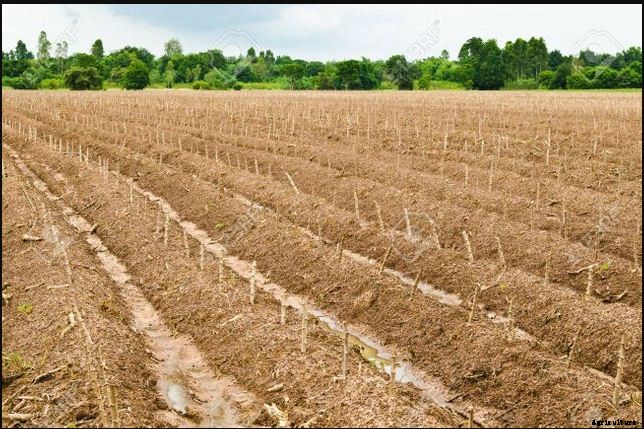
Cassava is mainly cultivated with the help of stem cutting. However, it is also possible to propagate them with the help of tubers and stems.
For commercial cassava plantation, learn the suitable cassava planting methods.
This crop can be cultivated throughout the whole year but it is essential to keep your soil moisten for about half a year after plantation on the field. According to cassava planting methods, take care in the plantation. Never plant an immature stem.
Plant a stem having more than 30 cm size and should be cut from a year old mature plant. Also, 4 to 7 nodes on the grafted stem are essential for setting well.
Plant your cut stem in the previously prepare did in the morning or evening in the cooler weather.
There are three methods of the plantation in commercial cassava farming. These three methods are listed below:
This method of plantation should opt for growing cassava in the monsoon to avoid the constant wetting of the rot.
To maintaining the moisture content on your farm, this planting method should be opted for growing in summer or hotter days.
If you are thinking to grow this crop in between summer and monsoon season, then go for this method of the plantation.
Note: In every method of the plantation, the stems should be planted by keeping the cuttings about the ¾ inside of the field and the remaining one or ¼ portion should be incorporated into topsoil.
The cuttings are planted in the prepared dig by keeping row distance about 1 meter. Plant them at a distance one meter apart.
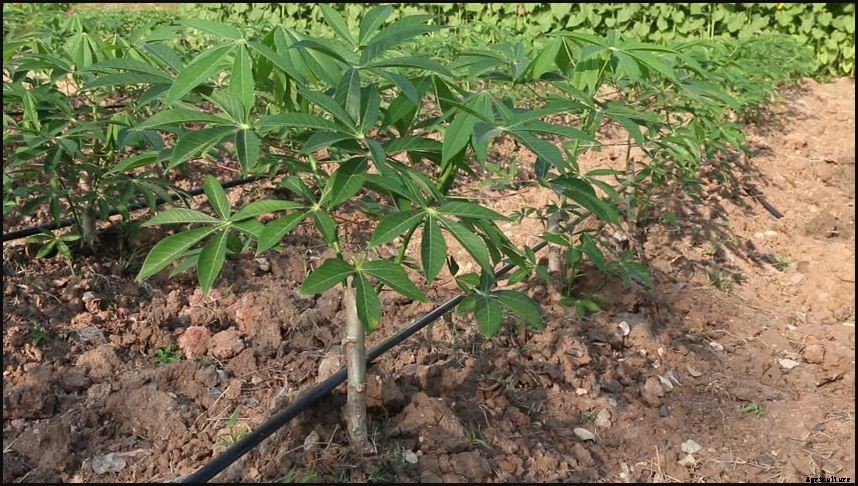
It is essential to provide water in sufficient amount to maintain the moisture content in your soil for the first month of the plantation so that grafted cuts set a well on the field and also to grow healthy tubers.
Frequent irrigations are needed in the conditions of drought. However, a 25 % moisture content in your field may help you in producing doubles the numbers of grown tubers.
Timely application of suitable manure and fertilizer in your cultivation can give your higher production.
For improved variety, it is a good idea to add farmyard manure, more than 20 tonnes per hectare along with proper chemical fertilizers. Also, add about 50 kg of Nitrogen, 50 kg of Phosphorus and 50 kg of Potash at time of land preparation per hectare land.
Also, the same dose of N:P:K should be applied at after about two months of planting cuts or stems on the field.
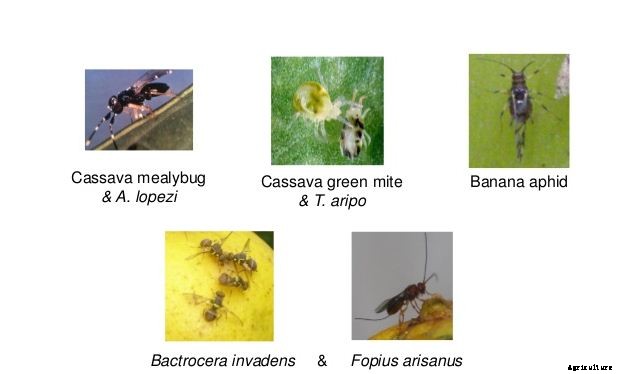
The following is the list of common pests and insects, observed in the cassava production:
However, wild pigs, goats, sheep’s, and rates are also harmful to your crop.
For controlling all these, try to keep away all these mentioned.
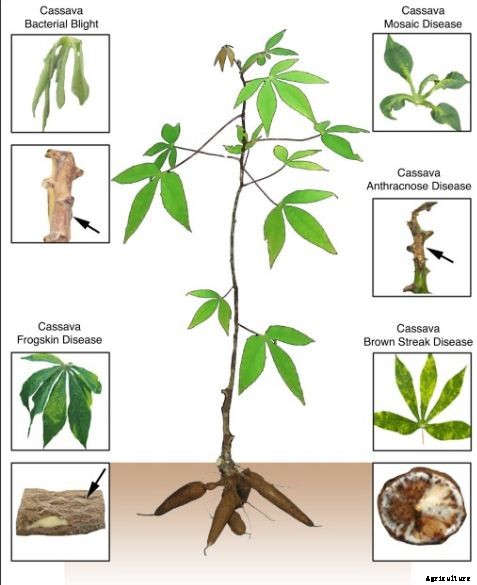
The followings are the main disease, that is observed in the commercial production of Cassava.
For controlling measure, learn the symptoms of all these mentioned diseases and operate a suitable treatment as sooner as they observed.
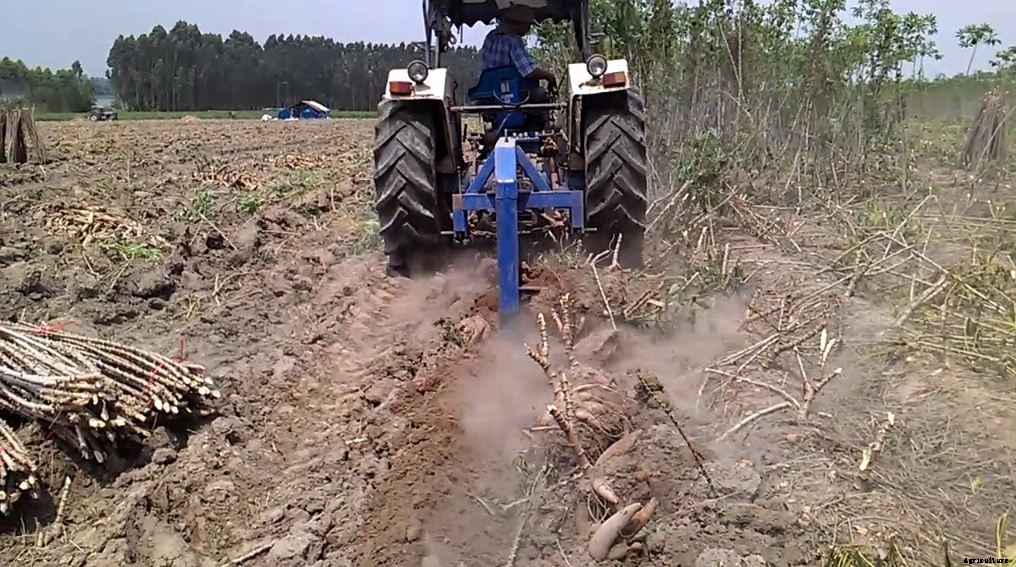
This crop becomes ready for harvesting in about 12 months of the plantation on the main field whereas short duration variety takes about 6 to 8 months. However, harvesting at the right time helps in obtaining the best quality of tubers in a higher amount.
This commercial crop is mainly harvested by hand, by lifting the base of the stem and then pulling it outs. Then they should be removed from the field though hand. Removed the upper portion of plants and stems before harvesting it.
Take care while harvesting roots. While harvesting, your roots should be not be damaged in any way.
The yield of this commercial crop depends on numbers of key factors such as theagro-climaticc condition, type of soil, the cultivar or variety is chosen for its cultivation along with good farm management skills.
However, it is possible to harvest about more than 40 tonnes of roots with good farm management skills through growing high yielding hybrid and for short-term variety, you can harvest roots, about more than 30 tonnes from a hectare land.


