Clover Cultivation (White); Farming; Planting Methods
Today, we are discussing white clover cultivation and its planting information.
Introduction to Clover
White clover which is scientifically called as “Trifolium repens” is a perennial legume. Its origin is in Europe and this is the type of legume which is distributed widely across the world.
The growth habit of white clover would be prostrate and stoloniferous, where a branch which is horizontal comes out from the plant base which in turn produces fresh plants from the buds at the tips or nodes, juke like in the case of strawberry. The leaves will consist of three leaflets. They may or may not have a watermark on their surface. Roots and leaves will be developed along the stolons where the nodes are present.
The heads of the flowers, each one of them containing 50 to 100 florets will be carried on long stalks from the axils of the leaf. Florets would be white in color, but their hue is pink.
Uses of White Clover:
- White clover can be used as a forage. This is one of the pasture legumes which is considered to be the most important one. White cloves are very pleasant to taste and are also nutritious which are suitable for all kinds of livestock and most of the wildlife. The plantation of white clover is mostly done along with orchardgrass, tall fescue, ryegrass or bromegrass. Plantation of Ladino white clover with orchardgrass will produce a great and premier combination of forage for the grazing systems which are intensive. Ladino white clover will grow very tall which is sufficient to get harvested for the purpose of hay, green chop and also silage. Common white clover will rarely grow tall to harvest it for the purpose of silage or hay. White clover which is grazed is very good in taste and also has a very high crude protein up to 30%, but there is a risk for bloating in ruminants if proper practices of management are not followed.
- White clover will be a great forage plant mainly for wildlife. The leaves of white clover will be grazed by moose, bears, deers which have white tails and voles which have a white foot. The seeds of the white clover will be consumed by bufflehead, sage grouse, horned lark, willow ptarmigan, American robin etc.
- The nitrogen which is produced by the white clover will be added in the mixture of seeds and this will benefit the grass seedlings. White clover will have solid stands which will, in turn, form a very good cover for controlling erosion, This cover would be formed on the fertile soils which are moist. On the sites which are dry, these solid stands may be spotty or sparse.
- Honey bees and other forms of insects will undergo cross-pollination on the flowers and collect nectar and pollen.
- White clover has the capability of growing in shade, maintaining a low profile, surviving even when the mowing is done repeatedly and withstanding the traffic will make both short-term and intermediate white clovers good for living mulch systems. In order to be effective, management of mulch crop has to be done so that there won’t be any competition with cash crops for the sake of light, moisture and also nutrients. The persistence of white clover while facing few herbicides and minor tillage will be used to benefit the systems of orchards, vegetables, and vineyards.
- If there is field traffic which is intensive and soil moisture is adequate, white clover will make a very good coverage for soil which will keep the alleyways in green color. It will decrease compaction and dust, at the same time protects wet soil from trauma which is caused by wheels of vehicles. White clover will help in the conversion of bare soil into active soil by making it as a habitat for organisms which are beneficial and are present in both upper and lower surfaces of the soil.
Types of White Clover:
The classification of white clovers is done as small, intermediate and large.
Small type:
The small types of white clover will rarely exceed the height of three inches and are mostly found in the areas which are closely grazed or in the lawns. The clovers which are of small type will have less productivity and they contribute in little amounts to grazing in the production of animals.
Large type:
The clovers which are of the large type or the ladino white clovers have large leaves which bloom late and grow upright more than the small and intermediate types of clover. In the balanced fertility and management, large clovers are independent reseeders and have fewer stolons and leave very close to the level of the ground. Due to these reasons, large clovers have less persistence of grazing.
Intermediate:
Clovers of intermediate type are the same as their name suggests, they are intermediate. The period of flowering and the size of the leaf will fall between the small clovers and large clovers. The intermediate type of clovers will reseed typically than large ones and have many numbers of stolons and leaves at the level of the ground. They also give rise to more forage than the small type of clovers. Due to these advantages, the intermediate type of clovers will have good persistence in the grazing.
The climatic requirement for Clover Cultivation:
 Clover Plantation.
White clover will need full sun, or the location where the white clovers are planted should be slightly shaded. The root system of the clover which is shallow will make it intolerant to the harsh conditions of drought.
The soil requirements for Clover Cultivation:
- White clover is a plant which grows in several types of soil and can also be grown in the ground or even a container easily. The soil which is well-drained and fertile is preferred by white clover. The soil should be slightly acidic with a pH between 5 to 6.5.
- You need to first make a determination of the correct type of soil in order to allow the clover to survive. Few of the types of clover will do their best in the soils with pH between 6 and 7 and some of the clovers do best in the pH between 8 and 8.5 which is very high. A soil testing kit will help you to determine the pH and will also let you know about any deficiencies in the soil in terms of minerals and nutrients.
- If you observe that the pH of the soil is very low, then make an adjustment to the soil by adding lime to it. If the pH of the soil is very high, then make a correction by mixing it in sawdust or peat moss. If you have made any sort of adjustments, then you need to wait for at least 6 months for the changes to take effect. It is always better to plan in advance on when you are going to plant clover.
- Select a clover type which best suits your soil pH. Make a research on the varieties of clovers by consulting a plant nursery or any garden center.
Read: Alfalfa Cultivation.
Preparation of Clover Cultivation field:
- Before the plantation, make sure that you are getting rid of any growth of plants which are not required. Make use of a weed killer like roundup in order to eradicate any weeds or unnecessary plants which are existing in the field.
- Few types of treatment of weeds like chemical broadleaf treatments, systemic herbicides will make you wait for 15 days before the plantation of new ground cover. You need to follow all the instructions mentioned in the label carefully.
- The seeds of clover will work best if they do not have any competition with weeds at the time of establishment. For removing vegetation and debris from the area of cultivation, start tilling the soil up to eight inches deep. If you till prior a month, then weeds would get some time for regrowth so that you can cut them before plantation of clover. If you till the soil before a month, it would also help to change the pH of the soil, if required.
- To allow the weeds and other vegetation to grow, the tilled area should be provided with water which is covered by light mist. This would help you to remove weeds in approximately two weeks before the plantation of clover seeds. There is no need to think a lot about watering if there is sufficient rainfall.
- Before two days of the plantation, dig the soil for weeds which have come up by using spade or shovel. This step will help you in eliminating the competition of the clover with weeds and make it survive.
Preparation of Clover seed:
The seeds of clover are tiny and lightweight. In order to make sure that they are evenly spread, it is always better to mix them with some other medium which will make it easier for them to get distributed in the ground.
Seeding for Clover Cultivation:
- The rate of seeding should be about 2 pounds per acre. To consider an average, in one pound, there would be up to eight lakh white clover seeds. To compare it relatively, there would be only 10,000 wheat seed for one pound. Because of the small size of the seed, the plantation of it should be done at the proper depth for them to emerge in a good way.
- The depth of seeding should be at 0.5 inches and it should not be exceeded at any cost. If the plantation of seeds is done with too much depth, the germination process would be poor and this leads to failure in the establishment phase itself.
- It is tough to adjust a grain drill which is standard for the accurate delivery of the amount of seed at depth and rate which are proper. You need to make use of drills along with seedboxes which have been designed for metering of small seed and their delivery.
- If the plantation is done without tilling and drilling, make use of disc openers to cut the sod which is existing and scratch the surface of the soil slightly. Make use of press wheels for the establishment of good contact between soil and seed at a depth which is shallow.
- Because of the depth requirement of clover seeds, the broadcast of seed can be done onto sod which is closely grazed at the time of late winter and can be incorporated into the surface of the soil by dragging, frost and hoof treading with stocking rates which are high temporarily.
- Making use of a chain drag is a cheap and quick method which can be used parallelly with broadcasting or in two different passes.
- Making use of animal hoof is an inexpensive alternative to a no-till drill. Frost can be used for the delivery of seed of clover to a planting depth which is ideal.
- Freezing will appear like a honeycomb on the soil which will allow the seeds of legume to get settled below the surface after various cycles of freeze-thaw.
- Broadcast seeding is very effective in the month of February than in the months of fall, so the production of forage in the first year will be decreased while broadcasting. You will need to raise the rates of seeding by at least 25% if the methods of broadcast seeding are used.
Management at the time of establishment of Clover seed:
The growth of seedling of clover should be favored when planted in combination with grasses which are established like bermudagrass or tall fescue. Too much competition from other grasses is the main reason for the failure of establishment of clover. Keep in mind that at the time of establishment, grasses are their enemies. You can take into consideration any practice which favors the seedlings of clover and penalizes the grass which is existing rather than killing it completely. Various management options are present to take care of the establishment of clover.
- Removal of excess forage and thatch before seeding in Clover Cultivation:
This will help in the prevention of shading and will improve the contact between seed and soil which will, in turn, help the seedlings to survive. Hence, forage which is excess should be eliminated by making use of heavy grazing methods. Haying is also be chosen as an alternative for the removal of excess forage.
- Planting must be delayed when white clover is planted in combination with bermudagrass or other perennial grasses:
The plantation of clover should be done into sod which is closely grazed at the time of fall or in the early stages of winter after the perennial warm-season grasses become dormant which will allow the adequate establishment of clover prior to green up. The plantation in spring should be avoided mainly in the coastal plains as they consist of heavy grass competitions with the seedlings of clover.
- Grazing management:
- At the time of seed establishment, while clover will produce a root and a primary stem. The primary stem will produce runners which will let the plant to get spread. Similar to bermudagrass, the stolons of white clover will give a secondary root system and will help in the perennation of white clover.
- Eventually, the primary root will die. Hence, it is a bit dangerous to let the secondary root growth to take place after the seed establishment. It is important to reduce the shading of grass and let the sunlight reach the seedlings of the clover.
- Hence, an act which inculcates balance should take place. The grass which is in the competition should be eliminated with less damage caused to young seedlings of clover due to grazing. Once the rooting takes place in the runners of the white clover, grazing can be done.
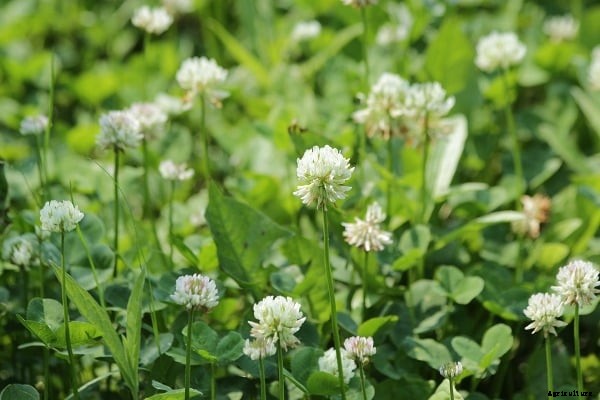 White Clover Field.
- Considering the effects of fertilizer on seedlings:
- In the primary year of establishment of clover, the nitrogen which is fixed by clover does not have minerals and is not available to grasses. So, prevent applications of nitrogen or poultry litter when clover is getting established as this will help in the growth of grass and maximize the competition.
- Nitrogen should be applied lightly during the production of grass that too when it is much needed. It should be between 25 to 40 pounds for one acre. Grazing should be conducted in such a manner that it decreases the injuries caused to clover. If the grazing methods which are controlled are not that feasible, application of nitrogen should not be done in the year of establishment.
- Good amounts of phosphate and potassium are required for the establishment of clover plants which are productive and also competitive. It is important to conduct a soil test and if required, phosphate and potassium can be applied for the successful establishment and persistence of clover.
- Search for any damage caused by insects in the early stages of fall:
Insects are the dangerous pests in the plantation of legumes at the time of fall. Pygmy crickets are the ones which can rapidly and completely remove the seedlings which have emerged recently. Search the fields carefully, slowly and closely and be prepared for the application of suitable pesticide if required. Crickets are tough to spot, but the presence of crickets can be found out by small bites which would be in the shape of a small circle on the leaflets of clover seedling. Delay in the plantation of clover until the completion of killing frost will reduce the pressure of insects in a great way.
Read: Cover Crops Advantages.
Management of White Clover after establishment:
- Fertilization of soil in Clover Cultivation:
A soil test is a mandate in every alternate year and lime, phosphate, potassium have to be applied in order to maintain productive stands which are healthy too. Though Potassium and Phosphorus are not eliminated in huge amounts while grazing, redistribution of nutrients can be done to shade, watering and other areas of lounging where the concentration on urine and dung is done. This would be really applicable in huge stocked pastures.
- Grazing management in Clover Cultivation:
- Though the white clover can tolerate close grazing, it is somewhat sensitive to the pressure of grazing. To consider an example, white clover can act as a weed in the lawns which are mowed often.
- Close removal of the plant material above ground will let the light to reach the leaves of white clover and helps in the growth of clover over the tall fescue. In contradiction to this, white clover is rarely found in the pastured which are not grazed or the fields of hay which are removed very rarely.
- The tall grass which is present in these ungrazed fields will shade the clover and will help in the growth of grass.
- When the pastures are being grazed in rotations in regular intervals to short heights, regrowth of clover would be favored over the growth of grass.
- Grazing rotationally will also improve the use of grass and lets to store the carbohydrates present in roots.
- Graze pastures which contain white clover to a height of 2 inches will help in the persistence of clover. 15 to 20 days of rest periods are good for the mixtures of white clover and bermudagrass, but regrowth periods of 21 to 30 days are required for the pastures of orchardgrass and tall fescue which contain white clover.
- If the pastures are grazed in a continuous way, make sure that you are monitoring the rate of stocking closely. Spot grazing and shading of clover will take place at stocking rates which are low whereas the high stocking rates will decrease the performance of the animals and grass vigour.
- Grazing can be started when the pasture reaches to a height of at least 4 inches to a maximum of 6 inches. This will be done by the first week of March if the white clover is planted individually, or the first week of February, when the clover is planted in a combination of some other grass.
- Controlling weeds in Clover Cultivation:
White clover can tolerate applications of 2,4-D than the other cloves, but the working of these applications in an effective way is completely dependent on the climate and maturity of weed species. 1 litre of 2,4-D for one acre will cause injury to white clover, but in many cases, there would be recovery. Clover is very much sensitive to dicamba, triclopyr, picloram and the use of such chemicals will cause complete destruction to clover which is existing. If the clover proportion has been decreased to 12% of the stand dry matter and if the pressure of weed is too high, it is good to kill the weeds and reseed the clover after the expiration of residual activity of herbicide.
Diseases in Clover Cultivation:
In clover cultivation, white clover will be affected by viruses sometimes. Alfalfa mosaic virus, peanut stunt virus and clover yellow vein virus are the ones which are transferred by pests like thrips. Most of these viruses will lead to decreased growth of stolon, the yield of leaves which is depressed and reduced nodulation and growth. There are no control measures and cultivars which are resistant to viruses. If there is any failure in the stands of clover due to viruses, reseeding has to take place and there is no other alternative.
Read: Growing Safed Musli.


