Jamun Fruits are highly beneficial for your body and health it is good especially diabetic patients. Now day people are keen about the fruit that are really healthy, they are searching for nutritious fruits, this interest has gained the good market for Jamun cultivation.
Jamun fruit farming is gaining more demand day by day. Jamun are easily cultivated, and you can earn good profit by cultivating Jamuns. Not only farming, owing a Jamun orchard is an immense pleasure to have a fruit farm.
Jamun fruits are hardly cultivated commercially, but they good scope for such cultivation. Jamun are very nutritious and delicious fruit. The Jamuns are fully of antioxidants and several important nutrients which are essential for your body. It is rich in medicinal properties, which can control blood pressure and diabetes.
The harvesting period is Jamun tree is a very short period. Due to its nutritional value and a short period of availability, the demand for Jamun surpasses its supply. Considering the huge market demand, cultivation of Jamun can be a very good business.
Farmers can easily earn huge benefits by cultivating Jamun. Implementing modern technologies for cultivation and irrigation, you can grow a very good farm of Jamun.
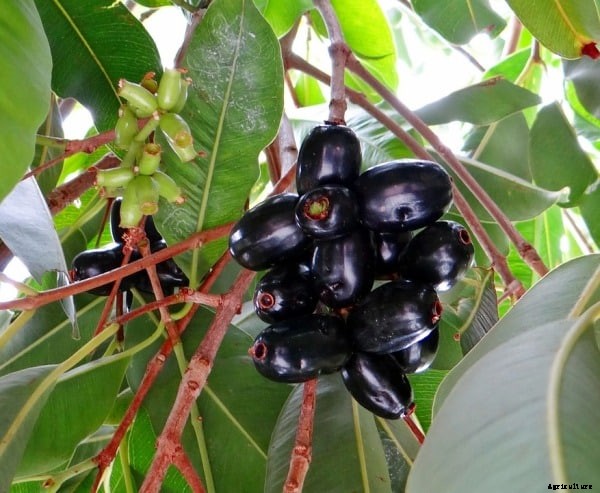
Jamun trees are evergreen trees with an average height of 30m with brown or grey bark. Leaves of Jamun trees are smooth which are 10-15cm long and 4-6cm wide. Flowers of the Jamun are yellow in color which is 5mm in diameter and having green fruits which turns crimson red at maturity. Fruits bear seeds which are 1-1.5cm long.
Top Countries Producing Jamuns:
The Jamun fruits are native to India. By the time they have spread to other countries as well.
Commercial Jamun cultivation is done in Pakistan, Nepal, Queensland, southern parts of Asia, China, Hawaii, Florida, Brazil, Guyana, Tobago etc. And in India, the states producing Jamuns are Kerala, Andhra Pradesh, Karnataka, Tamil Nadu, Maharashtra etc.
Different Varieties of Jamun:
There are many improved varieties of Jamuns that are available, but these are not suitable for cultivation. The native Jamun varieties are the to start a farm. Native Jamun variety that is very profitable, is called the Raja Jamun which generally grows in the northern part of India. This variety Jamuns are in purple color and a large size. Another variety Jamuns are called paras grown in Gujarat, these Jamuns large sized fruits in purple color. This Jamun variety of Jamun grows in the city of Varanasi these fruits are seedless. Narendra Jamun 6 is a popular Jamun variety which is grown in areas of Faizabad. It is said to possess the desirable characteristics.
Some more popular and profitable Jamun varieties are ashada, kaatha, bhado, badama, jathi etc. Some popular hybrid varieties are KonkanBahadoli, CISH J-42, Rajendra Jamun 1, Goma Priyanka, CISH J-37 etc.
How To Start Jamun Cultivation:
For commercial Jamun cultivation, you need to know about the latest methods of cultivation and should have proper knowledge of Jamun Cultivation. Only this can expect you to gain a high fruit with good profits.
Soil Requirement For Jamun Cultivation
The Jamun trees are considered very hardy and are easily grown in almost all types of soil. You can grow in loamy soil for the cultivating of Jamun plants. Don’t opt too deep or too light soils, as the growth rate is very low in these soils. Jamun trees are resistant to waterlogging and saline conditions. But if you are cultivating them for commercial purposes, you should avoid waterlogging and saline soils. For commercial Jamun Cultivation, the soil you use should be well drained, fertile and Young Jamun plants thrive in fertile soils. When the plants grow older, the roots develop deep. So, the soil has to be deep enough to allow the root penetration. Soil should be well aerated and of good quality. The optimum pH levels of the soil would be more or less neutral. Using soils of extreme pH can cause harm for cultivation.
Climatic Conditions For Jamun Cultivation
Jamun Cultivation is best in regions of tropical and subtropical climates. You can grow Jamun trees well in lower ranges of the Himalayas having an altitude of up to 1300 m.
Areas that are neither hot nor too cold climates are ideal for cultivating Jamun.
The Jamun trees require very dry climate, at the time of flowering and fruit formation. A minimum rainfall at the early time of the fruiting season is good for fruit setting and development of young plants.
The mature plants do not need constant care and attention, young plants are susceptible to frost conditions. So, the young plants need protection from the frost.
Land Preparation For Jamun Cultivation
Land should be prepared properly before planting. Clear weeds, stumps, and materials that belong to previous cultivation from the field. Once the land gets cleared, plow the field several times. After that, do harrowing of the land that gives fine tilth of the soil. The soil improvement must be done in the summer season. After that, you just need to dig out pits of dimensions 1mx1mx1m.
After digging for several days, fill the pits with well-decomposed farmyard manure, which is mixed with topsoil and use it for filling the pits. After filling the pits, you need to do light irrigation. This method helps soil to settle down, you can add some more compost if required.
You also must provide proper drainage channels in the field so as to avoid water logging conditions in the land.
Plant Propagation Methods For Jamun Cultivation
Jamun trees are propagated from seeds and other vegetative methods. But if youarepropagating them directly from seeds, it takes many years to produce fruits. Jamun seeds are used to grow seedlings, which are then used as rootstock for vegetative propagation.
There are many Vegetative propagation methods, some are inarching, budding and grafting which are generally practiced.
The inarching method is not suitable for commercial propagation.
There is no dormancy period for the seeds of Jamun. Seeds of Jamun are directly sown into the soil. The germination period 10-15 days, this may vary depending on the climate. Budding or grafting method is done with the seedlings that are one year old.
The seedlings are transplanted for use as a rootstock in the spring or monsoon season. If applying budding method, make sure that the seedlings have attained 10-14mm of thickness. The ideal time of budding method is in the month of July or August.
If you are cultivating in regions, where rains arrive early, the budding method can be started in the months of May-June.
There are also many methods of budding. You can choose for kert, shield or patch methods of budding.
Planting Methods Of Jamun Cultivation:
There are many methods of sowing: Direct sowing is done by seeds or Grafting method is also used.
For planting, select only the healthy plants for grafting or budding. The grafting method should be done at a point which is no higher than 20-30cm from the level of the ground. Make sure that the root system of the sapling is developed properly and has fibrous roots.
While planting, plant the sapling in the middle of the pit. The grafting or budding point should be kept above the soil. Plant sapling carefully, and put soil near the base and secure it gently to the ground.
Immediately after planting, irrigate the plants lightly. And provide support to the plant if required.
Planting Season And Spacing In Jamun Cultivation
Ideal season to transplant Jamun plants is spring or the onset of monsoon season. And is recommended to plant them in the If you are planting in the spring, the young plants have to face a hot summer.
In planning to sow in the spring season, it is planted in the month of February-March and if planning in monsoon season it is planted in the month of July-August.
The ideal spacing for grafted or budded plants is of 8m x 8m. If planting seedling plants, you should provide spacing of 10m x 10m.
The sowing depth should be 4-5 cm deep.
The seed rate should be a one seed per pit is recommended.
Seed treatment in Jamun Cultivation:
Seed treatment should be done before sowing, to protect crops from soil borne disease and pest. Bavistin is recommended for seed treatment. Once the seeds have gone through chemical treatment, they should be air dried and are used for sowing.
Steps for Sowing seeds in Jamun Cultivation:
Jamun seeds are raised on the beds that are 4 to 5 cm deep. After sowing seeds they should be covered with a thin cloth to retain moisture. And treated with chemicals to protect crop form virus attack. Jamun seeds takes 10-15 days to germinate from sowing.
Now dig the pits before the monsoon season starts. The Size of the pit should be 1m x 1m x 1m. In these prepared pits transplanting is done.
The Ideal time for transplanting is the next monsoon, by the time seedlings will have 3-4 sets of leaves.
An Irrigation should be done during the germination period, stop watering the plant 24 hours before transplanting, so that the seedlings can be easily uprooted and be turgid at transplanting time.
Irrigation Methods In Jamun Cultivation
First irrigation should be applied at the time of planting the Jamun plants.
After that you need, apply light irrigation. Seeds sown before the monsoon season don’t need any irrigation.
The young Jamun plants need 8-10 irrigations per year.
Irrigation is compulsory during time of flowering and fruit setting.
For mature plants frequent irrigation is not necessary. Irrigation is compulsory in dry weather and winter seasons. Constant irrigation in winter, will save the plants from the harmful effect of frost.
Irrigation for the young plants should be done at regular intervals.
After manuring, Light irrigation is compulsory.
A young Jamun plant it requires 6-8 irrigations and a mature Jamun plant requires 5-6 irrigations.
Apart from the regular irrigations, you need irrigation is required in the months of September – October for good bud growth and in the months of May – June for good fruit growth.
During the drought, life-saving irrigation is given.
Drip irrigation is most efficiant system to provide the water at regular intervels.
Training and pruning in Jamun Cultivation
Young Jamun plants should be trained for the development of the framework, keep the main stem or trunk clean up to a height of 60-90 cm from the ground level by cutting of the basal branches and sprouts.
Pruning of Jamun plants is just needed to remove diseased, dry and crisscross twigs.
Manuring and fertilization: The Jamun trees usually don’t require any for any manures or fertilizers. But for commercial Jamun cultivation, you need to apply some nutrition management methods.
During the pre-bearing period, 25-30kg well rotten farmyard manure or compost/plant/ year should be applied to the plant.
For matured and fruit bearing trees, the application of manure should be increased up to 50- 60kg/plant/ year.
The ideal period for applying organic manure is in the month before flowering.
Fully matured trees should be fed with should be applied 500 kg N, 600gand 300g K /plant /year.
Jamun trees have excessive vegetation growth if you grow them in fertile soils. If you apply the nutrients to the trees with excessive vegetation growth, the fruit will be is hampered. So, in this the application of manure should be very less of nutrients at that time.
Apply the manure as per the growth of the trees.
Aftercare
Rainy season is the best time for green manuring.
Intercropping with seasonal vegetable crops, fruits and other vegetables in the initial years is recommended.
Intercropping will provide you some extra income
Sprouts that are grown at the base of young Jamun plants should be removed timely and the plantation should be kept weed-free.
Jamun is a cross- pollinated crop. Encouraging the insects like honeybees will maximize fruit set and productivity.
Weed Control
Frequent hand weeding should be done from the base of the plant to keep the field weed free.
If weeds are not controlled, then it will affect the crop growth.
Mulching is the best method to control weeds and it also reduces soil temperature.
Diseases And Pest Management Of Jamun Cultivation
Listed below are some common diseases and pests affecting Jamun plants and their control methods.
Leaf eating caterpillar: This is common pest, which will affect the crop by eating the fresh growing leaves and stem. This pest can be controlled spraying of Flubendiamide@20ml or Quinalphos@400ml per acre in 150 ltr of water.
Jamun leaf caterpillar: this pest will affect the crop by eating leaves and fruits. These are controlled by spraying of Dimethoate 30 EC @1.2ml/ltr.
Bark eating caterpillar: The caterpillar will feed on the bark of tissue. This can be controlled by spraying of Rogor30 EC@3ml/ltr or Malathion 50 EC @3ml/ltr of during the time of flowering to get rid from Bark eating caterpillar.
Jamun leaf roller: The leaf roller will roll the leaves and damage them. This can be treated with Chlorpyriphos 20 EC @2ml/ltr or Endosulfan 35 EC @2ml/ltr.
Leaf webber: The leaf webberwill feed on leaves and buds. This can be treated with Chlorpyriphos 20 EC @2ml/ltr or Endosulfan 35 EC @2ml/ltr.
Jamun Tree Diseases and their control:
Anthracnose: It causes leaf spots, defoliation and dieback disease in the crop. This disease can be controlled by spraying Zineb 75WP@400gm or M-45@400gm per acre in 150 ltr of water.
Flower and fruit drop: In this the flower and fruits get drop early without maturing. This will result in low yield. Spraying of Gibberellic acid 3 once during full bloom occurs and next after 15 days of interval when fruit set.
Instead of chemical application, use some natural methods to get rid of the pests or dispose of the affected parts of the plant.
Jamun trees during fruit bearing period, should be protected from birds and monkeys. Most of the fruits are destroyed by them. Make a protective cover like a net or mesh around and over the trees to protect them.
Yield of Jamun Fruits
A properly managed Jamun orchard, can yield of 70-80 kgs from a budded or grafted tree. On the other hand, a seedling tree will give you a yield of 80-100 kgs.
Harvesting Jamun Fruits
Both the grafted or budded plants will start producing fruit after 5-6 years andJamun trees propagated from seeds will mature in 8-10 years.
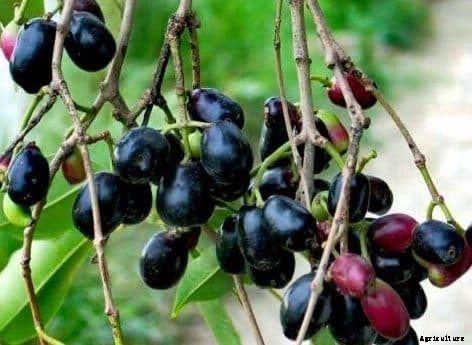
In commercial farming, the grafted/budded tree takes a couple more years. The fruits mature to harvest at the onset of monsoon when the color changes from green to purple, bluish-black or deep red.
Jamun fruits are harvested only after they ripen by shaking of branches or hand picking.
Seedling trees will start producing at the age of 9-10 years, whereas budded ones take 5-6years.
The Jamun trees flower in the months of March and continues up April.
The Jamun fruits ripen during June- July or with the onset of rains.
The fruits take about 3-5 months to ripen after full bloom.
Fruits change their color from green to deep red or bluish black. Jamun fruits won’t ripen after harvesting.
Jamun trees need several pickings, since all fruits do not ripen at a time. The average yield of fully grown budded, and seedling trees is 50-70 kg and 80-100 kg /plant /year.
Jamun fruits are highly perishable. Jamun fruits can be stored for 2to 3 days under ambient temperature.
Fruit Grading:
Generally, there is no grading of fruits. Blemished or bruised fruits can be removed before packing. Jamun fruits are packed in bamboo baskets and transported to the markets.
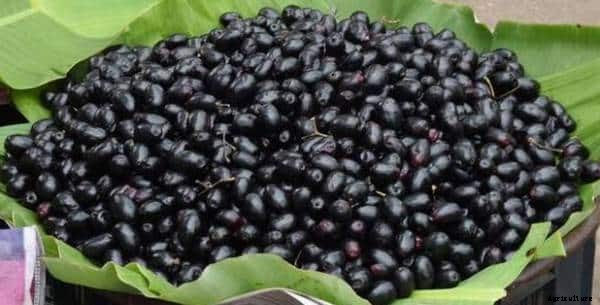
The Jamun fruits are sold on green leaves or on pieces of newspaper.
Physiological disorder
A Severe drop of flowers and fruits has been observed in Jamun at various stages. This problem generally occurred at young stage during 5-7 weeks of full bloom.
The problem of flower and fruit drop can be minimized by spraying of GA3 (60ppm) twice, one at full bloom after fruit offset.
Post-Harvest Management And Marketing Of Jamun Fruits
The Jamun fruits should be marketed as soon as they are harvested. Use fresh and undamaged for selling in the market.
The Jamun fruits should be packaged properly and sent daily to the market for selling. They should be stored under proper storage conditions, you can only store the fruits up to 3-4 weeks.
Bottom Line of Jamun Cultivation:
The cultivation of Jamun is not common due to lack of awareness and knowledge.
If you have proper knowledge and use proper implements for Jamun Cultivation methods, you can easily get good profits by marketing the fruits.
The demand for the Jamun fruits is also very high and is set to increase in the future years.