Kaju cultivation tips and techniques
Today, we learn the Kaju Cultivation tips and growing methods.
Kaju trees are attractive trees with large leaves and pretty, pink flowers. Cashew or Kaju tree is a tropical evergreen plant that can reach 20 to 46 feet in height. It has green, elliptical, leathery leaves that are spirally arranged on the branches. Kaju tree produces flowers arranged in multi-branched inflorescence called panicle. The health benefits of Kaju are several. It has all the vitamins need to for good eyes, hair, teeth, and skin. Cashew nut has shown its effects in fighting cancer and diabetes.
Kaju nut, one of the most delicious and nutritious nuts has been a product of wide demand all over the world. Kaju is an item of food so rich in protein, fats, and vitamins that it is regarded as a delicacy even in the advanced countries of the world.
Kaju tree: The Kaju-nut tree is a fast grower and an evergreen tropical tree. It grows to a height of 12 meters. Blossoming takes place between November and January month. Seedling trees flower in the third year after planting. The fruit ripens fully within two months.
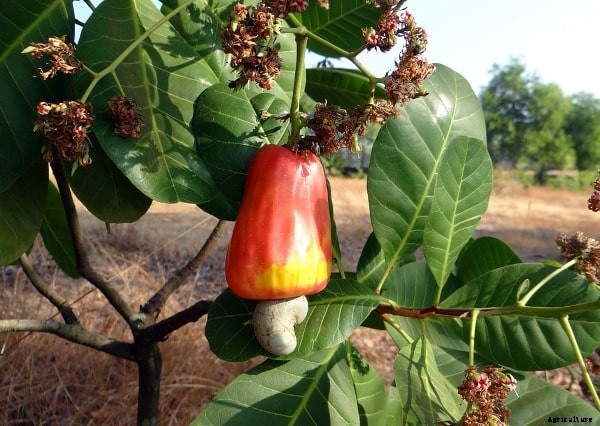 Cashew Tree.
Kaju fruit (Cashew nut): The nut is attached to the lower portion of the Kaju apple which is conically shaped. The cashew nut or seed hangs at the bottom of the apple and is c-shaped.
The Kaju seed has within the outside shell the edible kernel or nut. In its raw form, the Kaju kernel is soft, white and meaty. When roasted it changes color and taste. Salted, it appeals to the palate as the main delicious nut. Cashew apples and cashew nuts are superb sources of nutrition. The Kaju apple contains five times more vitamin C than an orange and contains more calcium, iron and vitamin B1 than other fruit such as citrus, avocados, and bananas.
Kaju shell oil extracted from the shells is caustic and causes burns on the skin. The mucous membranes of the mouth and throat are severely affected when it comes into contact with Kaju or cashew shell oil or the irritating fumes emitted during roasting. The cashew kernel is a rich source of fat (46 percent) and protein (18 percent) and is an excellent source of calcium, phosphorus, and iron. It has a high percentage of polyunsaturated fatty acids, in particular, the necessary fatty acid linoleic acid. Three major cashew products are traded on the international market are raw nuts, cashew kernels, and cashew nut shell liquid.
Different cultivation tips and ideas for Kaju:
- Kaju trees are genuinely tropical and very frost sensitive.
- The Kaju trees grow in a wide spectrum of climatic regions between the 25°N and S latitudes.
- Although the Kaju can withstand high temperatures, a monthly mean of 25°C is regarded as optimal.
- Yearly rainfall of 1000 mm is satisfactory for production, but 1500 to 2000 mm can be regarded as optimal.
- The Kaju tree has a well-developed root system and can tolerate drought conditions. Rain during the flowering period causes flower abortion due to anthracnose and mildew.
- During harvesting, while nuts are on the ground, rain and overcast weather cause the nuts to the rotor to begin germinating.
- Kaju nuts germinate within 4 days when lying on wet soil.
Kaju cultivation care:
- Make sure the farm is not prone to heavy winds.
- Maintain the surroundings of the farm clean from weed and debris. Mulching can be done around the tree to prevent the growth of weeds. It helps in conserving moisture.
- Use adequate water for irrigation and fertilize well. It’s better to use green manure. Use pesticides if needed.
- Remove any sick or dead branches from the Kaju tree. Branches which are infected with pests must be pruned to prevent the infection from spreading. Cut the entangled branches so that the Kaju tree grows at a faster rate.
Kaju cultivation techniques:
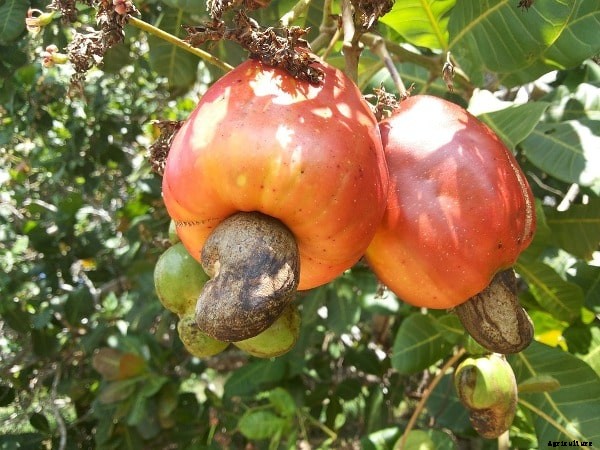 Kaju Cultivation Techniques.
Propagation techniques used in Kaju cultivation:
A number of propagation methods have been tested for the multiplication of Kaju. The air-layering process was found to be one of the popular methods among growers. This procedure, however, produced trees with poor anchorage as the root density was found to be low. It resulted in the poor field establishment and high susceptibility to cyclones and drought conditions. Air layering was hence found to be unsuitable for commercial exploitation. In the case of mound layering too, the absence of a tap root was found to be one disadvantage. Epicotyl grafting was another process that had limitations due to high mortality at transplanting and the incidence of collar-rot at the nursery stage. Softwood grafting developed in the research centers was found to be the most viable process of propagation that was commercially acceptable; it gave a success rate of about 70 percent. The technique of softwood grafting is similar to epicotyl grafting except for the difference in the age of the rootstock.
Kaju is propagated by both seeds and by vegetative methods. Seed propagation results in enormous variability in the seedling progeny. Therefore, high yielding Kaju varieties are commercially propagated by different vegetative methods to produce true to type planting material.
Softwood grafting: This is the most popular and the best process for commercial multiplication of improved Kaju varieties and found to be suitable for propagation almost round the year. However, the higher success rate of grafting can be achieved during June to October month due to an abundance of mature scion shoots, a favorable temperature, and higher relative humidity conditions.
Air layering: This is the earlier process which was being followed before the softwood grafting was standardized in Kaju. In this process, the mature shoots on the tree are girdled and the girdled region is fastened with moist growth medium to facilitate the rooting at the girdled region. Once sufficient rooting is observed after 3 months, the shoots with roots are cut from the tree for use as true to type planting material. This process has become obsolete now for cashew.
The following management techniques are important in young grafted plants;
- Grafts want to be watered frequently, depending on the season.
- Excess water needs to be drained by providing drainage holes in polybags.
- Shoots on the rootstocks have to be nipped off frequently.
- Polythene wrapping at the union has to be removed about 3 months after grafting to prevent girdling.
- When the scion leaves turn from brown to green color, rootstock leaves have to be removed (approximately 60 days after grafting).
- Flower shoots that sprout during the normal flowering season must be removed at the nursery stage.
- To prevent roots penetrating into the ground, grafted plants must be shifted frequently or placed on thick gauge black polythene sheets.
- The partial shade has to be provided to avoid sun-scorch by placing the grafted plants in a lath or screen house. Direct sunlight must be avoided as polythene bags tend to perish. Watering on alternate days must be done in summer.
- Regular insecticide sprays want to be given to control leaf sucking insects.
- When transporting grafted plants, terminal shoots and taproots must be protected.
Kaju cultivation tips:
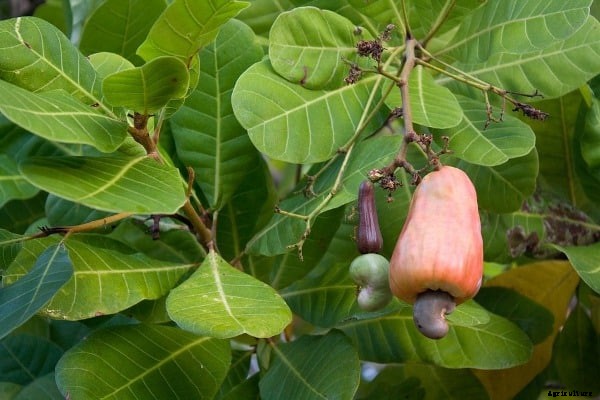 Cashew Cultivation Tips.
- The Kaju is a strong plant that is renowned for growing in soils, especially sandy soils that are generally unsuitable for other fruit trees. For the best production deep, well-drained sandy, sandy-loam soil is suggested. Kaju trees will not grow in poorly-drained soils.
- Kaju tree needs at least 6 hours of direct sun; it grows gradually and doesn’t fruit if grown in the shade.
- Two grafting methods, namely side grafting, and wedge grafting are practiced with success. Grafting should commence as soon as possible (seedlings of 3 to 4 months old) and planted out in the orchard to check the taproot from bending.
- Cashew prefers poor sandy soil and laterite soil with the pH level around 5 – 6.5. Never grow a Kaju tree in a clay-rich soil. It is heavy and encourages waterlogging, and in the case of growing Kaju trees, the soil you use must be well drained in a way that water will flow smoothly.
- Irrigation is very important during the establishment of young trees because it doubles the growth tempo of young trees in a dry season. Due to the deep root system, the Kaju trees can survive several months without irrigation. Mature trees must receive 1800 liters of water per tree every 2 weeks.
- Kaju seedlings are grown under shade (45 %) and hardened off before planting in the orchard. It is important not to disturb the root system during planting. Young trees must be supported for the first 2 to 3 years, so that wind will not blow the plants over.
- Sow fresh Kaju seeds for germination, as they germinate easily.
- Trees grown from seeds take 3 to 5 years to produce its first fruits. Our recommendation is to buy a potted plant from a nursery, this method you’ll not have to wait that long.
- Select a location that is well protected from the wind.
- Kaju grows better when the temperature remains around 80°F (25°C) although it can withstand temperatures as low as 50°F (10°C) and as high as 105°F (40.5°C) without any problem.
- Keep the area around the base of Kaju tree free from weeds, small shrubs, vines, and debris.
- Watch for sick or dead branches, prune them if required.
- Harvest when Kaju apples turn pink or red and cashew nut shell is gray. After harvesting, divide the cashew apple from the nut.
That’s all folks about Kaju Cultivation Tips and Methods.
Read: How To Grow Hydroponic Lettuce.


