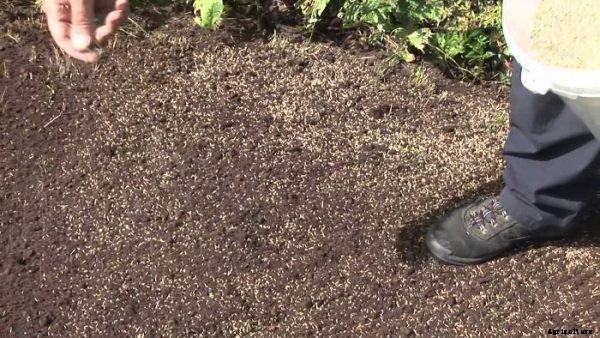
The lawn is a land where the grass is grown as a green carpet for a landscape and it adds beauty to your garden. It is the most decorative item used both indoors and outdoors. To make lawn good it should be well maintained, if not it completely ruins beauty. The lawn not only harmonizes with a décor of the drawing-room but also sets of suitable background for a specimen tree or a shrub, as well as for colorful beds and borders. Lawn grass is laid on gardens of houses, corporate offices, terrace gardens everywhere. Generally, the lawn should be laid in wide-open areas where there is direct access to sunlight, in front of a rockery and a water pool.
Site and soil suitable for Lawn Growing
Once you choose the site for the lawn, you should select the size and shape of the lawn. The site should well prepared.
The site for Lawn Growing
Make sure that the site you select for lawn should get full sun and the best situation is the southern side of the house and site in the south-east and south-west directions are best for making lawns. The lawn doesn’t grow under shades of trees.
The soil in Lawn Growing
Dood grass grows well on any type of soil. But for the establishment of a good lawn, the soil should be fertile loamy soil rich in humus with good moisture-holding capacity is most suitable. A slightly acid soil with pH 5.5 to 6.0 is good for the growth of grass. If the soil has low pH add 300 gm of chalk or ground limestone per sq. the meter on sandy or a similar amount of slake lime on clay loan should be applied.
Site Preparation for Lawn Growing:
Digging.
Levelling.
Enriching the soil with organic manures or by amending with fertile soil.
In the case of heavy soils, you should add coarse san by removing soil to a depth of 20 cm.
Soil with pH 6 to 5.6 is best for lawn growing if the soil is very acidic lime should be added and to clayey loam or alkaline soil gypsum of the same quantity may be added.
The ground should be having provision to drain the excess drain water.
The site should be thoroughly leveled with a spade, peddles and weeds are handpicked. The soil should be rolled with a roller. Weeds should not be allowed to grown and should be 4
Lawn Growing Methods
Lawn Growing by Seeding:
The best grass suitable for seeding is Doob grass. This grass spread very fast, and forms roots at the nodes, the foliage is dark green, narrow with parallel vines. Lawn grass grown from seeds has opted when grassroots are available. You need 30 kg of lawn seeds required for one-hectare land.
How to seed?
First, the soil should be cleaned and rolled slightly.
The site should be divided into suitable small squares or rectangles.
Then the seeds are mixed with double the quantity of finely sieved soil and should be rolled and watered with a rose can.
The seeds take four to five weeks for germinating.
A lawnmower should be used for easy maintenance and for seed spreading.
Lawn Growing by Turfing :
The turfs are pieces of the earth with compact grasses. Their turfs are cut into squares uniformly from a place where the grass is short, compact, and free from weeds. These turfs are places directly on the prepared ground site, side by side, and beaten down flat with turf beater. The space between should be filled with fine soil. The entire turfed areas should be rolled and watered liberally. Turfing is very expensive lawn making.
Lawn Growing by Turf Plastering: This method of lawn making follows the below process:
The doob grass which is free from weeds is collected and chopped into small bits.
Two baskets of grass should be mixed with one basket each garden soil and fresh cow dung and the shovel full of wood ask with the required quantity of water and make a thick paste.
This mixture is spread with a thickness of 2.5 cm, uniformly on the site that is leveled and rolled properly.
Water the ground with a rose can. The on the next day ground should be rolled and make grass spread all over the ground.
The land starts growing in a fortnight.
To start with, cut with a scythe and after three months, use the lawnmower.
Lawn Growing byDibbling Roots: This is a less expensive method, small pieces of grassroots should be dibbled 10 to 15 cm apart in the ground when it is wet. The roots spread and grown underground in the course of six months making a fairly compact lawn by frequent mowing, rolling, and watering.
Lawn GrowingbyAstroTurf: This is a synthetic lawn that is used in developed countries in roof gardens and playgrounds. It is maintained the same as the normal lawns, but the sprinkling of water is the main constraint to bind the synthetic fiber to provide a surface akin to a lawn carpet.
Mowing and Rolling in Lawn Growing
Rolling makes the grass in contact with soil and maintains the ground level. After the first rain, you should roll the lawn with a medium-sized roller. The lawn should be rolled after every weeding or every week to get an even surface.
Mowing a lawn is as important as watering it. The lawn should not grow more the 6 cm in height. In winter mowing should be done every week or twice a week.
Scraping and Raking in Lawn Growing
Crusts, matted and woody forms of grass are formed due to constant mowing and rolling. So to remove them scraping and raking are always beneficial and good for lawn maintenance. If the lawn is full of crusts lawn should be scraped with khurpi followed by May or early June. If the lawn condition is good, you can do only raking in both ways will be sufficient to take out the old runners and loosen the soil. Then mow the grass until the old stump of the doob is well-trimmed and the lawn will be cleaned and exposed to the sun.
Read this: Custard Apple Cultivation.
Lawn Growing Care
You should fertilize your lawn thrice a year, to maintain greenery.
Weeds should be removed regularly, otherwise, they spread, seed multiply and overpower the grass. Fill the gaps with grassroots and fine soil. You water your lawn at regular intervals.
You should not use a mower until a firm green sword is formed. The grass should be cut with a sickle and the surface is then rolled. The heavy roller is used frequently but not when the ground either too wet or dry.
Mowing should be done at brief intervals and never allow to produce seed stalks. Don’t cut the grass too short it may damage the grass.
Different types of grass grow in different sizes, you should get complete grass details from vendors or landscaping companies.
The ideal height of the grass is 3 to 4 inches, don’t remove one-third of the grass leaf in a single cutting is not recommended.
Mow only on dry grass and not when the grass is wet. Make sure the mower’s blade is new and sharp before starting a fresh moving session.
Rake the lawn before the rain and top dress with a rich mixture of decomposed manure and soil. This will accelerate the grass with new vigorous growth.
The lawn should be watered in the early hours, watering time will allow the water to reach the roots without evaporating.
Spread the water homogeneously across the lawn without overflooding or missing some areas. Several applications of water would be necessary for such surfaces to ensure adequate penetration.
Suitable plants for Lawn Growing
Beautiful trees or plants add more beauty to your lawn, below is the list of plants that add beauty to your lawn:
Chlorosis: Grass turns yellow with a deficiency of magnesium and iron.
How to control?
Spray ferrous sulfate for iron, and for magnesium spray magnesium sulfate.
Dog Urine: Dead Grass in the law.
How to Control?
You must replant the grass.
Fertilizer burn: Lawn turns brown in the summer season.
How to control?
You must drench the injured areas and drain the excess fertilizers into the soil.
Improper Mowing: Due to improper mowing lawn turn yellowish and look dry.
How to control?
Mow enough to remove not more than 1/3 rd height of the grass at a time. Keep the mower blade sharp.
Improper Watering: Improper watering will shallow roots, and overwatering causes diseases.
How to control?
Watering should be done at regular intervals and about 10 to 15cm in depth.
Pest Control in Lawn Growing
Leafhoppers: These are problematic pests that suck the juices from grass blades causing stripped white, yellow, and brown leaves. To control leafhoppers you should spray dimethoate.
Nematodes: These pests directly affect the roots of lawn grass and make a bleached out appearance. To control these pests, you should apply furadan.
In case if you miss this: Organic Vegetable Farming In Greenhouse.
Mud Crab Project Report, Culture Profit, and Cost
Dairy Farming Subsidy In India – By Government
Cultivating High-Dollar Crops: Turn Your Gardening Skills into Serious Cash
Growing Grapes Organically – A Full Planting Guide
Air Purifying Indoor Plants – In India
Industrial Hemp Cultivation – In India
Cost of Cultivation of Saffron, Saffron Business Plan
Pig Farming Subsidy and Loan in India – A Full Guide
Quail Farming Business Plan, License for Profits
Poultry Farming Subsidy and Loan Information in India
Duck Farming Basics, Housing, Feeding for Eggs, Meat
Organic Vegetable Farming Plan, Advantages
Goat Farming Plan in India – A Beginners Guide
Dairy Farming Plan in India – A Full Guide
Modern Farm Equipment in Agriculture
Rice Production in Myanmar; Paddy Farming In Myanmar