
Welcome to Modern Agriculture!

Let us discuss today about Raspberry Farming, Growing Practices.
The Raspberry is of the aggregate fruit, as it gets developed from a single flower, but has more than one ovary and all join a form a fruit. These are similar to the blackberry. These Raspberries are originated from the genus of Rubus. They belong to the Rosaceae family. Raspberries are scientifically named as Rubus idaeus. These are commercially grown in countries like Canada, the United States and also the northern Europe. These are popularly used in the preparation of ice creams, jams, jellies and also these can be eaten fresh. These fruits are eaten all over the world. Russian is one of the top producers of Raspberries. There are many varieties in these each and every variety differs in colour, taste and also in size.
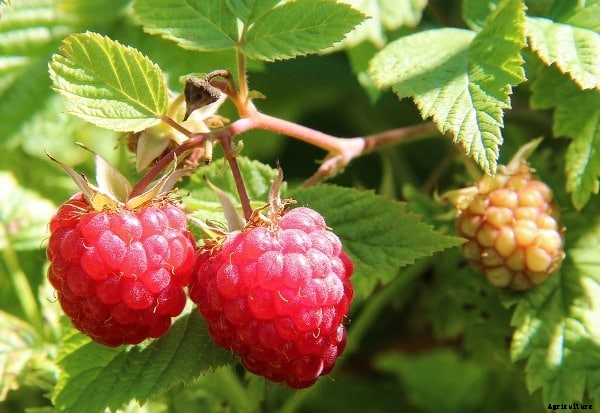
Plant: The raspberry plant reached up to a height of 2 m, they are woody, rounded, erect stems and they are fitted with over hanging slender branches. The thorns are straight and are less resistant than black berries.
Leaves: The leaves are pinnate and they have 3 – 7 serrated leaflets, they fluffy on the back.
Flowers: The flowers of Raspberries are white and grouped in 10 flowers; they are 1 cm in diameter.
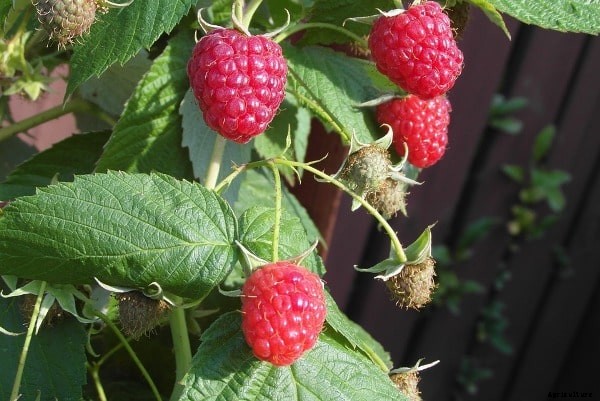
Fruit: The fruit is red in colour, they are of soft texture, they ripe will in summer or autumn. The fruit weighs up to 3 – 5 g. The fruit is made up of 100 drupelets.
Nutrients that are present in Raspberries are
Indian summer:
September:
Boyne:
Taylor:
Latham:
Dundee:
Fallgold:
These varieties are seen very randomly Amber, Clyde, Heritage and Black Knight
For Raspberry Farming, slightly acid soils can be used for growing them as plants can tolerate this type’s soil. The pH level, which is suitable for Raspberry Farming, is 6.0. The soil should not be extremely alkaline or extremely acidic. These plants can also tolerate poor soils and also they give good yield. But the soil should have good draining capacity. The soil should contain rich organic matter.
These Raspberries can be grown in colder climates. There are also some varieties which can be grown in warmer climates. According to their growing requirement the varieties should be selected. They grow well in higher elevations. These plants can be susceptible to winds also. The plants can tolerate moderate amounts of rainfall, but these plants can’t tolerate excessive rainfall ads these can cause damage to rainfall.
The land should be cleaned by removing weeds, stones and rocks. After weeding is completed, then the land should be ploughed several times, then the soil attains fine tilth. The land should be levelling and harrowing this will help the soil. The land should be applied with farmyard manure.
It is preferred to buy the seedlings from the nursery and plant them in the main field. The planting depth also matters. The depth which is used in the nursery same depth should be used in the main field for planting the seedlings. Pits must be dug for planting. These pits should be filled with soil and also with farmyard manure. After these activities, then the planting should be done. After planting them, they should be irrigated.
Based on the variety the planting season should be decided. As some varieties prefer summer season and some prefer winter season. The spacing should be at least of 2 feet from each row. If we give enough space for plants they grow well.
For propagation, vegetative propagation methods should be used in Raspberry Farming. In the propagation, healthy vegetation or cuttings should be used.
At the time of land preparation farmyard manure should be given. For knowing the nutritional requirement of the soil a soil test should be conducted. The plants should be applied with split doses of Nitrogen, Phosphorous and Potassium. To get a good yield of fruits the soil should get proper nutrition’s. The soil gets barren when too much of fertilizers are applied to the soil. In a balance with chemical fertilizers, organic fertilizers should also be used.
As per the moisture content in the soil the irrigation should be given to the Raspberry crop. If the soil contains low moisture, then irrigation must be provided. Irrigation is not required during the rainy season. The frequency of irrigation should be reduced in the winter season. Trickle irrigation is more preferred in slopes. The excess water near plant should be drained out the field. After planting, irrigation should be given, at the time of flowering and fruit development irrigation would be crucial.
Weeding: The unwanted plants and weeds should be removed from the field. The weeding can be done through hand or by applying the weedicides or herbicides.
Pruning: The unwanted stems, branches should be removed from the plant as this will help the air to penetrate.
Training: The must be trained from a young age, as it can trail the wall or fencing. So that it can’t occupy more space.
Mulching: The weeds or the unwanted plants can be used for mulching, as this helps the soil to conserve the moisture.
Fruit thinning: The fruit thinning helps the fruit to attain the good color and size.
The pests and diseases that affect the Raspberries are:
All these can be controlled by pruning, which is a good and natural method. These will help the problem to eliminate them easily. Using resistant varieties will also help to great extent in some cases. The plant may be helpful in controlling the problems by applying appropriate of chemical and also by removing the affected parts of the plant.
After they attain good color and size, then they should pick early in the morning when they are dry. The harvesting should be done manually by hand picking. They should be picked carefully. As they are delicate to handle, so they must be handled properly. While picking them, they detach from the stem easily.
Cleaning: After they are harvested they should be washed and cleaned. They should be cooled.
Storage: These all should be stored in a lower temperature; they are perishable as they may get damaged quickly. After picking they should be immediately kept in a cold storage. These can be stored for 1 week.
Sorting: They should be sorted as per their size and shape.
Grading: These should be graded as per there colour and quality.
Packing: They should be packed in baskets or in carton boxes.
Marketing: Raspberries have high demand in local and also in international markets.
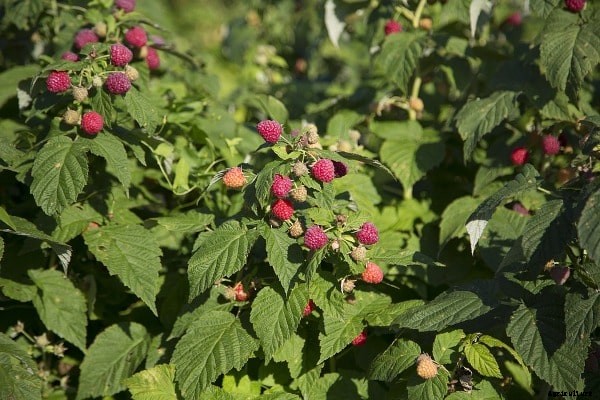
The yield differs for very variety and also it depends on cultural activities. The average yield of the Raspberries is 3 – 5 kg of fruits per plant in a year.


