
Welcome to Modern Agriculture!

The following write-up details about “Dragon Fruit Farming”.
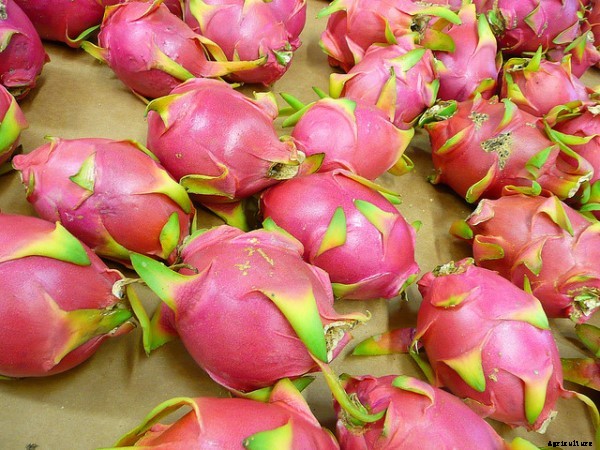
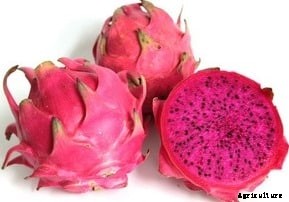
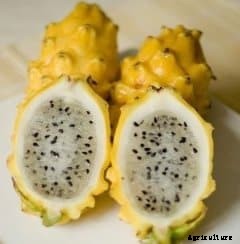
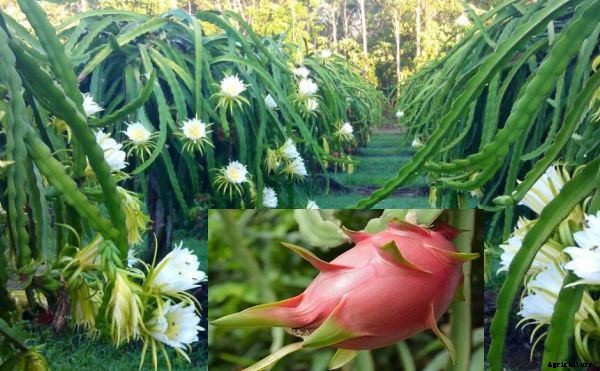
Introduction to Dragon Fruit:- Dragon fruit is one of the exotic fruits grown across the world. Dragon fruit is native to Central America, Mexico and South America. Dragon fruit is also known as “pitahaya” or “Pitaya”. A dragon fruit tree is a cactus vine and belongs to the genus of “Hylocereus” and family of “Cactus”. Dragon fruit tree stems are succulent and triangular with high margins on branches. Usually its flowers are in white or pink in large size with bell-shaped and tubular. Dragon plant blooms flowers at night and these flowers have an excellent fragrant smell as well. When it comes to fruit, it is fleshy with skin colours of red, yellow or purple. The dragon fruit pulp colour can be in red, white, yellow or pink with black seeds. Generally, each dragon fruit weighs about 200 grams to 1 kg. This fruit will have sweet or slightly sour taste. With proper orchard management practices, commercial farmers can obtain decent profits with dragon fruit farming. Some of the countries involved in commercial production of dragon fruit are; Vietnam, Sri Lanka, the Philippines, Cambodia, Thailand, Taiwan, Malaysia, Indonesia & Bangladesh.
Advantages of Dragon Fruit Farming:- Why one should go for commercial production dragon fruit?.
Scientific Name or Botanical Name of Dragon Fruit:- “Hylocereus undatus”
Family Name of Dragon Fruit:- “Cactaceae”
Dragon Fruit Other Names:- Indonesia buah naga, nanettika fruit, Kaktus madu, Long guo, Strawberry Pear, Cactus fruit, Night blooming Cereus, Khmer sror kaa neak, Thai kaeo mangkon, Cereus triangularis, Thanh long,, Jesus in the Cradle and Belle of the Night.
Dragon Fruit Names in Other Countries:- Pitahaya (Spanish), Trái Thanh Long (Vietnamese), Drachenfrucht (Geramn), 피타야 (Korea), Pitaja (Polish), froúto tou drákou (Greek), Pitaia (Portuguese), فاكهة التنين (Arabic), Lóng shuǐguǒ/龙水果 (Chinese), drage frukt (Norwegian), klèt maŋk/มังกรผลไม้ (Thai), Na Gha Maut Thee (Burmese), Pitahaya (Finnish),ドラゴンフルーツ (Japanese), Pūķis augļi (Latvian), Fructul dragonului (Romanian), මකරා ( Sinhalese), ស្រការនាគ (Cambodian), Pitahaya (Czech), Pitaya (French), ZmeJ ovošJe (Macedonian), Дракон фрукты (Russian), Dragon frukt (Swedish), Pitaya (Turkish), Pitaja (Hungarian), buah naga (Malay), 火龙果 (Taiwanese).
Dragon Fruit Names in Indian Languages:- Pitaya (Hindi), Agippazham (Tamil), Pithaya (Malayalam), Pitaya (Kannada), Pitaya (Marathi), Pitaya (Telugu).
Health Benefits of Dragon Fruit:- The below mentioned are some of the health benefits of Dragon Fruits.
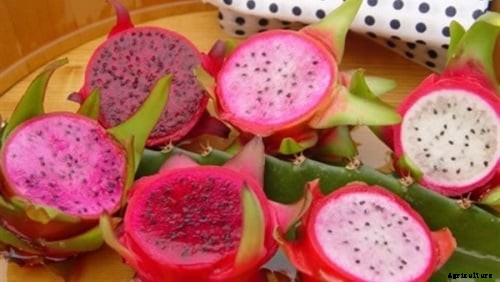
Varieties (Cultivars) of Dragon Fruits:- Currently there are many species of dragon fruit plants are widely cultivated in the world. The following are popular dragon fruit types.
Climate Requirement for Dragon Fruit Farming:- Dragon fruits can be grown in both tropical and sub-tropical climatic conditions. These trees love sun light and survive with minimal average annual rain fall. Dragon trees are very sensitive to frost conditions and should be avoided such scenarios.
Soil Requirement for Dragon Fruit Farming:- Dragon fruits can be grown in wide range of soils. However, well-drained sandy loam soils rich in organic matter are ideal for its growth. It is better to avoid water stagnation locations as it causes the root rot disease resulting in heavy crop loss. A mixture of sand in garden soil would be appropriate in case of poor soils. These trees even tolerate rocky terrains to survive and yield the fruits. Commercial growers should go for soil test and based on test results, required nutrients or micronutrients should be supplemented in the soil. The ideal soil pH range for dragon fruit farming is 5.0 to 8.5.
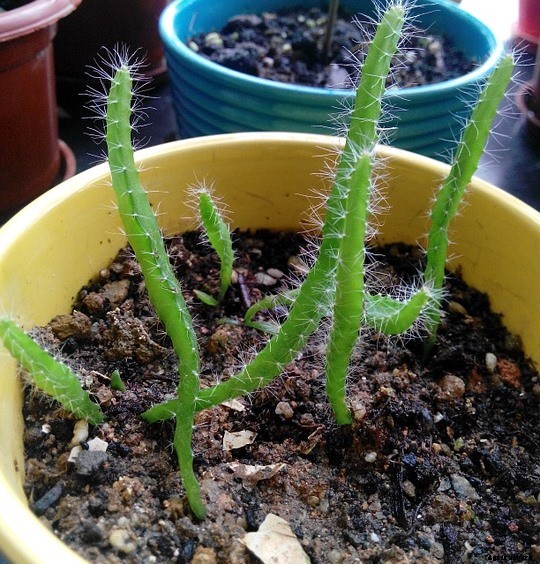
Propagation in Dragon Fruit Farming:- Dragon fruits can be propagated by seeds and cuttings. However, seed propagation is little tough and it will take long time to grow. Commercial growers prefer the propagation through cuttings.
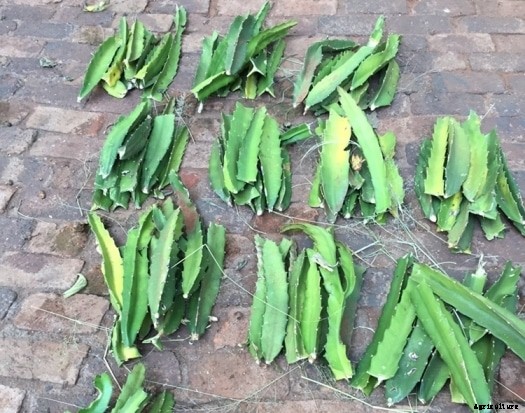
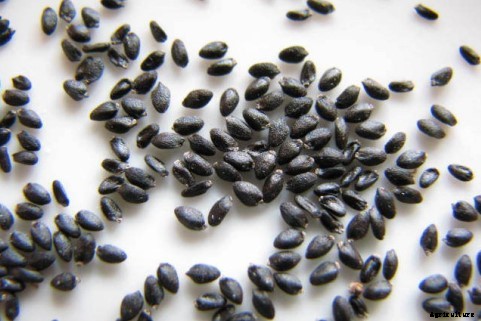
Land Preparation, Planting and Spacing in Dragon Fruit Farming:- Land should be given 2 to 3 deep ploughing till it reaches fine tilth stage. Make sure the field is weed free and it is better to have a fence around the field to protect from any predators. Prepare the beds of 45–50 cm high and 3 meter broad with loose soil. Provide 1200 – 1300 supporting poles/ha (RFC/cement poles are preferred for long run) with the distance between tree to tree of 3 meter x 3 meter . As dragon fruit tree prefers sunshine, so the good distance should be maintained to receive proper sunlight. The supporting poles should have 12 cm in diameter and 2 meter long. After establishing in the field, these poles should at least 1.4 to 1.5 meter high from ground level.
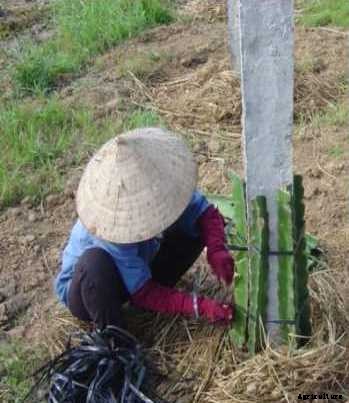
For better yield, 2 to 3 years old strong and dark green healthy (damage free and pest free) branches should be selected for transplanting in the field. Cut pieces of 45 to 50 cm long and make sure these cuttings have good eyes, which are covered by strong thorns. The selected branch cuttings should be treated with pesticides to control pests and disease 1 month (30) days before planting in the main field. It is better to plant at the end of the year after rainy season is over for best plant establishment. 4 cuttings can be accommodated (planted) for each supporting pole and make sure to cover with soil, straw. These cutting should be tied properly for vertical growth.
Irrigation in Dragon Fruit Farming:- Dragon plants require very less water as compared to other fruit crops as it belongs to cactus family. This tree can survive without water for months. However, in heavy drought conditions or fruit setting phase requires water once in 4 days. It is good idea to have a drip irrigation method for better utilization of water and weed supressing. On an average, each dragon plant requires 1 to 2 litres of water/day during the summer/drought days. The frequency of irrigation depends on soil type, moisture holding capacity, plant age and climatic conditions.
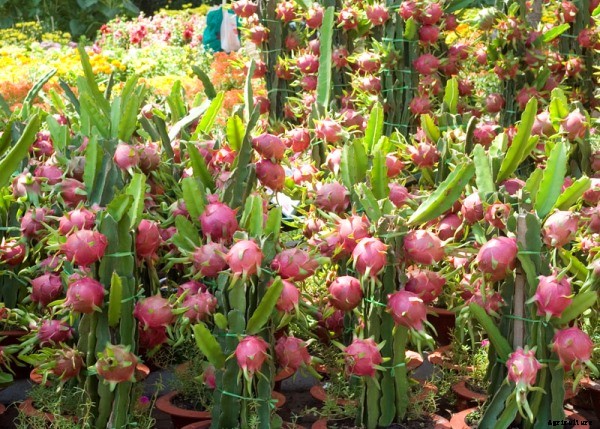
Manures and Fertilizers in Dragon Fruit Farming:- Dragon plants responds very well to manures and fertilizers. During initial stages of plantation, they require more nitrogen and so the fertilizer should contain more nitrogen and during flowering or fruit set stage, the fertilizer should contain phosphorus (P) and potassium (K). Avoid urea application as it may cause stem rot. Make sure to apply garden compost or well-decomposed farm yard manure (FMY) of 5 to 10 kg/plant for every 45 to 60 days. However, additional fertilizers of N:P:K and ZK should be applied during flowering and fruiting stage. In subsequent years, the dose of the fertilizers should be increased depending on plant size. To obtain maximum yield, any bio-fertilizers or liquid organic fertilizers or fruit stimulating hormones can be applied.
Intercultural Operations in Dragon Fruit Farming:- Proper and timely intercultural operations make sure high yield and quality produce.
Pests and Diseases in Dragon Fruit Farming:- There are no serious or particular pests and diseases found in dragon fruit farming. Fruits should be protected especially from birds and other predators. Apart from this there a chance that it may be affected by fungal or root rot diseases due to overwatering or heavy rains. Soil must have good drainage and overwatering should be avoided.
Note: Your local Horticulture is a good source for finding suitable solutions for controlling pests and diseases in Dragon Fruit Production.
Harvesting in Dragon Fruit Farming:- The dragon fruit normally fruits 18-24 months after plantation. The maturity of fruit is identified by fruit skin colour. Usually, dragon fruits change from bright green to red or pink at maturity. Dragon fruit is oval to ovate in shape and 12 to 15 cm long and the fruit usually forms 30 to 50 days after flowering. Harvest Matured fruits only as this vine can be harvested 3 to 4 times in one season (year).
Yield in Dragon Fruit Farming:- Yield of fruit crop depends on many factors such as soil type, climate, variety and orchard management practices. In dragon fruit farming, on an average one can obtain. One plant typically produces 1 kg of fruit and every pole will have 4 plants so 4 kg/pole. One acre will produce about 6 – 7 tons of dragon fruits/harvest. In a year, 45 – 50 tons of dragon fruits per hectare can be produced under ideal farming conditions.
Economics in Dragon Fruit Farming (For India Only):- Dragon fruits are sold in the market at Rs.400 to 500 per kg, but the general price at the farm gate is approx. between Rs. 125 to 200 per kg (In India).
Note:The cost and profits will change region to region.
Marketing of Dragon Fruit:- Freshly harvested fruits can be transported to local fruit markets and can be sold to fruit agents at farm gate. Extra care should be taken for export markets.


