
Welcome to Modern Agriculture!

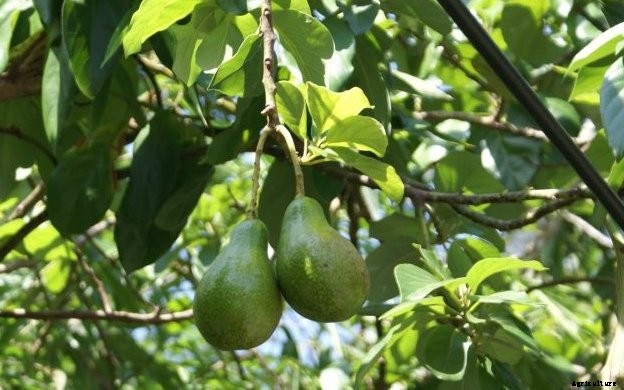
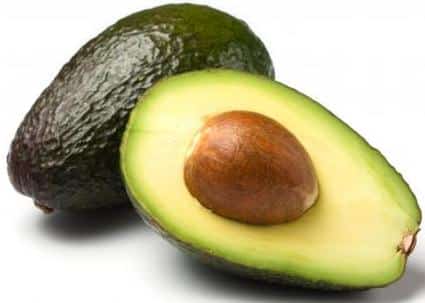
Avocados are ancient fruits and originated from Central America and Mexico. These fruits are commonly called as “Butter Fruits” in India. Avocado is a tropical fruit and looks similar to pear fruit. These fruits are a good source of nutrients compared to other fruits. Avocados are existed since the 1900s in India and first introduced in the country’s west coast by way of Sri Lanka. Commercial cultivation of avocados is limited in India and mainly south Indian states produce avocados. Avocado fruits are mainly used as fresh fruit. They are also used in salads & sandwich fillings. Even though avocado farming is picking slowly in India, avocados cultivation has a good future in India. Generally, July through Sept is the time period to find avocados in the market.
Some of the health benefits of avocados are listed below.
Avocado, Butter Fruit (English),
Makhanphal (Hindi),
Vennai Pazham (Tamil/Malayalam),
Alpukat (Marathi),
Mager Nashpati (Urdu),
Benne Hannu (Kannada),
Venna Pandu (Telugu).
Avocado farming slowly picking up in India. Currently, there are limited south Indian states that are in the production of avocados. Commercial cultivation is happening in Tamil Nadu, Kerala, Maharashtra, and Karnataka. Sikkim is the only northeastern state where avocados are grown.
West Indian race, Guatemalan race, and Mexican race are major avocado races that are well adapted to tropical and subtropical climatic conditions.
Read: Dairy Buffalo Project Report for 10 Animals.
Fuerte, Pinkerton, Hass, Purple, Pollock, Green, Round, Peradeniya Purple Hybrid, Trapp, and Long. Fuerte is widely grown cultivar in India.
Avocado plants are grown in tropical and semi-tropical humid areas. These plants cannot tolerate hot dry winds and frost. They thrive best in true tropical to warmer parts of the temperate area.
These fruits can be grown on a wide variety of soils except on poorly drained soils as these plants are very sensitive to waterlogging. Avoid the saline soils as these plants cannot tolerate saline conditions. The optimum soil pH should be between 5.0 and 7.0 for better growth and yield.
Usually, avocado is propagated through seeds in India. Generally, the avocado viability of seeds can be increased storing the seeds in sand @ 5 °C (or) storing the seeds in dry peat. Mature seeds taken from the avocado fruits are used for direct sowing on nursery beds or in polyethylene bags. After growing seedlings for six months in the nursery can be transplanted to the main field.
Make the land weed free and fine tilth by giving a couple of ploughings. Prepare the soil in such a way that water should not be stagnated. Adding enough farmyard manure or a well-decomposed compost will increase the fertility of the soil so the yield.
Dig the pits size of 90 cm x 90 cm and fill the pits with farmyard manure and topsoil in 1:1 ratio preferably in Feb to March period. Plant spacing in an avocado fruit farming depends on the cultivar and growth habit of the plants. Generally, a plant spacing of 8 m to 10 m is recommended in the avocado plantation. For “Fuerte” variety, more spacing should be given due to its spreading nature. In Sikkim, a distance of 10 m x 10 m is preferred in June to July period on hills slopes.
As intercropping provides extra income, farmers can choose to have any kind of vegetable or pulse crops in the interspace. These crops may fix the nitrogen and suppress the weeds and increase soil fertility. The only precaution should be taken care to grow the crops a little far from an avocado plant.
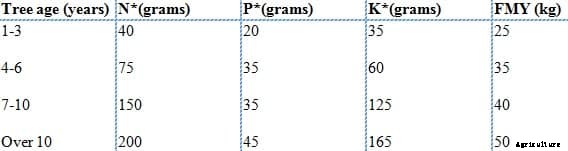
This crop requires heavy manuring nitrogen plays a major role in an avocado fruit farming. Seedlings of avocado should be applied with N: P2O5: K2O in a proportion of 1:1:1 whereas older plants can be applied in the ratio of 2:1:2. Generally, the soils having pH value above 7.0 will show the iron deficiency which can be corrected by adding iron chelate @ 30 to 35 grams/tree. For best yield and growth of the avocado, apply inorganic fertilizers along with organic manures. Urea should be in two split doses in the month of March-April and Sept-Oct.
Recommendation of fertilizers & manures for an avocado plant:
Irrigation in an Avocado Fruit Farming:
In an avocado fruit farming, irrigation should be carried out as soon as the transplantation takes place in the main field. Subsequent irrigations can be carried out @ 3 to 4 weeks interval, especially in dry hot weather conditions. Mulching should be carried to avoid any moisture stress during the winter season. Mulch the plants with dry grass or dry leaves to retain the moisture. There is no need of irrigation in the rainy season. In case of heavy rains or flooding, water should be drained out as avocado plants are very sensitive to water stagnation. Drip irrigation is the preferred irrigation method as it improves the size of the fruit and oil percent and reduces the harvesting time.
Pruning is rarely done in an avocado plantation except in upright cultivars such as Pollock. If the plants have spreading nature (ex: Fuerte), branches should be thinned and cut. Avoid heavy pruning practice which promotes excessive vegetative growth and results in lesser yield.
Read: Lemon Tree Pruning Methods.
When plants are young, weeds should be controlled either mechanically or chemically. Hand weeding can be carried out in the avocado plantation. Chemical weedicides can be applied to prevent the weeds.
In the avocado plantation, the common pests found are mealybugs, scales, and mites. Control measures should be taken by spraying appropriate insecticides.
Diseases found in an avocado plantation are fruit spot, leaf spot, and root rot. To control the root rot disease, apply metalaxyl by mixing with soil just before planting the seedlings. Contact nearest horticulture department or agriculture department for appropriate pest and disease control measures in an avocado fruit farming. These diseases and pests may vary from each verity and soil type and moisture/climate conditions.
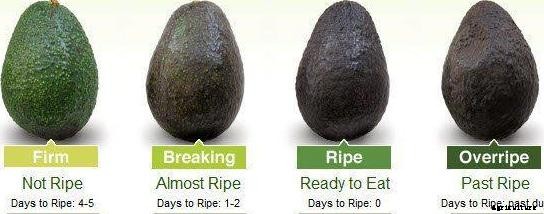
Plants grown from seeds will be ready for fruit harvesting in 5 to 6 years after planting. There are two varieties of fruits in avocado farming, purple and green. To determine the maturity of the fruits, the color change should be observed. Usually, purple variety will change the color from purple to maroon whereas in green variety, color changes from green to yellow. Avocado fruits will be ready for harvesting when the seed coat changes its color from yellow-white to dark brown color. These fruits only soften after harvest and it takes 5 to 10 days for ripening.
Read: Post Harvest Techniques for Fruits; Vegetables.
The yield depends on the variety, age of the tree and farm management practices. An average yield of 200 to 500 fruits per tree can be obtained. From 10 to 12 years old trees, the yield can be expected from 300 to 400 fruits per tree.
Goat and Sheep Farming Business: Read Here.


