
Welcome to Modern Agriculture!

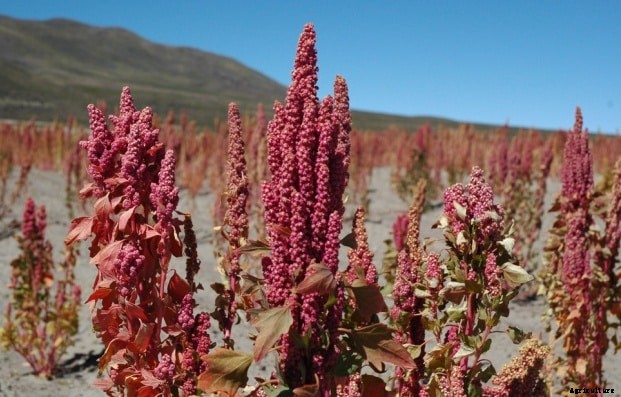
Introduction of Quinoa:- Well, now a days, people are talking about quinoa farming. What is quinoa? Quinoa is a grain crop that is grown for its edible seeds and It is pronounced KEEN-wah. It is an annual dicotyledonous plant and grows about 1 to 1.5 meter in height. Quinoa seeds are used as substitute of rice. Quinoa seeds are highly nutritional and have high percent of protein compared to other cereals. The main colours of quinoa are green, purple and red that change in different colour shades during maturation period. Cooked quinoa can be dried which lasts for several weeks. In India, quinoa farming has bright future due to its high protein content and less carbohydrates compared to rice. The challenge for Indian farmers is to get the seeds. Some people are importing quinoa seeds from South America and Mexico. Once, seed production of quinoa starts, the commercial farming of quinoa will be successful in India. Quinoa is also grown for the purpose of fodder (green manuring). Quinoa extract is also used in soaps, shampoo and body milk. Bolivia, Peru and Ecuador are top production countries of quinoa in the world.
Health Benefits of Quinoa:- The following are the health benefits of Quinoa.
Common Names of Quinoa:- Quiuna, Parka, Dawe, Chuppah and Kinwa.
Soil and Climate Requirement for Quinoa Farming:- Quinoa is a hardy plant can be grown from sea level up to about 4,000 m. This grain can be grown in poor soils as well. However, the most suited soil for quinoa farming is sandy loam. Avoid heavy clay soils as they are not suitable. Frost causes the damage at flowering stage which results in yield reduction. Soils should have good drainage and high organic matter, with moderate slopes and average nutrient content. Quinoa prefers neutral soils although it is usually grown on alkaline soils up to pH of 9.0 and acidic soils up to pH of 5.0. The ideal temperature for quinoa cultivation is around 18°C to 20°C, although it withstands temperature extremes ranging from 39°C to -8°C.
Propagation in Quinoa Farming:- Propagation is done through seeds.
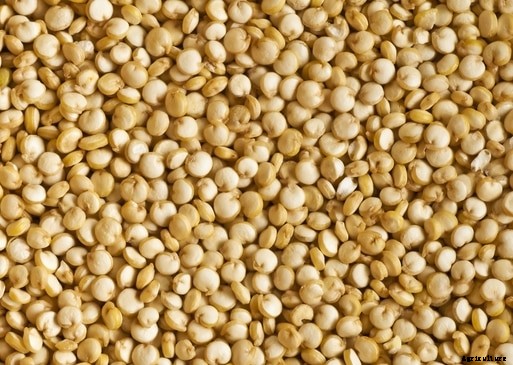
Land Preparation, Sowing in Quinoa Farming:- Land should be given couple of ploughings to make weed free and bring the soil to fine tilth stage. Quinoa crop can be sown from the mid of the May when soil temperature reaches 5 to 7 °C. Seeds can be directly sown in the main field or transplanted. The most appropriate plant density in quinoa farming ranges from 150 to 500 plants per sq.meter area. The row spacing depends on many factors. However, the most common row spacing is 50 cm or25 cm or 12.5 cm and recommended depth of sowing is 1 to 3 cm. Generally, seed rate in quinoa farming is about 15 to 20 kg per hectare area. Usually seed germination occurs within 24 hours after planting when adequate moisture is present in the soil, and seedlings emerge in 3 to 5 days.
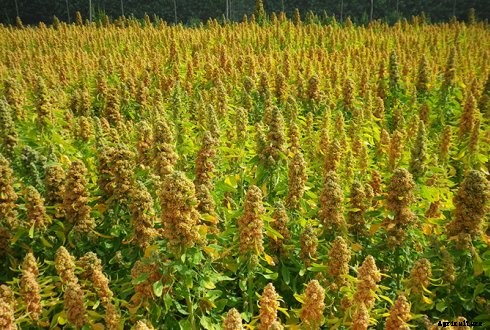
Pests and Diseases in Quinoa Farming:-
Apart from insect pests and diseases birds are also common problem in the quinoa crop.
Selecting high quality seed cultivars with good pests & diseases resistance is primary task for preventing quinoa crop diseases.
Note: Contact your local agriculture/horticulture department for their control measures.
Irrigation in Quinoa Farming:- Generally, rain fed crops do not require any irrigation if there is a well distributed rain-fall throughout the year.
Intercultural Operations in Quinoa Farming:- If the quinoa crop is grown in wide row spacing then plants branch easily and their growth is hastened as well as the growth of weeds, therefore inter-row cultivation should be carried out. Usually, weeds should be removed mechanically in quinoa cultivation. When the plant reaches 20 to 25 cm, the first weeding is done, and also thinning if the seedlings are clustered together or need to be moved to spaces with a greater availability of water.
Manures and Fertilizers in Quinoa Farming:- Supplement the field with 20 to 30 tonnes of well rotten farm yard manure to enrich the soil with organic matter during land preparation. Quinoa crop responds well to nitrogen fertilizer. This crop requires chemical fertilizers of N:P:K in the ratio of 120 kg:50 kg: 50 kg per 1 hectare land.
Harvesting in Quinoa Farming:- Usually quinoa crop will be ready for harvesting in 3 months to 4 months after sowing depending on the variety. Quinoa crop is harvested when they reach physiological maturity and are laid in the field for 35 to 45 days, after which they are threshed on ground and beaten with sticks or trampled by bullocks. The quinoa crop can be harvested using either combine with a standard header or sorghum header.
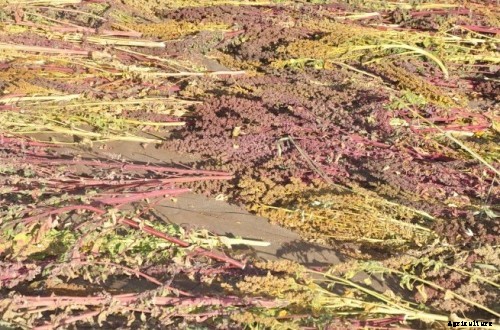
Post Harvesting in Quinoa Farming:- Quinoa grains that contain appropriate grain moist should be separated from impurities, plant particles. The separated grains can be stored in a dry and cool place.
Yield in Quinoa Farming:- Generally on an average yield of 500 kg to 1500 kg of grains can be expected. However, with proper farm management practices, fertilization and improved varieties, yield of up to 5 tonnes per hectare of quinoa grain can be achieved and green manure or fodder of 5 to 10 tonnes per hectare can be obtained.
For Asia farming : Read here.

