Mmmm . . . peaches picked at their peak are pure perfection! Here's how to plant, grow, and harvest peaches at the right time. Plus, we have some delicious peach recipes to try with your bounty!
To grow peaches, the trick is to choose a type that will fit with your climate. Peach trees can be grown in USDA Zones 4 to 9, but do especially well in Zones 6 to 8. If you live in one of these latter zones, you can focus on choosing a variety based on its flavor and harvest-time. If you live in colder regions, there are some varieties that are more cold tolerant that you should choose instead.
Planting
When to Plant Peach Trees
- Peach trees should be planted while they're dormant—typically in late winter or early spring (depending on climate).
- In regions where the ground freezes during winter, hold off on planting until the soil has thawed and the ground is no longer waterlogged from snowmelt or heavy spring rains.
- It's best to plant the trees the same day that you get them (if possible) to reduce stress. Potted trees can tolerate not being planted for a little while, but bare-root trees should be planted as soon as possible.
- Select a tree that is about 1 year old and has a healthy root system. Older trees tend not to be as productive or vigorous overall.
Choosing and Preparing a Planting Site
- For the best fruit production, the tree should be planted in an area that receives full sun all day long. Morning sun is especially crucial because it helps to dry morning dew off the fruit.
- Choose a site with well-drained, moderately fertile soil. Peach trees won't do well in areas where soil is compacted or remains consistently wet.
- Soil pH should be on the slightly-acidic side, between 6 and 6.5.
- Be sure to avoid planting in low areas, as cold air and frost can more easily settle there and affect the quality of your peaches.
How to Plant Peach Trees
- Dig a hole that is a few inches deeper and wider than the spread of the roots. Set the tree on top of a small mound of soil in the middle of the hole. Be sure to spread the roots away from the trunk without excessively bending them.
- For container-grown trees, remove the plant from its pot and remove any circling roots by laying the root ball on its side and using clean shears to cut through the offending roots. (Keep root pruning to a minimum, overall.)
- For grafted trees, position the inside of the curve of the graft union away from the sun when planting.
- Tip: Especially for dwarf or semi-dwarf grafted trees, the graft union must be 2 to 3 inches above the soil surface. If it's any lower, the grafted tree (called the scion) may start to put out its own roots and grow into a standard-size tree.
- Do not fertilize at the time of planting.
- If you are planting standard-size trees, space them 15 to 20 feet apart. Space dwarf trees 10 to 12 feet apart.
- Most types of peach trees are self-fertile, so planting one tree is all that's needed for fruit production.
Check out our video to learn more about how to plant a bare–rooted fruit tree.
An Alternative Planting Method
If your circumstances are suitable, you might want to try a technique practiced in England. It involves planting a peach tree—ideally a dwarf variety—on the south side of the home (or other structure), directly under the eaves. Over time, the gardener prunes and trains the peach tree to espalier in a fan-shape against or very near to the wall of the house.
Plastic sheeting is attached to the eaves and draped to cover but not touch the tree, similar to a lean-to tent. This keeps the tree dry in winter, and the tree enjoys the warmth of the sun—directly and reflected off the house—year round. The plastic should be opened or lifted during bloom time to welcome pollinating insects, and on hot, sunny days to ventilate the tree and prevent foliage burn.
Care
How to Care for Peaches
- About 4 to 6 weeks after the tree blooms, thin the fruit so that they are 6 to 8 inches apart on the branch. If too much fruit is left on the tree, it is likely to be smaller and subpar. Thinning the fruit ensures that the tree will focus energy on the remaining fruit.
- Prune and fertilize to encourage 10 to 18 inches of new growth during spring and summer.
Fertilizing
- About 6 weeks after planting, fertilize young trees with a balanced (10-10-10) fertilizer.
- Tip: Apply fertilizer in a circle around the tree, but keep it at least 18 inches away from the trunk. This encourages the roots to spread outward, rather than in on themselves.
- During the second year, add 3/4 pound of nitrogen fertilizer once in the spring and once in the early summer.
- After the third year, add about 1 pound of nitrogen fertilizer per year to the mature trees in the spring.
- To help make the tree hardier, do not fertilize it within 2 months of the first fall frost date or while the fruit is maturing. Fertilizer should only be applied between spring and mid-summer.
Pruning Peach Trees
Peach pruning should NOT be avoided. If left unpruned, peach trees weaken, may become diseased, and bear less fruit year after year. Peaches bloom and bear fruit on second-year wood; therefore, the trees need to make good growth each spring and summer to insure a crop for the next year.
Each winter, a large number of red 18- to 24-inch shoots need to be present as fruiting wood. If the trees are not pruned annually, the fruiting shoots move higher and higher, becoming out of reach. Alternate-year pruning results in excessive growth the year following heavy pruning, so annual, moderate pruning is essential for the long-term control of tree vigor and fruiting wood.
- Be sure to prune the tree to an open center shape. In the summer of the first year, cut the vigorous shoots that form on the top of the tree by two or three buds. After about a month, check the tree.
- As soon as you have three wide-angled branches, spaced equally apart, cut back any other branches so that these three are the main branches.
- In the early summer of the second year, cut back the branches in the middle of the tree to short stubs and prune any shoots developing below the three main branches. After the third year, remove any shoots in the center of the tree to keep its shape.
- Be sure to prune the tree annually to encourage production. Pruning is usually done mid to late April. Pinching the trees in the summer is also helpful.
Pests/Diseases
- Borers
- Aphids
- Japanese beetles
- Leaf hoppers
- Brown rot
- Powdery mildew
- Leaf curl
- Mosaic viruses
Recommended Varieties
- 'Redhaven', which is the standard and most popular choice. These peaches are medium-size, but can be small if the tree is not properly thinned. Its skin is tough and firm and red in color.
- 'Reliance', which is a hardy variety. It produces small and soft fruits.
- 'Harmony' ('Canadian Harmony'), which is winter hardy and moderately resistant to bacterial leaf spot. It produces medium to large fruit and freezes well.
- Some zone favorites are:
Zone
4
5
6
7
8
9
10
Variety
Hale
Madison
Saturn
Contender
Frost
Topaz
Florida Beauty
Harvest/Storage
How to Harvest Peaches
- Peaches are harvested when they are fully ripe from late June through July and August.
- With peaches, it's especially important to harvest at the RIGHT time.
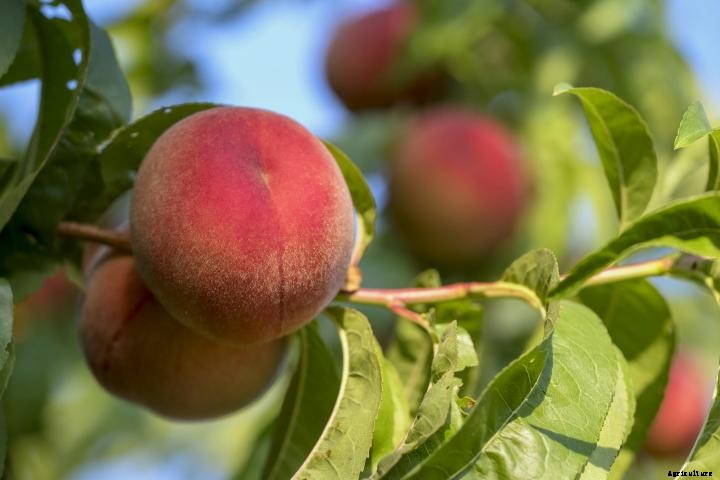
- Though this timing depends on what type of peach variety, you can generally go by the color of the fruit. When peaches are fully ripe, the ground color of the fruit changes from green to completely yellow. No green should be left on the fruit. They should come off the tree with only a slight twist. The fruits found on the top and outside of the tree usually ripen first.
- Be careful when picking your peaches because some varieties bruise very easily.
- Tip: Peaches ripen faster in a closed paper bag at room temperature.
How to Store Peaches
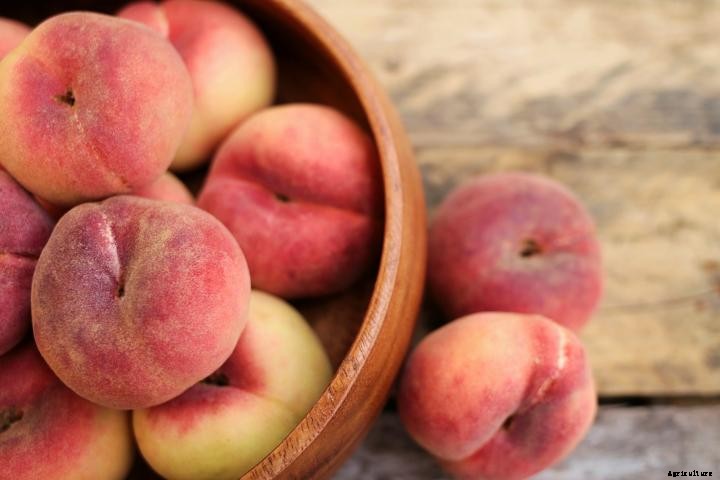
- You can store peaches in the refrigerator in a plastic bag. They should keep for about 5 days.
- You can also make use of fresh peaches by making peach jam or peach butter.
- Peaches can also be canned or frozen for storage.
Wit and Wisdom
- Although peaches are native to the Chinese countryside, the peach was brought to the western world through Iran.
- Test buds of peaches and other sensitive fruits for freeze damage. Bring in a few twigs cut from the trees and place them in a vase of water. If the twigs bloom in a week or two, expect blossoms in the spring and a crop the following fall.
Recipes
Peach Jam
Peach-Glazed Chicken
Golden Peach Salsa


