With immense flower heads, hydrangeas flaunt an old-fashioned charm in summertime that's hard to resist. Fall is the best season to plant hydrangea, followed by early spring. Our Hydrangea Guide provides information on proper planting, growing, pruning, and winter care.
About Hydrangeas
Unrivaled in the shrub world for beautiful flowers, these elegant plants are easy to cultivate, tolerate almost any soil, and produce abundant blooms. Colors beguile with clear blue, vibrant pink, frosty white, lavender, and rose blossoms—sometimes all blooming on the same plant!
Hydrangeas are excellent for a range of garden sites from group plantings to shrub borders to containers. Varieties abound (every year, it seems, breeders present us with more options!), and gardeners’ expectations of bloom size and color are boundless. To know how your hydrangea will grow, pay attention to the types, defined below. When you know what to expect, delights will be magnified.
Enjoy this ode to the beautiful of hydrangeas and learn how to grow hydrangeas in our guide below.
Planting
When to Plant Hydrangeas
- Autumn is the best time to plant hydrangeas, followed by spring planting. The idea is to give this shrub plenty of time to establish a healthy root system before flowering. Do not plant in the heat of summer.
- Plant the shrubs in early morning or late afternoon when it's cooler and the plant is less likely to suffer heat stress.
Where to Plant Hydrangeas
- Most hydrangeas will thrive in fertile, well-draining soils that receive plenty of moisture. Add compost to enrich poor soil.
- Generally, hydrangeas prefer partial sun. Ideally, they will be given full sun in the morning, with some afternoon shade to protect from the hot midday sun. This is especially true for the Bigleaf hydrangea (H. macrophylla), which is prone to wilting. Some varieties are more tolerant of full sun.
- Space hydrangeas anywhere from 3 to 10 feet apart, depending on type.
How to Plant Hydrangeas
- Dig a hole as deep as the root ball and 2 to 3 times as wide.
- Set the plant in the hole and fill it half full with soil. Water. After water is absorbed, fill the rest of the hole with soil.
- Water thoroughly again.

How to Grow Hydrangeas from Cuttings
Hydrangeas can easily be grown from cuttings. They root readily and the process makes for a great lesson in propagation. Here's how to do it:
- On a well-established hydrangea, find a branch that is new growth and that has not flowered. New growth will appear lighter in color than old growth, and the stem will not be as rigid.
- From the tip of the branch, move 4 to 5 inches down and make a horizontal cut. Make sure that there are at least 3 to 4 pairs of leaves on your cutting.
- Remove the lowest pair of leaves from the cutting, trimming them flush to the stem. Roots grow more easily from these leaf nodes, so if you can afford to remove more than one pair of leaves, do so. Be sure to keep at least 2 pairs of leaves at the tip end of the cutting, though.
- If the remaining leaves are quite large, cut them in half, removing the tip-half. This prevents the leaves from hitting the sides of the plastic bag you will place over the cutting later on (to keep the humidity up).
- (Optional) Dust the leafless part of the stem with rooting hormone and an anti-fungal powder for plants (both available at a local hardware or garden store). This will encourage rooting and discourage rotting.
- Prepare a small pot and fill it with moistened potting mix. Plant the cutting in the soil, sinking it down to the first pair of remaining leaves. Water lightly to get rid of any air gaps around the stem.
- Cover the entire pot loosely with a plastic bag. Make sure the bag isn’t touching the leaves of the cutting, otherwise the leaves can rot. (Chopsticks or something similar can be used to prop up the bag and keep it off the leaves.)
- Place the pot in a warm area that’s sheltered from direct sunlight and wind.
- Check on your cutting every few days to make sure that it isn’t rotting and only water again once the top layer of soil is dry. With luck, the cutting should root in a few weeks! (Check by gently pulling on the cutting; if you feel resistance, roots have formed.)
Care
Hydrangea Care
Watering
- For the first year or two after planting and during any drought, be sure hydrangeas get plenty of water.
- Water at a rate of 1 inch per week throughout the growing season. It's better to deeply water 3 times a week than sprinkle water in a shallow manner. This encourages root growth.
- Bigleaf and smooth hydrangeas require more water, but all varieties benefit from consistent moisture.
- Leaves will wilt if the soil is too dry, and flowering will be hampered by a lack of water.
- Use a soaker hose to water deeply and keep moisture off the flowers and leaves.
- It's best to water in the morning to prepare hydrangeas for the the heat of the day and to avoid disease.
- Add organic mulch underneath your hydrangeas to help keep the soil moist and cool, add nutrients over time, and improve soil texture.
Fertilizing
If your soil is rich, you may not need to fertilize hydrangeas. Too much fertilizer encourages leafy growth at the expense of blooms. The best way to determine your fertility needs is by using a soil test.
Apply fertilizer based on your specific hydrangeas. Each variety has different needs and will benefit from different application timing.
- Bigleaf hydrangeas can benefit from several light fertilizer applications in March, May and June.
- Oakleaf and panicle hydrangeas do best with two applications in April and June.
- Smooth hydrangea plants only need fertilization once, in late winter.
Winter protection
- In the fall, cover plants to a depth of at least 18 inches with bark mulch, leaves, pine needles, or straw in the fall. If at all possible, cover the entire plant, tip included, by making cages out of snow fencing or chicken wire, and loosely filling the cages with leaves. (Do not use maple leaves, as they tend to mat when wet and can suffocate the plant.)
How to Change the Color of Hydrangea Flowers
It is possible to change the flowers’ colors, but not instantly. Color correction takes weeks—even months. Wait until the plant is at least 2 years old to give it time to recover from the shock of its original planting. Also note that it's easier to change blue flowers to pink than pink to blue.
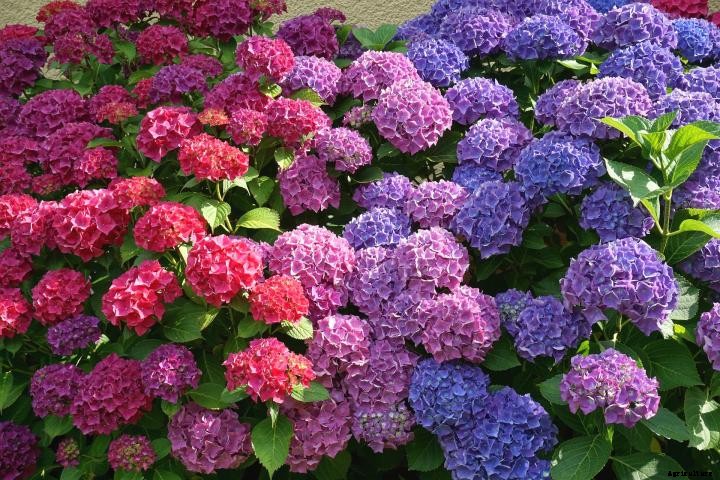
It's not every hydrangea that changes color. The color of some Bigleaf hydrangeas (H. macrophylla)—especially Mophead and Lacecap types—and H. serrata cultivars change color based on the soil pH.
Acidic soils with a pH of less than 5.5 produce blue flowers; soils with a pH greater than 6.0 produce pink flowers. White flowers are not affected by pH.
See How to Change the Color of Hydrangea Flowers for more information.
How to Prune a Hydrangea
Many of our readers' questions involve pruning hydrangeas. And no wonder—it's confusing, and all depends on the variety of hydrangea. Luckily, as long as you know which type you've got, it's easy to figure out what sort of pruning technique to employ.
Learn the essentials below, then read more about how to prune hydrangea varieties here.
Hydrangea Type |
When to Prune |
Where Flowers Appear |
Bigleaf
(H. macrophylla)
Summer, after flowering
On old growth
Oakleaf
(H. quercifolia)
Summer, after flowering
On old growth
Panicle
(H. paniculata)
Late winter, before spring growth
On new growth
Smooth
(H. arborescens)
Late winter, before spring growth
On new growth
Mountain
(H. serrata)
Summer, after flowering
On old growth
Climbing
(H. anomala subsp.
petiolaris)
Summer, after flowering
On old growth
Pruning Common Hydrangeas
The most common garden hydrangea shrub is the Bigleaf variety, Hydrangea macrophylla. (See more below.)
Bigleaf (H. macrophylla), Oakleaf (H. quercifolia), Mountain (H. serrata), and Climbing hydrangeas (H. anomala subsp. petiolaris) are pruned AFTER the flowers fade in the summer. These varieties bloom on the previous season's stems ("old wood").
- Flower buds actually form in the late summer and flower afterwards the following season, so avoid pruning after August 1.
- Only cut away dead wood in the fall or very early spring.
- To prune, cut one or two of the oldest stems down to the base to encourage branching and fullness.
- If the plant is old, neglected, or damaged, prune all the stems down to the base. You'll lose the flowers for the upcoming season, but also rejuvenate the plant for future years.
- It's best not to deadhead (remove faded blooms) on the big Mopheads; leave them over the winter and cut them back in early spring (to the first healthy pair of buds). It's fine to deadhead the Lacecaps; cut down to the second pair of leaves below the flower head.
- When growing H. macrophylla (and H. serrata) varieties in Zones 4 and 5, do not prune unless absolutely necessary, and then do so immediately after blooming. Otherwise, remove only dead stem in the spring.
Other Hydrangeas
Panicle (H. paniculata) and Smooth (H. arborescens) hydrangeas are pruned BEFORE flower buds are formed. These varieties bloom on the current season's stems ("new wood").
- Prune in the late winter when the plant is dormant. This means that if the buds are killed during the winter, the plant will produce new buds in the spring which will produce blooms.
- In general, prune only dead branches, and do not prune to "shape" the bush.
Read more about how to prune hydrangea types.
Pests/Diseases
Protect against pests and disease by choosing resistant cultivars.
- Powdery mildew, leaf spot, wilt, and bight can all appear on hydrangeas.
- Pests are rare, but can appear when plants become stressed. Common pests include aphids and red spider mites.
Properly caring for hydrangeas is your best defense. (See above tips on watering and hydrangea care.)
Recommended Varieties
For a more detailed overview of the many types of hydrangeas, check out Hydrangea Varieties for Every Garden.
There are two main groups of hydrangeas:
Group 1: Plants that Bloom on New Growth (This Year's Stems)
The following hydrangeas, which form their buds in early summer on new growth, will flower reliably each year, requiring no special care.
- Panicle hydrangeas (Hydrangea paniculata)
- ‘Grandiflora’ is a big, old-fashioned, floppy variety, ‘Tardiva’, ‘White Moth’, and ‘Pee Wee’ fit the scale of small gardens. ‘Limelight’ produces cool-green flowers and grows to a height of 6 to 8 feet.
- Smooth hydrangeas (H. arborescens)
- Look for the cultivars H. arborescens ‘Grandiflora’ and ‘Annabelle’, which produce many large (up to 14 inches across), tight, symmetrical blooms in late summer.
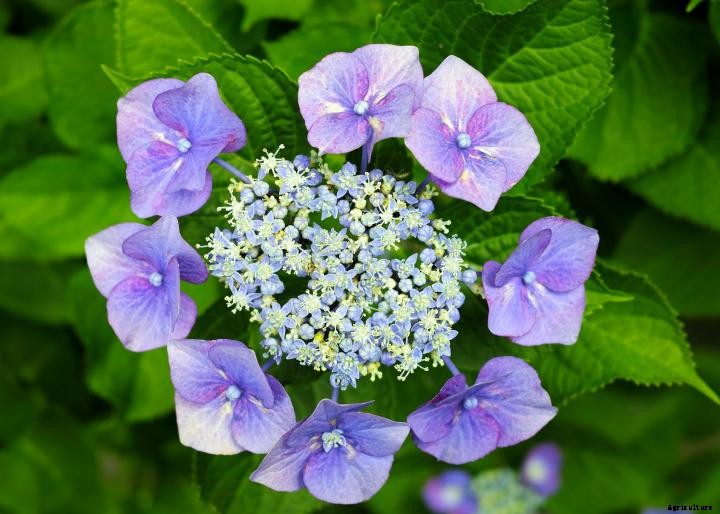
Image: Lacecap hydrangea
Group 2: Plants that Bloom on Old Growth (Last Year's Stems)
If you live in Zone 8 or warmer, choose plants from this group. Gardeners in cool climate zones will find many of them a challenge, because they set flower buds in the fall. Although hardy to Zones 4 and 5, the buds are prone to damage by an early frost in fall, a late frost in spring, or excessively cold temperatures when dormant in winter. This, along with untimely pruning, can result in inconsistent flowering or no flowering at all.
- Oakleaf hydrangeas (H. quercifolia)
- You can expect exceptional fall color from ‘Snow Queen’, ‘Snow Flake’, and ‘Alice’.
- Bigleaf hydrangeas (H. macrophylla)
- We love ‘All Summer Beauty' (Mophead), which has profuse, dark blue flowers—turning more pink in soils with near neutral pH. If its buds are winter-killed, the plant will form new ones in spring and still bloom.
- 'Nikko Blue' (Mophead) is vigorous, with large, rounded, blue flowers.
- 'Blue Wave' (Lacecap) produces rich blue to mauve or lilac-blue to pink flowers.
- 'Color Fantasy' (Mophead) has reddish or deep purple flowers and shiny, dark green leaves. It grows to about 3 feet tall.
- Mountain hydrangeas (H. serrata)
- Examples are ‘Bluebird’ and ‘Diadem’. In acidic soil, ‘Preziosa’ produces blossoms of an extraordinary blend of pale shades of blue, mauve, violet, and green.
- Climbing hydrangeas (H. anomala ssp. Petiolaris)
- 'Firefly' is a newly-patented variety exhibiting variegated foliage.
For more about hydrangea varieties, see Hydrangea Varieties for Every Garden.
Harvest/Storage
How to Cut and Store Dried Hydrangea Flowers
Use dried hydrangea flowers to create a wreath or other decorations around the house:
- Cut the flower heads when the flowers have matured and developed a papery consistency.
- Remove leaves from stems, and hang upside down in a warm, dry, dark, airy room.
- When completely dry (usually a couple of weeks), store in a dry location out of direct sunlight.
- To enhance flower color, spritz dry flowers with diluted fabric dye.
How to Use Hydrangeas in a Bouquet
- Place the freshly cut hydrangea stems immediately into cold water to avoid wilting.
- Recut the woody stems at a slant under water. Remove lower leaves on the stems.
- Arrange the stems in a vase and place in a cool spot.
- Check the water in the vase daily and mist the blooms with water.
- Soak wilting blooms in cool water for 10 to 15 minutes to revive them.
Wit and Wisdom
- The word "hydrangea" is derived from Greek hydor meaning "water" and angeion meaning "vessel," referring to the plant's seed pods, which look like small water jugs.
- In the language of flowers, hydrangeas symbolize gratitude for being understood, or frigidity and heartlessness. See more flower meanings.


