
Welcome to Modern Agriculture!

Wondering about that white fungus on your plant? The fungal disease powdery mildew is a common problem in gardens, infecting a wide variety of plants and reducing the quality and quantity of flowers and fruit.
Powdery mildew is a fungal disease that affects a wide variety of plants. There are many different species of powdery mildew, and each species attacks a range of different plants. In the garden, commonly affected plants include cucurbits (squash, pumpkins, cucumbers, melons), nightshades (tomatoes, eggplants, peppers), roses, and legumes (beans, peas).
When the fungus begins to take over one of your plants, a layer of mildew made up of many spores forms across the top of the leaves. These spores are then carried to other plants by the wind. Powdery mildew can slow down the growth of your plant and, if the infection is severe enough, will reduce fruit yield and quality.
Powdery mildew spores typically drift into your garden with the wind, but if you've had powdery mildew occur in the past, new outbreaks may also come from dormant spores in old vegetative material or weeds nearby.
Unlike many other fungal diseases, powdery mildew thrives in warm (60-80°F / 15-27°C), dry climates, though it does require fairly high relative humidity (i.e., humidity around the plant) to spread. In cooler, rainy areas, it does not spread as well, and it is also slowed down by temperatures higher than 90°F (32°C). It tends to affect plants in shady areas more than those in direct sun, too.
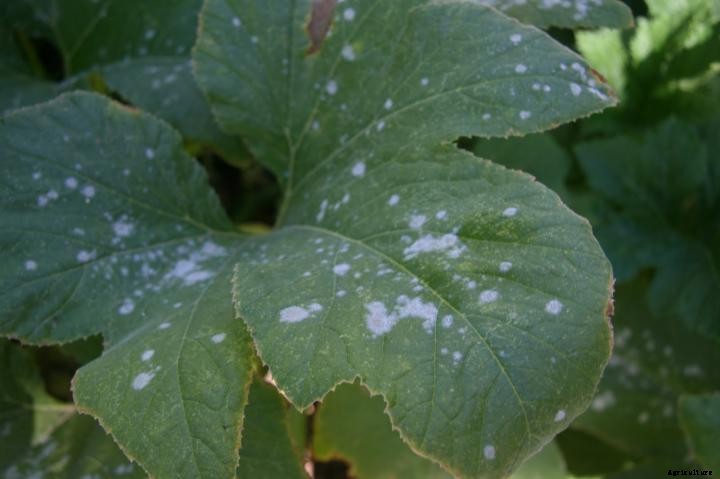
Powdery mildew first appears as small white spots on the upper part of the leaves. Photo Credit: The Regents of the University of California, UC Davis.
As with all pests and diseases, the best means of controlling powdery mildew is proactive prevention.
Once plants are heavily infected, it's very difficult to get rid of the disease, so focus on preventing it from spreading to other plants. Remove all infected foliage, stems, and fruit and destroy them, either by throwing them in the trash or by burning. Do not compost any infected plant, as the disease can still be spread by the wind and persist in the composted materials.
After pruning off infected parts, do not allow pruning shears to touch healthy leaves. First sterilize your pruners with rubbing alcohol.
Homemade Prevention
Effective organic fungicides for treating powdery mildew include sulfur, lime-sulfur, neem oil, and potassium bicarbonate. These are most effective when used prior to infection or when you first see signs of the disease.
Fungicides
There are many fundicides, especially for rose bushes, that are highly effective with low toxicity, no residue, and long duration. One example is Triadimefon. It can be sprayed with 1000–1200 WP of 15% wettable powder, 1 times intervals of 10 days, and 2–3 times. But check with your local nursery for fundicides approved in your area.


