Welcome to Modern Agriculture!

Properly spaced tomato plants are likely to be healthier and produce a larger harvest than those that are overcrowded or too widely spaced. Tomato spacing depends on two factors; what types of tomatoes you’re growing and how you plan on supporting the plants. Once you have those key pieces of information, it’s easy to figure out how far apart to plant tomatoes.
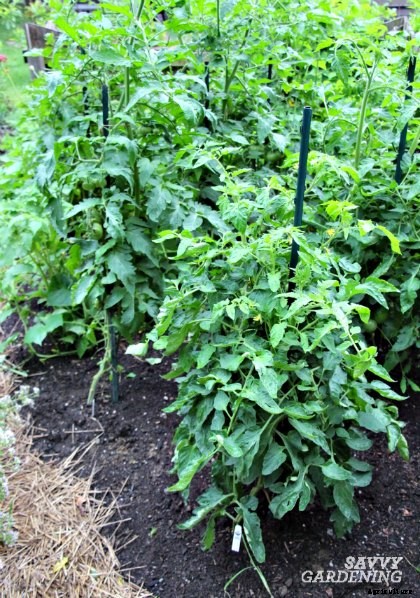
There are four main reasons to aim for well-spaced tomato plants:
Determinate – Determinate tomato plants are also called ‘bush tomatoes’ and form compact plants that grow about three feet tall, although some larger varieties can grow up to four feet. Because the fruits of determinate tomatoes ripen around the same time, they’re often grown by gardeners who like to can or preserve their harvest. Determinate tomatoes are often left unsupported, but they can also be held upright with sturdy tomato cages.
Indeterminate – Unlike determinate tomato plants which grow to a certain size and stop, indeterminate varieties can grow six to eight feet tall. They only stop growing when the end-of-season frost finally kills the plants. Also called ‘vining tomatoes’, they yield their harvest over a long period of time and are best grown on sturdy supports like tall wire cages, stakes, or trellises.
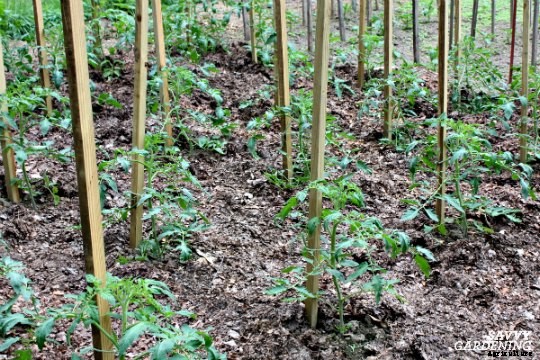
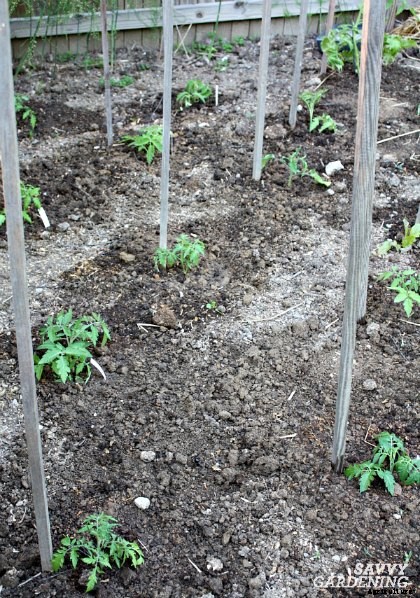
How far apart to plant tomatoes is dependent on the types of tomatoes grown – determinate or indeterminate – and the types of supports used. Trellised plants in sturdy cages or supports can tolerate a closer planting than those allowed to sprawl on the ground. Of course, there are other benefits to trellising your tomato plants. They’ll be less likely to suffer soil-borne diseases.
Determinate tomatoes – Space dwarf determinate tomatoes, which only grow 12 to 18 inches tall one to two feet apart. Full-sized determinate tomatoes should be planted two feet apart.
Indeterminate tomatoes – This is where supporting your plants makes a big difference with spacing. I plant staked indeterminate tomato plants 18 to 24 inches apart. They are pruned regularly during the growing season to control growth and encourage good air circulation. And while I don’t allow any of my tomato plants to sprawl on the ground, if you prefer to leave your indeterminate plants unstaked, space them three to four feet apart.
When growing in gardens or raised beds, leave four feet between rows to permit good air flow and, in the case of in-ground gardens, to give you space to work around the plants.
Now that you’ve got your tomatoes properly spaced, don’t neglect pruning! Determinate tomatoes don’t need to be pruned, but staked indeterminate tomatoes need regular pinching to remove suckers which promotes healthy, productive plants. It’s not difficult to prune tomato plants, but it should be done every 7 to 10 days.
Suckers are vegetative shoots that develop in the crotch between the main stem and a branch. Suckers do produce flowers and fruits and while leaving suckers can mean more tomatoes, the overall fruit size will be decreased. And of course, the plants become a tangle of foliage with little airflow.
In early summer, I let two to three suckers develop, but pinch the rest every week or so. When the suckers are 2 to 3 inches long they’re easy to remove with your fingers. If you let them grow larger, you may need a pair of pruners to cleanly remove suckers.
Learning how far apart to plant tomatoes isn’t difficult, and it’s so important for the health and production of your plants. For further reading on growing tomatoes, be sure to check out the award-winning book, Epic Tomatoes by Craig LeHoullier.
For more on growing tomatoes, check out these related posts:
Have you been wondering how far apart to plant tomatoes? Any tips to add?