
Welcome to Modern Agriculture!

Heirloom vegetables are defined in several ways. Some consider heirlooms to be any vegetable cultivars that have been grown for a certain length of time. Other people consider vegetables to be truly heirlooms only if being passed down by a family or group has preserved them. Heirlooms are always open-pollinated, since hybrid seed can not be maintained by ordinary means. However heirloom vegetables are defined, interest is increasing in our edible heritage.
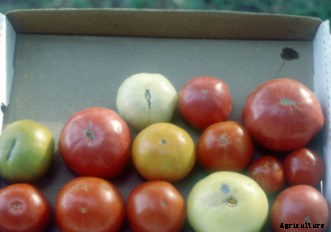
A box of heirloom tomato varieties are a taste of the past.
J. Powell Smith, ©2016, Clemson Extension
One reason to grow heirloom vegetables is simply that they are a taste of the past. Many varieties, which had been prized and maintained for generations, have been lost in recent decades as fewer people save seed year to year. For many gardeners, saving an heirloom cultivar is a connection to their heritage.
Many gardeners grow heirlooms that have superior flavor. Heirloom varieties that have been selected for taste and tenderness through several generations are often tastier than cultivars that have been selected for ease of shipping, uniform appearance or ability to grow well throughout the country.
When gardeners save the seed of the best-tasting, best-performing plants in their gardens each year for a number of years, they gradually select their own special cultivars. Those selections will be suited to their own growing conditions and tastes. Open-pollinated seed that has been grown and harvested for generations in a region or microclimate becomes adapted to that area’s soil, climate and pests.
Many people grow and save old cultivars because they save a lot of money by avoiding the purchase of new and expensive hybrid seed each year. Hybrid seed will not produce similar plants when saved from year to year.
Another vital reason to maintain heirlooms is to keep their genetic traits for future use. When old varieties of food crops are not maintained, the gene pool grows smaller and smaller. This may lead to increased disease and pest problems.
If you grow heirloom vegetables, you will almost certainly save seed. More and more companies are beginning to carry old cultivars in their seed list, but most heirloom gardeners want to ensure their seed supply against changes in fashion. Many also feel that saving their own seed gives them more connection to the entire process of growth and regeneration.
Do not try to save seed from hybrid vegetables. It will not produce plants the same as those from which it is collected. Saving seed can duplicate open-pollinated cultivars, if the crop is not allowed to cross with other strains of related vegetables.
There are several ways that home gardeners can maintain their seed stock without unwanted crossing.
Some vegetables are mainly self-pollinating; their seeds will produce plants like the parent plant that produced the seeds. Beans, peas and peanuts, lettuce, eggplant, peppers, and tomatoes are usually self-pollinating. Insects occasionally cross them, so plant them with at least 10 feet between varieties. Beans and tomatoes are very popular as heirloom vegetables partly because they are easily maintained true to type. Vegetables that are cross-pollinated by insects or by wind need to be isolated or raised at a considerable distance from other varieties. This distance may need to be several hundred yards or more, depending on the crop. Onions, cucumbers, corn, pumpkins, squash, broccoli, beets, carrots, cabbage, cauliflower, melons, radishes, spinach, Swiss chard, and turnips are all insect-or wind-pollinated. In a small garden, the easiest way to ensure purity is to grow not more than one variety of a species at a time. If your goal in raising an heirloom variety is to preserve it, you do not want it to cross with something else.
One way to isolate cultivars is to grow them in separate screened cages, or to cover individual flowers with bags and hand-pollinate them. Another method is called time isolation. Time plantings so that different varieties are not flowering at the same time and so cannot pollinate each other. Choose plants to save seed from before you harvest the rest of the crop to eat. You should choose the healthiest, most productive, and most flavorful plants to save for seed. Make sure that you label them clearly for seed to avoid temptation.
Allow seeds to ripen fully before they are harvested. Mature seeds are more likely to grow well than seeds harvested too soon. Strong, healthy plants produce healthier seeds than seed from weak, stressed plants.
Warm, dry conditions while seed matures increases their storage life. It is best to harvest your seeds and bring them inside for final drying as soon as they are fully mature and dry, especially if rains threaten
Most vegetable seeds remain viable for three to five years when stored properly. Place thoroughly dry seed in a tightly closed glass jar and keep the jar in a cool dry location. Put silica gel packets in with the seed to help keep it dry. You can add diatomaceous earth to seed to help prevent insect damage. Store seed in the refrigerator to further increase its life expectancy. To test for germination, sprout seeds between moist paper towels; if germination is low, either discard the seeds or plant extra to give the desirable number of plants.
Long-lived seeds include beets; all cabbage relatives such as broccoli, cauliflower, collards, and kale; cucumber; lettuce; melons; peppers; sunflower; tomato; and turnip. If you keep them cool and dry, these seeds should maintain good viability for five years or more.
Medium-lived seeds include beans, carrot, chard, eggplant, parsley, peas, pumpkin, and squash. These, properly stored, should last at least three years.
Short-lived seeds can only be depended on to last to the next growing season. This list includes corn, leek, onion, and spinach seed.
Beans of all kinds are very popular heirloom vegetables. There are thousands of cultivars, with huge variations in taste, size, color and markings, and climate adaptability.
Beans are usually not cross-pollinated. Separate plantings by enough distance to avoid having their vines intertwine. Allow the seed to thoroughly mature on the vine. Pull the entire plant and place it in the shade to dry out for one to two weeks. Bring inside to finish drying if rain threatens. Shell and store in a cool, dry area in a paper bag. Bean and cowpea seeds will keep for three or more years.
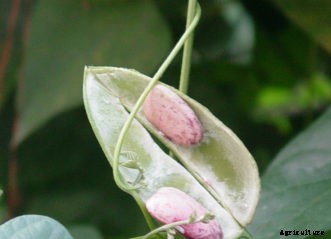
Red Calico Butterbeans have been maintained by the Thweat family in Tennessee since 1794.
J. Powell Smith, ©2016, Clemson Extension
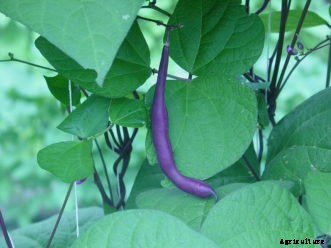
Purple Pod Pole beans turn green when cooked.
J. Powell Smith, ©2016, Clemson Extension
All corn is wind-pollinated and will readily cross with other varieties. Varieties should be widely separated, from 600 feet to over half a mile to ensure purity. You can also save seed by bagging the ears that you want to save for seed and hand-pollinating them, or by growing cultivars that will be separated by blooming time. You should always grow at least 200 corn plants in a large block when saving seed. Save seed from 50 ears of different plants to reduce inbreeding depression. Let the seed dry thoroughly on the plant and then dry further once husked. Seed lasts only one year.
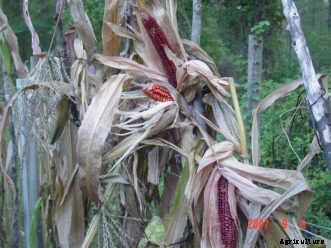
Bloody Butcher Corn is used for decoration and flour making.
J. Powell Smith, ©2016, Clemson Extension
There are many different forms of cucumbers that are rarely seen in stores. Cucumbers are cross-pollinated by insects. So if you want to save cucumber seed, plant only one variety. Let the fruits hang on the vine until ripe (skin becomes yellowish and hard). Then handle like the process for tomatoes given below.
Cut off seed stalks when fluffy in appearance, just before all the seeds are completely dried. Seeds will fall off the stalk and be lost if allowed to mature on the plant.
Treat melons in the same way as cucumbers.
Potatoes are popular heirloom vegetables. There are many unusual colors, shapes, and flavors that are seldom found at the grocery store. Heirloom potatoes are saved from year to year as tubers, and so are very easy to maintain true to name.
Okra pods should be left on the stalk until brown and well-matured. Remove the pods and place them in the shade until thoroughly dried. It is best to store okra seed in the pod until ready for planting.
Peppers are usually self-pollinating. Insect cross-pollination does occur sometimes, and if it does, hot bell peppers can result, since the gene for hotness is dominant. If grown closer than 500 feet apart, plants must be caged or bagged to prevent spicy surprises in future years.
Peppers should be allowed to ripen until they become red. Cut the pepper pod in half and scrape the seed onto a piece of paper. Spread out the seed and dry thoroughly before placing in a storage container. Wash your hands thoroughly with soapy water after harvesting the pepper seeds, since the residues will burn eyes and lips for hours after contact.
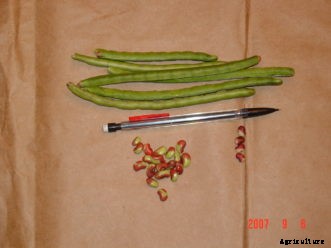
Calico Crowder peas are delicious fresh or dried.
J. Powell Smith, ©2016, Clemson Extension
Southern peas are handled in the same way as beans.
Winter and summer squash and pumpkins are all related. Crossing readily occurs between varieties of the same species. No crossing occurs between different species. Grow only one variety of the same species, and separate by ½ mile or hand pollinate to maintain purity. The commonly grown species are: banana, buttercup, cushaw and hubbard squash (Cucurbita maxima); butternut squash (Cucurbita moschata); acorn, crookneck, and scallop squash, zucchinis and most pumpkins (Cucurbita pepo); and Mexican gourd (Cucurbita ficifolia).
When the outer covering of the squash is so hard that it cannot be dented with your fingernail, the seeds are generally mature. Split the squash fruit open, scoop out the seed and wash until all pulp is removed. Spread out on newspaper to dry.
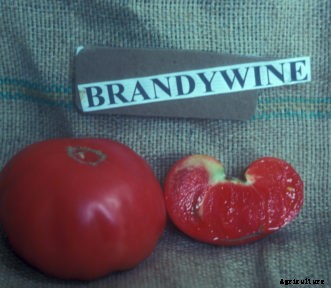
Brandywine tomatoes is known for its superb flavor and texture.
J. Powell Smith, ©2016, Clemson Extension
Tomatoes are self-pollinators and are usually not cross-pollinated. Only the potato leaf varieties must be separated. In order to save the seeds, pick fruit from desirable plants when ripe. Cut fruit and squeeze out pulp into a container.
Add a little water and let ferment two to four days at room temperature, stirring occasionally. When seeds settle out, pour off pulp and spread seeds in a thin layer to dry thoroughly. Store in an envelope or glass jar in a cool, dry place. Properly stored seeds will remain viable for four to 10 years.
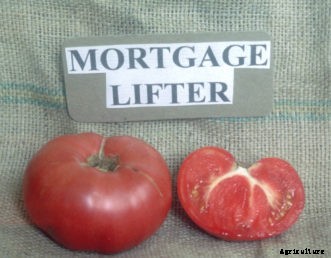
This tomato variety was developed by M.C. Byles of West Virginia in the 1940’s. He sold the plants for $1.00 each and was able to pay off his $6,000 mortgage in six years.
J. Powell Smith, ©2016, Clemson Extension
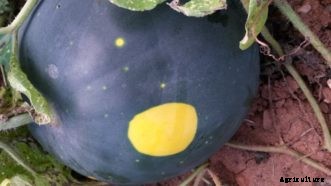
The Moon and Stars watermelon has characteristic yellow spots that gives this variety its name.
Barbara H. Smith, ©2016 HGIC, Clemson Extension


