
Welcome to Modern Agriculture!

Introduction to Hydroponic Cucumber Farming
Cucumber (Cucumis sativus L.) is one of the most popular vegetable crops cultivated broadly throughout the world. Hydroponic culture involves growing plants in nutrient solutions, with or without the use of artificial substrates like rock wool, peat, or sand to provide support for root growth. Cucumbers grow well and have few difficulties under hydroponic conditions.
Hydroponics system is a technique of growing plants without soil and the limitations of space and climate. In traditional farming, plants depend on soil to obtain all nutrients needed for their growth. In contrast, a hydroponic system provides all of these nutrients without involving sunlight, soil, extra labor, allowing farmers to benefit from efficiencies and to reap large produce yields. Cucumbers thrive in the hydroponics system due to their rapid growth rate and requirements for warmth, moisture, and nutrients. They are one of the highest yielding plants generally grown in greenhouses.
Some Important Factors Considered in Hydroponic Cucumber Farming;
Several important factors have to be considered when choosing fertilizers and preparing a hydroponic nutrient solution for Cucumber farming;
There are several types of Cucumber. As a general classification, there are slicing Cucumbers and pickling Cucumbers. Slicing Cucumbers, such as the European, mini, and green Cucumbers are normally eaten raw in salads and sandwiches. They are dark green and modern varieties are seedless. Pickling Cucumbers are generally pickled. These types are smaller and lighter in color. Gherkins are small Cucumbers used exclusively for pickling. Most commercial Cucumber varieties produced today are seedless. Hybrid Cucumber varieties are preferred for hydroponic farming as many offer resistance to major diseases such as powdery mildew that are extremely common in types with no resistance and can be difficult to control long term.
In recent years there have been several new Cucumbers varieties introduced, many of which lend themselves well to hydroponic systems. Some of the popular indoor varieties include the Old World favorites such as Long English and Lebanese Cucumbers.
The common Cucumber varieties such as American slicers which include Slice Master and Marketmore will also do well in a hydroponic system. Persian pickles are another old-world cultivar, becoming popular in pickling.
Cucumber varieties have varying sizes, shapes, maturation rates, and disease resistance characteristics. Hybrid Cucumber varieties are generally best for hydroponic production.
Cucumber plants grow best with warm temperatures and high light. Cucumbers are also a high-light plant and, aside from summer, they are usually under light-limited conditions. Plant productivity increases with supplemental lighting. Cucumber plants like somewhat higher temperatures than tomatoes. Their minimum night temperatures must be about 20°C and during the daily maximum temperatures of 23 to 25°C are ideal. Relative humidity should be maintained at about 75%. Light levels of about 5500 lux (510-foot candles) for 14 to 16 hours per day are adequate. Carbon dioxide enrichment from 800 to 1000 ppm will help the Cucumber plants compensate for the lower than natural sunlight conditions when using artificial lights.
Light and Temperature – Cucumbers only need a relatively moderate amount of light in comparison to other crops 8 to 12 hours daily is sufficient. Post seedling and germination temperatures range anywhere from 18 to 29°C. They can be grown 2 to 3 plants per planting space.
Hydroponic Cucumber plants need high to medium light levels and warm temperatures, so growing difficulties can occur during cloudy or cool weather. Dutch-type Cucumbers need temperatures between 15 to 27°C. Good growth occurs when daytime temperatures are between 23 to 26°C and night temperatures don’t fall below 18°C.
EC – Optimum EC for Hydroponic Cucumber ranges from 2.2 to 2.7 mS. If growth is too vegetative (too many leaves and not a lot of fruit) you can increase the EC level to shift the plants to a more generative stage. Permit the leachate to reach as high as 30%, but lower than if the Cucumber plants are too vegetative. If the growth is too generative, lower the EC level, and increase the leachate. Lowering night temperatures will also stimulate generative growth.
Mix your Hydroponic nutrients according to the package directions, and thoroughly water your Cucumber plants with the nutrient solution. Nutrient solutions commence with a standard vegetable formulation.
The optimal pH level for Cucumbers grown hydroponically is 5.5 to 6.0. For more advanced growers EC ranges should be from 2.2 to 2.7 mS. Cucumbers will also benefit from CO2 enrichment which will accelerate fruit production and increase crop yields. When the Cucumber plant matures, before the fruiting switch to a solution with higher potassium levels.
Greenhouse Cucumber seeds have high germination rates. Unlike most hydroponic crops started in small seedling sizes, Cucumber seed can be directly sown in 4-inch blocks of coconut coir, stone, or mineral wool, or any similarly suitable substrate for hydroponic production. Fertilize seedlings with a moderate-strength nutrient solution during propagation. After plants have three or four mature leaves, they are ready for transplanting. Once Cucumber transplants are ready, they can be grown-out in systems used for other vining greenhouse crops such as Dutch buckets filled with perlite or slabs of stone wool or coconut coir in a gutter system. Plants are most commonly grown in double rows in the greenhouse with both systems.
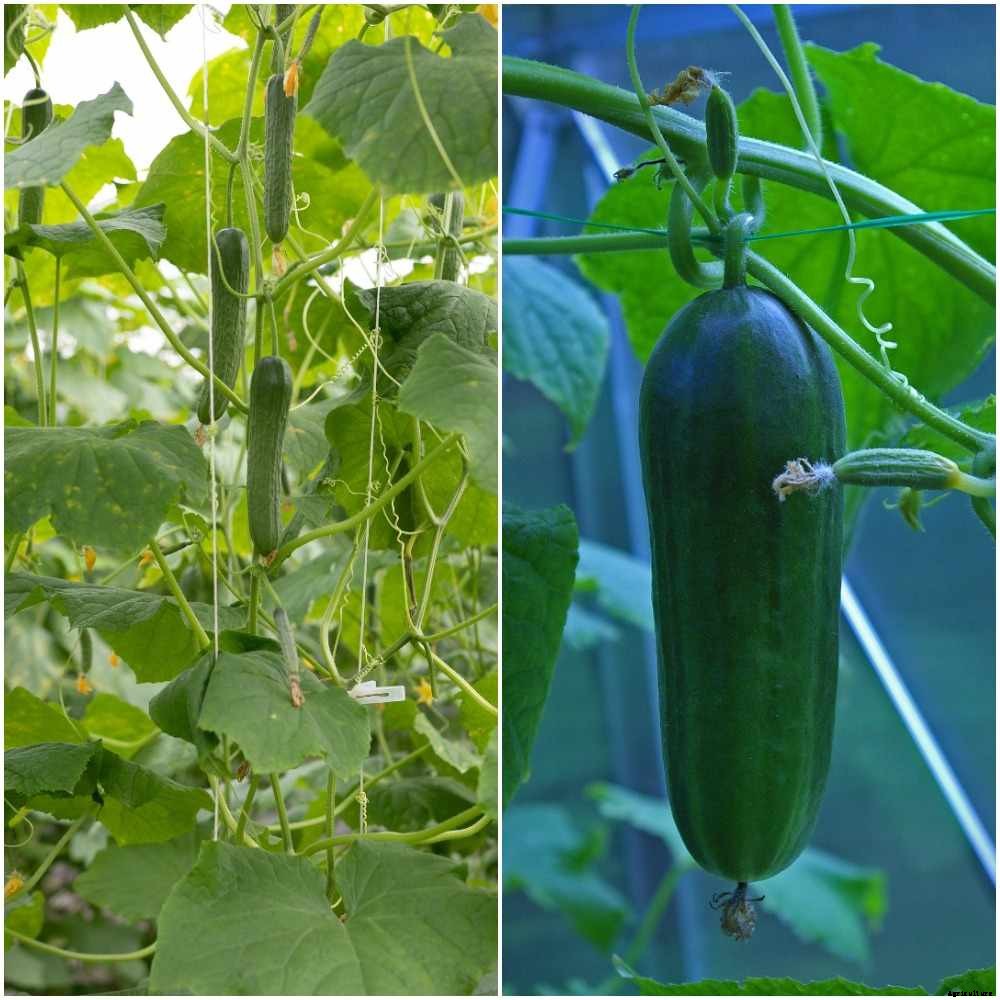
Cucumber plants are generally vining plants and need to be supported not only for the health and yield of the plant but also to maximize the use of vertical space. Even bush varieties support for optimal production. In a hydroponics setup, they must be trained to grow upwards along supporting structures such as strings or wires, light trellises or mesh structures will also suffice.
Cucumber vines being indeterminate need to be trimmed, trained, and maintained to prevent them from overtaking your entire growing area. Initially, the plant’s growth must be directed upwards on a wire or string support that leads to overhead support. Once the Cucumber plant has reached the overhead support it should then be trained so that the majority of the Cucumbers will hang downwards.
Germination periods in Cucumbers vary depending on the variety and conditions. Temperature levels around 26°C are best for accelerated growth. Seedlings, once they emerge should be hardened off with a gentle breeze and temperatures around 22 to 23°C before planting permanently in a hydroponic system. The minimum night temperatures should be no less than 18°C.
European Cucumbers are spaced at 5-6 feet between rows by 16 inches between plants. Bush varieties can be planted closer together always consult the seed pack, as plant spacing varies from cultivar to cultivar.
Cucumber seeds can be sown into individual cell pots with perlite or vermiculite. Oasis Cubes also work well for seed starting, Blocks of rock wool are also suitable, and coco coir will suffice. The seed must be placed deep enough to prevent it from drying out; this will also help the seed coat to release as it germinates.
Presoak all media like Rockwool, vermiculite, etc in pH balanced water for at about 45 minutes before using it. Dry media will soak up moisture from the roots. Use straight water [pH balanced is preferable] for the first few days following seed germination until the embryonic leaves have fully emerged. By the 3rd or 4th day, use only a half-strength nutrient solution for about a week before graduating to full strength solution.


