A step by step guide for growing cucumber Hydroponically
Let us discuss today the techniques of growing cucumber Hydroponically and Hydroponic cucumber problems, required Hydroponic nutrient solution formula along with Hydroponic cucumber benefits, Hydroponic cucumber varieties and the yield of Hydroponic cucumbers. why wait, let us dive into it.
Hydroponic Cucumbers
You must have seen beautiful young girls putting a slice of cucumber on their eyes, in summers you can spot vendors selling cucumber with delicious salt to beat the heat. This is because cucumber consists of a plentiful amount of water to rejuvenate our body and counteract the scorching heat of summers.
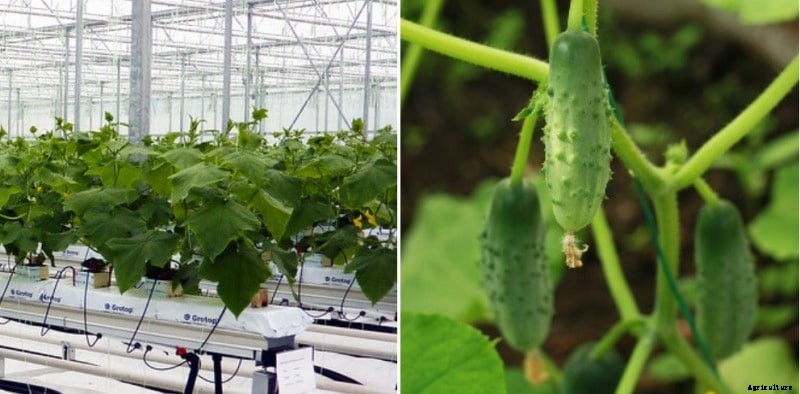
Cucumber (Cucumis sativus) is a far and wide grown member of the gourd family Cucurbitaceae. It is a creeping vine that bears cucumiform fruits that are often used as vegetables or fruits. Cucumber has been always been cultivated by conventional cultivation technique on a huge scale due to its high demand especially in summers. But modern cultivation technique has the ability to increase its production manifold one such technique is hydroponics. Hydroponic cucumbers are getting popular among new home gardeners as well as experienced growers because of the numerous advantages it offers. Rapid growth, exceptionally high yield, low insect pest damage and ability to cultivate cucumbers outside its growing season are prime Hydroponic cucumber benefits.
Cucumbers thrive in hydroponics due to their rapid growth rate and desires for warmth, moisture, and nutrients which are effectively filled in the hydroponic system. They are one of the highest yielding plants commonly grown in a hydroponic setup. So simple answer to How to increase cucumber yield is trying hydroponics at your home.
One of the most satisfying aspects of growing your own cucumbers is the freshness and constant supply of the harvested product. Plucking your own cucumbers fresh from the vine gives a crisp and juiciness that is tough to beat and is often a pretty pleasant surprise for first-time cucumber growers.
You may also check How to Grow Hydroponic Chilli.
Getting hydroponic plants started:
The first point that comes in mind after hearing hydroponics is, of course, the setup; there is the majority of ready to use hydroponic setups available online that you can buy anytime as per your connivance, space and number of plants to be grown. As per the experienced hydroponic growers ‘Simple Non-circulating hydroponic system’ also known as the Kratky method, deep water culture method are found successful for raising your own hydroponic cucumbers indoors and for Growing cucumbers hydroponically outdoors you can opt for NFT hydroponic system and the large ebb and flow system. Growing cucumber outdoors is simpler than growing them indoors and typically yield more due to the availability of larger space. Outdoor cucumber plants can be trained vertically, meaning less space is required between the plants. The best part is a spacing requirement is less in hydroponic container cucumbers than the traditional ground cucumbers which simply means more hydroponic plants hence more yield.
Best varieties of cucumber growing Hydroponically
When you plan for growing cucumbers hydroponically, selecting a variety for hydroponics might look difficult but for hydroponics, any cucumber variety can work. But you must choose a variety based on your purpose (cucumbers or pickles), on the basis of your setup and you can go for resistant varieties as well. They have varying sizes, shapes, maturation duration and disease resistance characteristic fruit shape and size. So long as you are not a seed saver, Hybrid varieties are usually best for hydroponic production.
Cucumber types fall under the following category :
Gynoecious Cucumber: This variety produces mostly female flowers. They yield more prolifically than standard varieties and are more disease resistant.
Parthenocarpic Seedless cucumbers are called parthenocarpic, meaning they set fruit without the need for pollination and hence no seeds are formed in the flesh. These are the preferred type for hydroponic cultivation. Such cucumbers will produce seedless fruits if raised isolated from other varieties.
Gynoecious means the plants produce female flowers only but they are also not necessarily seedless. Parthenocarpic cucumbers are almost all gynoecious, meaning that they only produce female flowers. However, not all gynoecious cucumbers are parthenocarpic. Gynoecious plants mean no pollen from male flowers will be there to pollinate the female plants, which may create misshapen fruit.
Burpless – these are sweeter in taste, thin-skinned and contain very little amount of cucurbitacin, which increases stomach discomfort and burping.
Bitter-free – most varieties of cucumber will sometimes develop a bitter taste if left on the vine too long. But these varieties are specially bred to be bitter-free.
Spineless – fruit with smooth skin and devoid of the white, prickly stubs.
Generally, modern hybrid cucumber cultivars used in hydroponics are relatively bitter free and burpless, though plant stress can result in the production of the compound cucurbitacin in the fruit, making them less appetizing.
Older, heirloom and open-pollinated varieties of cucumbers often build up bitter flavors, predominantly if the fruit is left too long on the vine before harvesting, and due to the conditions of moisture, temperature or pest and disease stress.
Even you can easily build this easy hydroponic system at home by DIY just follow these steps and forget rest.
You may be interested in Growing Basil from Cuttings, Seeds.
Requirements for growing cucumber Hydroponically:
Barrel/Drum/plastic container with Lid about 100-200L capacity.
The way to start growing cucumber is propagation through its seed which can be easily obtained from various online sites and stores. Within a couple of days after cucumber seed sowing, once true leaves are formed the seedling is ready for transplanting. Cucumbers seeds can be sown into individual grow pots with a growing medium like perlite, vermiculite or a blend thereof. The seed should be placed deep enough so that it is prevented from drying out, this will also help the seed coat to soften as it germinates. The simplest way to cultivate cucumbers in hydroponics is to plant them in ready to use Rockwool starter cubes.
When such media starting cucumber seeds, it is important to put the seed into the medium so that the end of the seed from which the root will emerge is down.
Soak the Rockwool cubes until they are fully drenched and permit them to drain. Once the Rockwool drains put one seed about ½ inches deep into each cube and water them regularly. Make sure that you have planted one seed per cube in your growing medium. Within a few days, you can observe the set of true leaves emerging from the Rockwool. Germination takes place best at 80 to 82°F and is rapid, with root emergence observed within two days.
For the beginners we would suggest using cocopeat pellets, the best thing about using cocopeat pellet is it is so natural and the plant roots form similarly as it would in soil. Regarding the water holding capacity, cocopeat pellet surely succeeds. It has a thin biodegradable cover around it the fabric is so thin it permits developing roots to penetrate through it without damaging the newly emerged seedling.
Prepare the Net pot/pot for transplantation of the seedling by filling it with expanded clay which will hold the developing plant. Transplanting the seedlings is very effortless if you use Cocopellets. Cocopellets are also known as rooting plugs. It is as trouble-free as just taking the seedling and placing it in another pot. Once germinated and transplanted the young cucumber plants grow very rapidly as long as the environmental conditions are encouraging. Within a week to 10 days of the seeding, the cotyledons are spread. Flower buds should be removed up to the 10th leaf stage. This is necessary to allow the plant to develop vegetatively before being loaded down with fruit.
Cucumber plants will produce for about three to four months once they have started yielding. It takes about four to six weeks from seed sowing to get the first cucumber ready to be picked well it also depends upon variety used. You can keep yourself constantly supplied with your own fresh cucumbers by starting new plants before the older plants are removed. For this, you have to assign the space to do that in the planning stages.
Now next step is to prepare the lid of the hydroponic container which will hold the grow pots in which we will transplant the cucumber seedlings. Now, this needs a little bit of effort. The idea here is to make a hole large as much as necessary to make a grow pot fit in. Depending upon the pot size selected, you can make a hole in the lid. As told above you can use any container for experimenting the technique may be a paint bucket too. Later fill the fitted grow pots with expanded clay and transplant the seedlings. Transplanting is as effortless as taking the plants in rooting plugs and simply placing it over a layer of expanded clay balls and fills the rest of the pot with expanded clay.
Now comes the best and most crucial part. The container or reservoir is filled with Hydroponic cucumber nutrient formula easily available in online sites (bloom formulation is one of them available online). The nutrient solution is poured up to a level such that the bottom of the net pot barely touches the nutrient solution’s top surface and roots are obtaining the nutrient solution effortlessly. When we transplant the seedling, the roots would not have come out of the net pot or grow pot so it may take few days for the roots to emerge out of the net pot and plunge into the nutrient solution filled below. Till then care must be taken to not let the net pot with expanded clay to dry out absolutely. To avoid this condition just water it with the nutrient solution every day. It will hardly take 3-5 days for the roots to emerge out of the pot and start to reach down for the nutrient solution.
After this simply relocate the bucket at a brighter place. Make sure that this place receives sunlight for about 10 and 20 hours. Also, make sure that the air-flow is sufficient. If you do not have a suitable place receiving direct sunlight you can go with grow lights placed almost 6 to 8 inches on top of the plants. With this, the plant grows taking up the available nutrients from the solution contentedly and yields all it can.
Make sure the nutrient solution you provide must have the following attributes:
Hydroponic cucumber ph Nutrient pH -6.0 to 6.5
Hydroponic cucumber ec 1.7-2.5 ; PPM 1190-1750The temperature must not exceed 60 to 82 degrees Fahrenheit; this range has been found best for accelerated growth. Night temperatures should be no less than 65 F.
Cucumbers are characteristically vining plants and should be strung upwards not only for the health and yield of the plant but also to maximize the utilization of vertical space. The growth of the plant can be directed upwards to overhead support and then downwards again so the maximum number of fruit can be harvested from a minimum of vertical space. For this in a hydroponics setup plants can be trained to grow upwards with the help of supporting structures such as strings or wires, light trellises or mesh structures.
Cucumber vines are indeterminate and also have to be trimmed, trained and maintained to prevent them from overtaking your entire growing area.
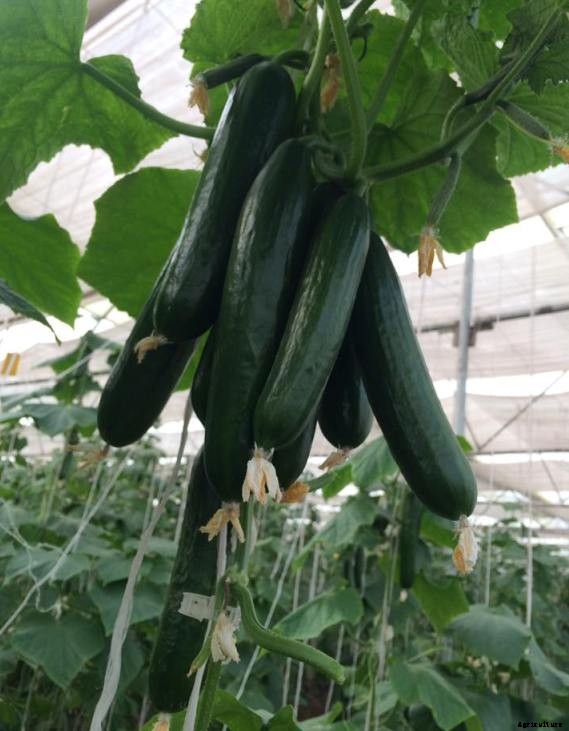
Once the plant has reached the overhead support it must be then trained so that most of the cucumbers will hang downwards, thus using your vertical space as efficiently as possible to obtain a bountiful hydroponic cucumber yield per plant.
One of the major Hydroponic cucumber problems is crooking, that causes cucumbers to develop a bend. Crooking is a physiological problem that results in cucumber fruit to develop a slight to pronounced bend, rather than the perfect long, straight shape. This is usually not a bigger issue for home growers, as it usually only reduces the aesthetic appeal and shape of the fruit thereafter affecting the consumer preference. Crooking can also be caused by an object such as training strings or leaf or stem interfering with the development of the fruits or due to feeding damage caused by insects such as aphids or thrips. In addition to this excessive moisture, High or low temperatures, poor nutrient solution supply or imbalances of essential mineral elements can also result in crooking.
You may also check How to Grow Tulsi in Pots at Home.
Some facts about Growing cucumber Hydroponically:
You might be thinking how long does it take to grow cucumbers in hydroponics, you can expect 5 to 6 weeks to get the first harvest after seed sowing.
The reason for cucumbers is not growing is the cucumber vines might be attacked by wilt diseases (Verticillium wilt, Bacterial wilt, and Fusarium wilt).
If your cucumber plant is turning into white, it might be due to powdery mildew disease which makes appears as white spots on the cucumber leaves. To treat the powdery mildew, you can use the mouthwash liquid.
If your cucumber seedlings turning yellow meaning that the plants are suffering from lack of fertilizers or micronutrients.
That’s all folks about ideas of growing cucumber hydroponically. Keep growing veggies without soil!.
You may be interested in Dragon Fruit Farming Profit.