
Welcome to Modern Agriculture!

Today, we are into a discussion of homemade hydroponic nutrient solution.
When Plants are grown in the soil they can easily get essential nutrients from the mother earth, but in a hydroponic system, you become the guardian. It’s up to you to make sure everything they require is in the nutrient mixture that you are providing that too in appropriate proportions so that you can witness their best yield.
Sure, you could just buy a premixed ready to use nutrient solution with one click, but what’s the fun in that?
Having a hydroponic garden is itself a reward and motivation. For managing your hydroponic garden relying on the readymade premixed nutrient solution is only a quick fix. To obtain a better yield from your hydroponic garden you need to understand what nutrients they need and most important when and how much they need? All you need is to have some time, the right procedure for making a tonic for your little hydroponic plants. And for this, we are here to tell what’s and how’s of making a nutrient solution.
So be ready for an easy and rewarding process of making own hydroponic nutrient solution at home.
Making your own nutrient solution allows you to fine-tune the level of each nutrient to your plants’ exact requirements, and you can save a lot of money in the long run. Preparing your own hydroponic nutrient solution is easy. It simply needs some preparation and a keen eye.
Before moving to full flash steps of making hydroponic nutrient solution first we need to understand what are nutrients? Why do plants require nutrients? What nutrients do? How do they work?.
So first you should know your plants, and know what and how much they need before you begin because each nutrient corresponds to a different function within the plant and also individual plant needs different types of nutrients.
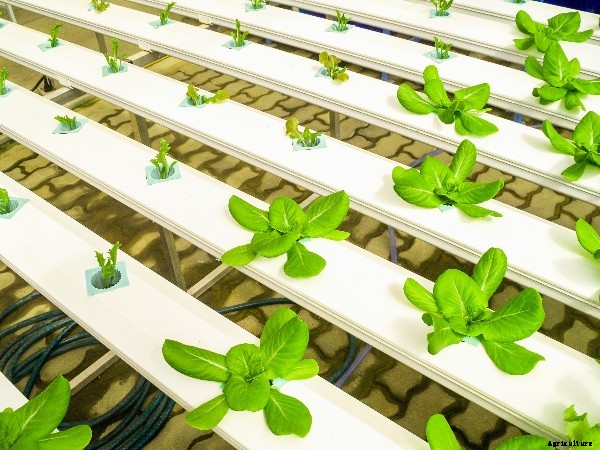
Plants require nitrogen, phosphorous, and potassium (N-P-K), and numerous trace elements for their growth and development. Nutrients are categorized into two classes on the basis of their amount required: macronutrients and micronutrients or trace nutrients. Essential elements categorized as macronutrients are elements that are used in higher concentrations than micronutrients. Even though micronutrients are used in lower concentrations, it doesn’t mean they are any less essential. There are six essential elements classified as macronutrients: nitrogen (N), phosphorus (P), potassium (K), calcium (Ca), magnesium (Mg), and sulfur (S). The eight essential elements categorized as micronutrients: iron (Fe), manganese (Mn), chlorine (Cl), boron (B), zinc (Zn), copper (Cu), molybdenum (Mo), and nickel (Ni). Collectively these 14 mineral elements make up the essential elements that are found in a complete hydroponic nutrient regiment necessary for the growth of plants. The liquid nature of the hydroponic nutrients allows them to be applied directly to the plant’s root system and nourish the plants under cultivation.
Read: How To Grow Vegetables in Terrace Garden.
All plants depend on the same type of primary macronutrients and micronutrients, but their concentration in solution will vary based on what you are growing. The ratios of the micronutrients, macronutrients and beneficial elements in a hydroponic solution will vary depending on a spectrum of factors. The type of crop, stage of growth and various environmental factors all come into play when fine-tuning a hydroponic nutrient solution. The hunt for a one-size-fits-all nutrient formulation has been largely indecisive. Although the following standard formulas are widely used:
The nutrient solution commonly famous as the “Hoagland solution” was formulated and published by D.R. Hoagland and D.I. Arnon in 1950. The duo measured the concentration of nutrients in a tomato plant (Lycopersicon esculentum) growing in a hydroponic solution. From that analysis, they determined which nutritional elements the plant drew from the solution and their function. The formulation is reasonably high in nitrogen and potassium, and it is mainly well-suited to large fruiting plants such as tomatoes and peppers (Capsicum spp.). Nutrient solutions based on the Hoagland formula are widely utilized by hydroponic growers.
For curious minds the recipe of Hoagland solution with nutrient solution composition is as follows:
Reference: Hoagland and Arnon, 1950
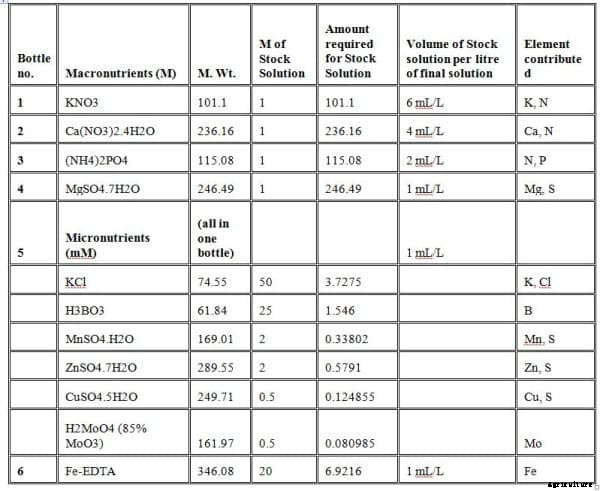
The procedure of making Hoagland solution as part of a homemade hydroponic nutrient solution:
Stock Solution
Read: A Guide for Starting a Hydroponics at Home.
Precautions to be taken when preparing Hoagland nutrient solution:
For stock solution
For a working solution
Rather than focusing on the nutrient uptake of a particular plant, Abram Steiner in 1968developed a formula for a nutrient solution with the conjecture that a universal proportion of nutrients would be most favorable for all plants. He explained that plants are capable to take whatever nutrients they require from a solution as long as the nutrients are available and that plants would pay out less energy absorbing nutrients when the nutrients are present already in an optimal ratio, which allows a more accurate control that offers potential for increased production and improved quality of plants under cultivation. Steiner solution provides a bunch of micronutrients suitable for foliage and flowering plants than a solution developed for fruiting plants.
Read: How To Grow Hydroponic Lettuce.


