
Welcome to Modern Agriculture!

Growing Dwarf Pomegranate Trees
Pomegranate fruit is one of the oldest known edible fruits and belongs to the family Lythraceae. In India, today Pomegranate cultivation is a highly lucrative and remunerative agriculture business. The Dwarf Pomegranate is one of the best compact and ornamental shrubs for small gardens. It produces breathtaking orange or red color trumpet-shaped flowers, followed by small 5 cm orange or red fruit. It is a dense, deciduous shrub with leaves that are dark with beautiful hues of bronze in the late autumn season. Its compact size makes it suitable for pots or containers. In regions with very cold winters, it can be brought indoors.
Regular Pomegranate trees can get tall, they are not ideal for indoors. This is why most people grow dwarf Pomegranate trees, which are smaller, and ideal for indoor spaces. This dwarf version will only reach 2 to 4 feet in height, therefore not taking up much space at all. In this article we also covered the below topics about dwarf Pomegranate tree;
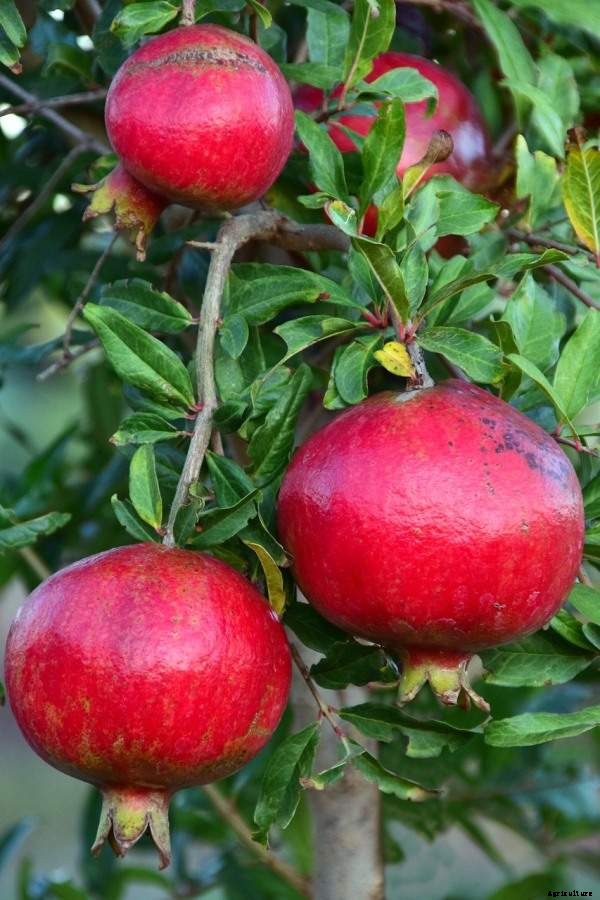
Normally, dwarf Pomegranate tree varieties are used as ornamental features in the home landscape and then produce edible fruit. Dwarf Pomegranates are ideal as a border or contrast planting for backyard space. The Dwarf Pomegranate tree is one of the most popular of all dwarf trees. Also, the dwarf Pomegranate tree is perfect for beginners as it stays naturally small.
The dwarf Pomegranate tree differs from the standard Pomegranate by its much smaller, glossy leaves about 1 inch/2.5 cm long, but especially dwarfs Pomegranate fruits, which are only the size of a golf ball. The shrub itself is not that dwarf though. It can easily reach 6 feet if left unpruned. Though, it responds well to pruning and so it kept between 2 to 3 feet in height. When growing a Pomegranate tree as houseplants by planting a dwarf Pomegranate tree, which reaches heights and widths of about 2 to 4 feet.
The flowers of dwarf Pomegranate trees are orange-red, with crinkled petals. The flower or fruit matures slowly, remaining on the Pomegranate plant for 6 months or more, it no longer looks as much like a flower, but has rounded out and is a fruit. The round fruits of Pomegranate trees are fully red a maturity, but they are not good to eat, without the sweet flavor of standard Pomegranate. Therefore, the fruits of the dwarf Pomegranate tree are essentially considered to be ornamental rather than edible.
The first step is to find the perfect Pomegranate tree variety. A regular Pomegranate tree can grow up to 30 feet tall whereas a dwarf Pomegranate tree only reaches about 2 feet. You can grow a regular Pomegranate tree indoors and then transplant it outdoors.
Dwarf varieties are small enough to be considered large shrubs and are best suited for container gardening. Some varieties are ornamental, so make sure you buy a variety that will produce fruit. For example, the ‘Wonderful’ variety is extremely popular and available in many garden stores.
Jyothi trees are dwarf and evergreen. Fruits remain small in size and the average fruit weight is 200 g. The rind develops a typical red color with pinkish-reddish colored arils.
The Nana dwarf variety of Pomegranate trees is one that’s known to have edible fruit. Some trees are more edible than others as some of the varieties have fruit that is meant to be more of an ornamental purpose. ‘Nana’ dwarf tree is an excellent choice for a container plant or in a mixed shrub or perennial border. Also, it is a nice choice to keep pruned as a bonsai specimen. This is easy to care for shrub is generally pest and disease-free.
The important dwarf pomegranate variety is ‘Nana.’ This tree grows compact, floriferous, and is considered robust and cold hardy. It grows in USDA Zones 7 to 11. The pomegranate tree grows up to about 1 meter tall as a container plant and forms orange to garnet red flowers that produce small fruits with viable seeds.
State Fair Pomegranate tree will grow to 5 feet tall and also produces many dwarf fruits (less than 2 inches in diameter). This selection is cold hardy and flowers profusely.
Provence – When most of the Pomegranate tree varieties are not much cold hardy, Provence variety is one you can look at. It can tolerate temperatures down to -15°C and can be grown in cold climate conditions.
Pomegranate production in India is about 8.07 lacs MT from an area of 109.2 thousand hectares. The major Pomegranate growing states in India are Maharashtra, Karnataka, Gujarat, Andhra Pradesh, Chhatisgarh, Himachal Pradesh, Nagaland, Orissa, Rajasthan, and Tamil Nadu.
Pomegranate can be grown under varied climatic conditions of the country and it performs better in semi-arid and arid regions.
The pomegranate tree thrives well in semiarid conditions. Deep loam to sandy loam soils is considered ideal for Pomegranate trees. It can tolerate alkaline/saline soils with a 9.0 pH level having lower EC than 0.5 mm hos/cm. It can grow in light soils but with assured irrigation and it requires hot and dry summers with cool winters.
It is tolerant to frost and freezes fairly well high temperature in summers and too low in winters encourages fruit cracking. Pomegranate has both types of cultivars like some are deciduous in winter and others are evergreen. The Pomegranate tree requires a hot and dry climate for the production of high-quality Pomegranates. The evergreen tree cultivars do not shed leaves in very cold winters.
Pomegranate trees are cold hardy down to approximately -10°C and will bear miniature fruits if grown in areas with year-round temperatures that rarely fall below -4°C. Grown in full sun, they will bloom when they are about 25 cm tall. Where the dwarf Pomegranate fruits do ripen, they are no less edible than full-sized Pomegranates from large shrubs or small trees. A good-quality and all-purpose potting mix are good for dwarf Pomegranates. Do not use garden soil for dwarf Pomegranates because it will become too compact in a container.


