Mango Tree Grafting, Pruning, and Training Techniques- A Beginner Guide:
The following information is about Mango Tree Grafting, Training, Pruning Techniques, and Tips.
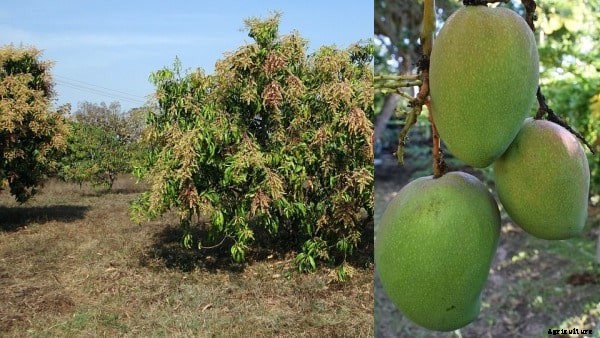
Mango is a tropical fruit. Mango trees grow in most landmasses along and near to the equator / Mango can be grown in almost all tropical regions. These trees are can be more profitable if cultivated under the following environmental conditions:
Mango Orchard.
The land elevation should be 600 meters above sea level, even the height of 800 meters is tolerable by the tree.
For producing more fruits, the mango trees need a completely dry period of 3 to 5 months for the fast maturing of vegetative parts and flowers. In case of any rains during the blooming period, will wash off pollen induces growth of pathogens (Anthracnose) which results in the dropping of both flowers and developing fruits. The development a mango needs plenty of sunlight up to 120 -135 days after the flowering period. Mango trees are biennials that produce fruits every two years. With the intervention latest cultivation methods, it can be made to bear yearly or even more often.
The ideal temperature for a mango plantation is around 21 to 37-degree C.
The Mango tree thrives well in deep loamy, soil rich in organic matter, and well-balanced macro and micro nutrient elements.
For healthy growth and fruit-bearing, a mango tree needs optimum moisture. Mango trees are successfully cultivated in areas where annual rainfall ranges from 500-2500 mm. For a profitable crop, the basic need is the distribution of rainfall rather than the amount.
The ideal pH levels of the mango tree are 6.0 – 7.0 or (5.5-6.5 pH). This promotes constant suppler nutrients to the roots of the trees. Mango trees are cultivated in a wide range of soils. For healthy growth of the plants, it needs well-drained soil with 2 M depth. Highly clayey and waterlogging soil is not suitable for mango cultivation.
The topography of Mango Plantation Land: the land should be flat to slightly sloping land, the soil should well-drained, and it should be able to hold the good required capacity of moisture. Even the stiff mountainsides are also opted for mango cultivation, but with difficulty in production management.
Mango trees should get a good amount of sunlight from morning to evening, from the top of its crown to the base of the trunk. Shading can affect its productivity. Even the Crowded branch and foliage can lower the fruit yields.
The trees should have moderate airflow or wind, aeration protects the trees from pest and diseases within the tree crown. The trees should not get strong winds mainly during the flowering and fruiting stage.
Avoid Areas Like:
The land at high altitude over 500 meters above sea level, cool temperature, humid condition, and rainy areas
Don’t choose the low-lying areas, valleys at the foot of hills and mountains where you don’t get a good amount of sunlight, no free flow of air, humid and too wet soils. Forest areas are also not recommended.
Propagation of Mango Trees:
Mango trees are grown from seed or though propagated vegetative. In vegetative, there are several methods. If trees are propagated from the seeds, it is an easy and cheap method. If a tree is propagated from seeds, we are unable to gain the character of parent trees, as the commercial varieties we get in the market are cross-pollinated. And growing a mango tree from seeds is highly time taking, and it is essential to raise seedlings for use as rootstocks.
Grafting is a method of vegetative propagation technique that multiple plants identical to the parent tree. Propagation is a method of raising new plants from a variety of sources like seeds, cuttings, bulbs, and other plant parts. Grafted mango trees are a quick process to start flowering and produce fruits.
Stone Grafting:
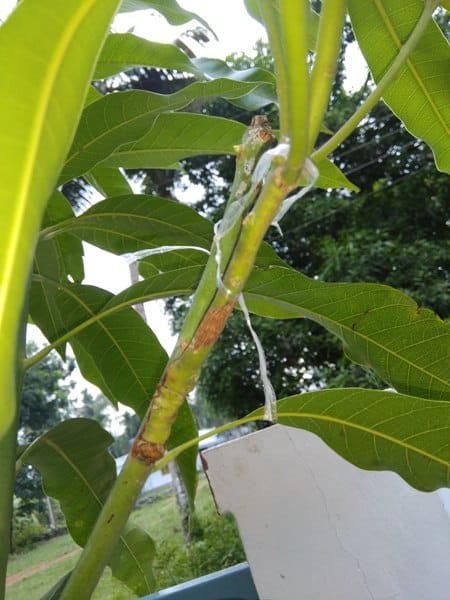
Stone grafting is very simple, low cost, and a quick method for the successful propagation of the mango tree. The percentage of success in this method is up to 75-80%. And in this, stones should be sown in June-July on raised beds. You should prepare the planting bed by mixing soil and FYM in the proportion of 2:1. After germination, seedlings with tender stems having coppery leaves picked along with stones still attached. Then these stones and roots are dipped in O.1 percent Carbendazim solution for 5 minutes after washing the soil. Then the stems of the seedling stems are headed back, leaving 6-8 cm long stem. Then a longitudinal cut is made to run down through the middle of the stem. You should make a wedge-shaped cut starting on both sides is made on the lower part of the scion stick. The age of the scion stick should be about 4-5 months and with a length of 10-15 cm long, containing plump terminal buds.
Now insert the scion stick is in the cleft of the seedlings and tied with polythene strips. The grafts are then planted in polyethylene bags with organic potting soil. Place the bags in the shade. The scion stars will sprout in 15-20 days after grafting. The month of July is the most suitable month for stone grafting.
This is another grafting method done when the rootstock is overgrown which is not suitable for stone grafting. In this method of grafting seedlings of 8-10 months old are opted, the grafting method is done on newly emerged flush. The scion wood should be defoliated 10 days prior to the grafting and has the same thickness as that of the terminal shoot. The method of grafting is like stone grafting. You can consider July and August as the best months for softwood grafting.
Inarching :
The inarching method is quite difficult and time-consuming, but this is highly used for the commercial propagation of mango plants. In this grafting method, we unite the shoot (scion) selected from the desired parent tree (mother plant) with the potted or transplanted seedling (rootstock) by grafting. In the inarching method, one-year-old seedlings of height 30 to 45 m with width 0.75 to 1.5 cm. You can grow the seedlings in pots or under the mother plant from which the grafts are to be prepared. You should select young and non-bearing trees as mother plants.
Collect a thin bark and wood, of length 5 cm and width 7.5 mm and with 2 mm deep, using a sharp grafting knife from the stem of the stock and from the scion branch. The cuts should be flat, clean, boat-shaped, even, and smooth. The cut’s end should be round and not angular. The cut surfaces of both (stock and Scion) are made to coincide facing each other so that there remains no hollow space between the two. Tie the strips of the union with Polythene/alkathene about 1.5 cm in width. After one month, give a ‘V’ shape cut every week for the Scion below the graft union and stock above the graft union so that the grafts get detached while giving the fourth cut. At the last stage, the top of the stock above the graft union will be detached completely. Inarching opted during the active growth period. The Ideal period for the inarching method of grafting is the monsoon in heavy rainfall areas and early monsoons in the light rainfall areas.
You may also check this: Button Mushroom Cultivation.
Veneer Grafting :
This method of grafting is the best for large-scale commercial propagation. The grafting method is simple, and you can have a good success rate. The rootstocks used for inarching are suitable for this grafting method. In this grafting operation, you should make a downward and inward 30-40 mm long cut in the smooth area of the stock at a height of about 20 cm. And at the base of the cut, a small shorter cut is made to intersect the first so as to remove the piece of wood and bark. The scion stick is inserted in a long slanting cut on one side and a small short cut on the other to match the cuts of the stock. The graft union is covered tightly with a polythene strip. And clip the rootstock in stages. The scion wood used for veneer grafting needs proper preparation. The desired shoots should be defoliated 10 days before the grafting process so that the dormant buds in the axil of leaves become swollen.
Planting a grafted mango seedling:
Mango trees are grown in all Asia and African countries, it serves in farmer family diets and also as a cash crop. In commercial mango plantations, both local and exotic species are cultivated for their sweet and aromatic fruits, mango is eaten fresh or processed into juice, jam, fruit leather, chutneys, or dried fruits. In areas of mango production, there is an increased demand for high-quality mango fruits for both domestic and export markets. Things to consider before planting a grafted mango seedling;
Make sure that there is enough space for planting the seedling preferably far from buildings and power lines, water pipes, or telephone posts.
Check the quality of soil conditions, fertility and the topography of the area selected fits the
mango variety to be planted, and Make sure that there is adequate sunlight exposure to the mango seedling planted.
Mango Tree Pruning:
Pruned Mango Tree.
Mango trees don’t need pruning annually for increasing flowering or increase yield like other deciduous fruit trees. Mango trees are terminal bearers, and the flowers grow on the mature wood. Pruning at the wrong time can give you a detrimental effect. Pruning will help stimulate shoot development in mango trees, which results in vigorous vegetative regrowth. Constant pruning can lead to no fruits for two to three years. Pruning mainly done to shape out the trees and open up the centers, it promotes the free movement of air and sunlight into the tree. And also facilitates the penetration of sprays through the trees and making control of pests and diseases much more efficient. The penetration of sunlight to the tree enhances the color of the fruit and improves quality.
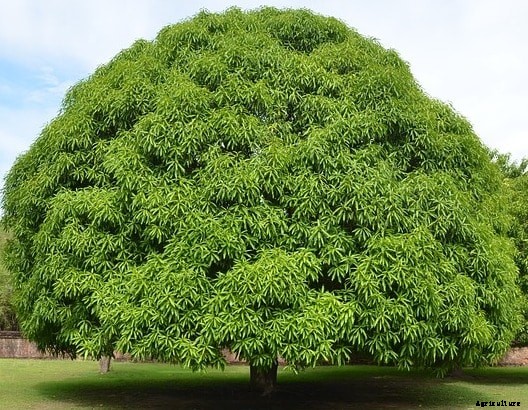
There are no rules and regulations for pruning mango trees. The main objective of pruning mango trees is to develop a good tree structure that meets all the above requirements and facilitates the harvesting and movement of machinery through the orchard. The ideal mango tree should have three and not more than four main trunks, be open inside and low-set. Over this height harvesting becomes difficult.
Pruning in Young Mango Trees:
In young mango trees, the early stages of growth are most important for the initial shaping of the young tree. A well-structured tree will give you a heavy crop, with easy spraying operations, and makes the fruits to get exposed to plenty of light leading to a good blush on the fruit at maturity. Young mango trees will grow to over 1-meter height before they get the branches. For a strong trunk, the trees should be allowed to grow to over 1 meter in height at the initial stage. Then cut back stem to a height of 0.6 to 0.7 m. The point of the first cut will point to the development of a strong frame. Mangoes grow in flushes; each flush is outlined by a concentrated whorl of leaves on the stem. Which is referred to as a “ring of buds”, as a bud capable of forming into a branch is situated at the base of each leaf. If you prune above the “ring of buds” that results in regrowth of seven or more shoots. These can then thinned for three or four to get a good tree structure. Pruning will make the branches well-spaced out up the trunk and only three shoots will normally develop, which results in a strong frame for future development. After the initial cut, leave the three shoots to grow into branches up to 1 meter long. Then cut them back about a meter in length, which will give you a good strong branch for supporting the growing tree.
It is important to note that the cut should be below the “ring of buds” so only three shoots will develop. Pruning should be done carefully in the case of young developing trees. Young trees are pruned at any time of the year. The main aim of pruning is to develop a spreading tree rather than a tall tree. Downward and inward growing branches or branches that cross over are also pruned.
Pruning Fruit Bearing Trees.
Pruning in Fruits Bearing Mango trees:
Mango trees don’t require pruning every year. Pruning depends on several factors. Mango trees will respond to the pruning by growing a vegetative flush, the heavier the pruning the more vigorous and numerous the flushes. And mango trees are terminal bearers, they develop flower at the ends of the branches and blooms are produced only on mature wood, means on the shoots that are six weeks or older. Mango trees do not have vegetative flushes near flowering time, which is usually done at the end of May into June. If you are planning to prune the mango trees, there are two main times when this should be done.
First Pruning- this is done after harvesting, and it should be completed by end of December.
Types of pruning :
Skirting: In this type of prune, we should remove low-hanging branches, these branches will interrupt the orchard operations such as fertilizer application and under tree spraying for weed control.
Opening up: In this pruning method, they remove branches inside the tree which cross over or clutter up the center of the tree restricting the penetration of fertilizers.
This method includes the removal of any diseased or dead branches in the tree, which could be a source of infection.
Second Pruning during Pre-Flowering:
The second section of pruning takes place in the middle of May and, which is followed by a floral rather than a vegetative flush. If this process is done too soon or too late after flowering has commenced, leads to loss of vegetative flushing. The time span for section pruning is limited to a quite short period of about two to four weeks.
Skirting: We should prune the low hanging branches, which may cause fruit to drag on the ground, make them unsaleable.
Opening up: We should prune the twigs and branches cluttering up the inside of the tree, as well as open up the top. This method facilitates spray penetration for better control insects and diseases and increases the light flow into the tree, improving fruit color.
Tip Pruning: The pruning of tips is recommended for the trees that have a vegetative flush just prior to flowering. Those young flushes are tipped to mature wood, then the resulting flush should be floral. This process’s main advantage is to reduce tree size, by cutting back two or even more flushes.
Reducing tree size: For reducing the size of the trees, you should cut back the back large limbs. The large size of trees risky with mangoes as they take two or more years’ production, depending on the amount cut back. If you cut the branches at right time, the flowers will develop on even large branches which have been cut back. For reducing or spreading the risk, cut back only one or two branches, each year, or cut back one side only per year. The second pruning is the best one for the major cutting back.
Hygiene: Hygiene is the best source to control flower and fruit infections. Any diseased or dead branches should be cut before the flowering period starts.
Rejuvenating the Mango Trees:
Commercial Mango Production.
Harvesting old trees can be a difficult task, the reason can be due to their size, and can have a build-up of pests (mainly scale) and disease as it is difficult to reach the whole tree to control the pest and diseases. So it’s best to cut the trees back to a more manageable size, based on the severity of the pruning you may lose as many as three crops. But the fruit production will improve together with fruit size and quality, once trees are recovered. With large, vigorous trees which are too high the cutting back can be done in two stages. First, the tall central trunks are cut back to about 3-4 m. The actual point to cut back will be the point where there are side branches. You should use a bow or a chain saw for this job. To cut back one-half of the tree, the remaining trunks and leaves will help protect the stump from sunburn. And freshly exposed trunks and branches to the sun are painted with white water-based paint diluted three or four times to protect them from the sunburn, which could bring on a borer attack to the damaged bark. And within no time numerous shoots will develop; select the most vigorous of these, and remove all the other shoots. Repeat this process as often as necessary until the selected shoots begin to dominate and take over.
Mango Tree Pruning Tips:
Old, unthrifty trees should be rejuvenated by moderate to severe pruning. This process of skeletonizing the tree means the cutting back the branches of the tree should be done until the basic frame is left.
In Moderate skeletonizing would the large branches are cut back to healthy wood, and as we should maintain the basic structure of the tree. In case of large unthrifty trees would benefit from severe skeletonizing, in this process all the main branches are cut back to the main trunk just leaving about a meter or so of the branch. The whole trunk and remaining branches should be painted with diluted paint to protect from sunburn and borer attack.
While cutting through larger branches with a saw, always cut 20-40 mm into the underside of the branch before cutting all the way through from the top. This gives a clean cut and prevents the branch from tearing away as the cut reaches the end.
Large upright branches and trunks should be cut on a slight angle to prevent water from sitting on the cut surface with the potential to cause rotting.
Large branches and main trunks should be cut off in sections, so that in one cut where they could fall onto branches below and damage them.
In case if you miss this: Rooftop Farming Procedure.
Mango Tree Pruning Tools:
Secateurs: These tools are handy for tip pruning and cutting outshoots and suckers. They should always be kept sharp. And they should be cleaned regularly, and a drop of oil prevents the blades sticking and rusting. A good pair of shears can cost a few dollars more, but are usually more robust and stay sharp longer.
Tlopping Shears: These tools are used for removing quite large branches, up to 50 mm in diameter. There are two types, one has a cross for over-cutting action where the blade is curved and passes across a cutting plate. Second is prone to splaying if used on very big branches. The other has an anvil type cutting action, the blade is straight and cuts down onto a cutting plate/anvil. This type is more robust and can cut through larger branches by taking two or more cuts.
Pruning Saw: This tool can cut through large branches and trunks up to 150 mm in diameter. These have a narrow, slightly curved blade, which enables them to be used in quite restrictive situations such as narrow forks of trees. Some companies’ blades are designed to fit into a long handle that helps the user to reach higher branches in the tree.
Training in Mango Cultivation:
Training is the best practice in which tree growth is given a desired shape and form.
Training young fruit trees is highly essential for proper tree development. It recommended directing tree growth with training than to correct it with pruning.
Training includes summer training and summer pruning and dormant pruning.
The main goal of tree training is to direct tree growth and minimize cutting.
Objectives of Mango Tree Training:
The main objective of training is to provide more sunlight and air to the center of the tree and to expose the maximum leaf surface to the sunlight.
It directs the growth of the tree, so that various cultural operations, like spraying and harvesting, are performed easily at the lowest cost.
This process protects the tree from sunburn and wind damage.
Training helps to secure a balanced distribution of fruit-bearing parts of the main limbs of the plant.
The principle of Mango Tree Training:
The main objective of training a young tree is to develop a strong framework of scaffold branches. All the training methods must stand or fall by their ability to make a tree capable of bearing high yielding fruits without undue breakage.
Training Systems in Mango Trees:
Central Leader
Open- Centre
Modified Leader
Central Leader System
In this system, the main trunk extends from the soil surface to the total height of the tree.
There will be many side branches growing at different heights in various directions.
Advantages of Central Leader System:
The trees grown with this system, are structurally best suited to bear crop load and to resist the damage from strong winds.
Disadvantages of Central Leader Systems:
Trees grown in this system, grow too tall and are less spreading.
Tree management works like spraying, pruning, thinning and harvesting is tough.
There can be a problem of Shading, that effect on the interior canopy (the lower branches of such trees may be so much in the shade that the fruit may not be able to develop proper color).
Open Centre System
In this system, the main trunk can grow up to 1.0 m by cutting within a year of planting.
There will be 3-5 lateral branches that are allowed to develop from the short main stem.
This system is widely used for peaches and is good for mechanical harvesting.
Advantages of Open Center System:
In this system, the trees so trained that allow maximum sunshine to reach their branches.
Trees grown in this system have the best coloration of fruits on the interior side of the tree.
Trees grown in this system produce more fruits and are low spreading, will facilitate the operations like spraying, pruning, thinning and harvesting.
Disadvantages of Open Center System:
Trees grown in this system are structurally weak, and their limbs are more likely to break with crop load and strong winds.
Modified Leader System
This system is most acceptable for commercial mango plantations.
This system gives the best results when compared to the central leader and open center systems.
In this system young tree is grown until it reaches the height of 2-3 m and then the growth is restricted.
Laterals are grown in a spiral fashion, up the central trunk and are cut until the proper number and distribution of branches have been obtained.
Advantages of Modified Leader System:
In this system, the branches are well distributed, and they get allowing plenty of sunshine to complete tree.
Trees grown in this system are structurally strong and not prone to limb breakage.
In this system, trees are grown to the limited height of trees, spraying, pruning, and harvesting may be done easily.
Training Systems of Training Dwarf Trees:
Spindle Bush: This system is a modification of the dwarf pyramid or works as an intermediate between a vertical cordon and a bush form.
This system differs from the dwarf pyramid in no specific arrangement of scaffold branches and from the vertical cordon in which the fruit is borne on shorter branches rather than directly on the main stem or trunk.
The main features of this system are to tie down of lateral shoots in a horizontal position with low or no summer pruning.
The tree is trained with or without the support of posts with a central leader straight and with many small fruiting ranches.
These branches of trees are bent out and down by spreaders to develop wide crotches and to induce early fruiting.
Tree spread is controlled by pruning the shoots to ½ to ¾ of their length or back to weak laterals.
Dwarf Pyramids: this system trains a tree with a central stem about 2.5 m tall with short branches radiate in successive tiers to build a pyramidal shape is build up.
The tree develops fruiting spurs on the short branches.
Summer pruning is a major action of success with dwarf pyramids.
Cordons: the trees grown in this system are single-stemmed trees. This system is rarely used for commercial fruit production. Cordon systems are vertical, oblique or horizontal.
Vertical cordons: In these systems, trees are trained erect and grown to a height of 10-12 feet and the first fruiting wood developed at about 30 cm. from the ground
Oblique cordons: In this system, trees are trained at the 45-degree angle.
Palmettes: this system refers to the shape of a palm leaf.
In this system, trees are formed by developing lateral scaffold branches from the trunk beginning at 30 cm above the ground.
These laterals are in pairs and are equally balanced in opposite directions.
There are four types in this system: Horizontal, Oblique, Candelabra, Fan Palmette.
Espaliers: like Kniffin system of training grapes.
This system uses trellis about 5 feet high with either 2 wires at 3 feet and 5 feet OR 4 wires at 2,3,4, and 5 feet.
In case if you are interested in this: How To Grow Organic Lettuce.