
Welcome to Modern Agriculture!

Today, we are discussing Pomegranate Farming Techniques, Planting Methods, and Varieties.
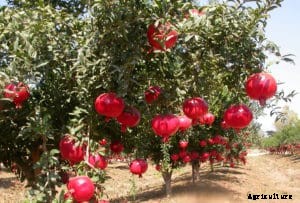
Pomegranate is one of the commercial fruit crops of India. It is native to Iran (Persia). Pomegranate is known as a drought-tolerant crop, yet regular irrigation is mandatory to commercial yield production. Water levels and optimal irrigation regime depend on a plurality of factors as soil type, tree size, physiological phase, and potential evaporation. As a rule, the tree needs little supplemental irrigation. The commonly used irrigation regime in pomegranate orchards relies mainly on the experience gained by growers and less on formal experiments.
Pomegranate prefers a dry climate. During fruit development, a prolonged hot and dry climate is required. The optimum temperature congenial for fruit development is 38°C. In a humid climate, the fruits are severely damaged by the pomegranate butterflies and do not develop sweetness. It is winter hardy and very drought tolerant. It can grow up to an elevation of 1850 meters.
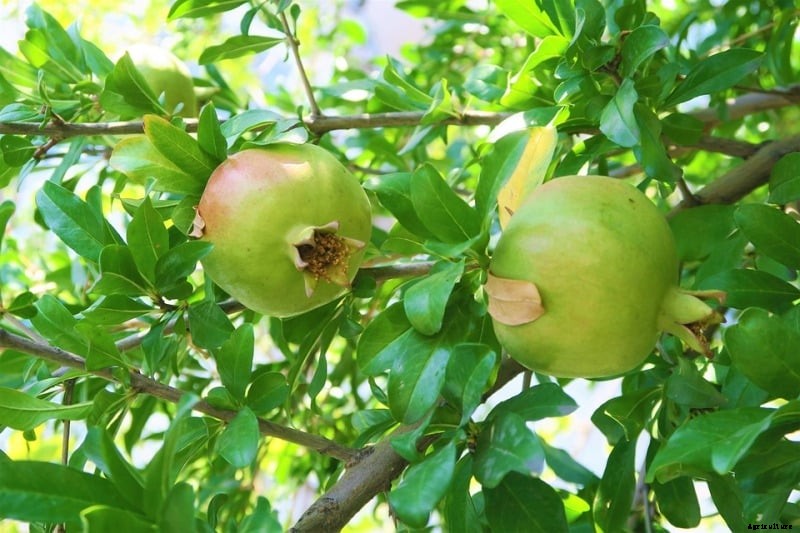
Pomegranate grows well under semi-arid conditions and can be grown up to an altitude of 500 m. above m.s.l.. It thrives well under hot, dry summer and cold winter provided irrigation facilities are available. The tree requires a hot and dry climate especially during fruit development and ripening. The Pomegranate tree is deciduous in areas of low winter temperature and evergreen or partially deciduous in tropical and sub-tropical conditions. It can tolerate frost to a considerable extent in the dormant stage but is injured at a temperature below -11°C.
It grows under a wide variety of soils and can tolerate even alkalinity and salinity to a certain extent. However, the best results are obtained in deep heavy loam and well-drained soils. It is sensitive to soil moisture fluctuations causing fruit cracking which is a serious problem of this crop. Well-drained, sandy loam to deep loamy or alluvial soils is suitable for Pomegranate Farming.
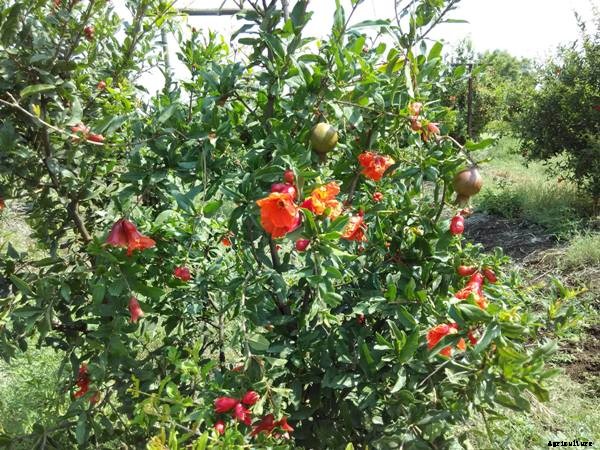
In recent years, several new varieties have been developed and new orchards have come with well-known improved varieties.
Ganesh :
This is a selection from ‘Alandi’ developed by Dr. Cheema at Pune which has revolutionized the cultivation of pomegranate in Maharashtra state. This has soft seeds and pinkish flesh with a juice of agreeable taste and bears heavily.
Dholka :
The popular variety of Gujarat with fruits of large size, rind greenish-yellow, flesh aril pinkish-white seeds soft, juice acidic. It is a medium cropper.
Jodhpur Local :
Medium-sized fruit with a hard rind, fleshy aril light pink, sweet, juicy, seed moderately hard.
Seedless (Bedana):
Fruit medium to large in size, rind brownish-green, fleshy aril light pink or whitish, very sweet, very juicy, soft seeded. ‘Bassein seedless & KVK – 1’ are from Karnataka and ‘Jalore Selection’ are popular names in north India. In South India, ‘Paper Shell’, ‘Spanish Ruby’, ‘Muscat Red’ & ‘Velladu’ have shown promise.
Other pomegranate varieties:
cultivated in India are Alandi or Vadki, Kandhari, Kabul, Muskati Red, Paper Shelled, Spanish Ruby, G 137, P 23, P 26, Mridula, Aarakta, Jyoti, Ruby, IIHR Selection, Yercaud 1 and Co 1.
Vegetative propagation is recommended in establishing pomegranate. Propagation by cuttings is common. Cuttings should be taken from suckers which spring from the base of the main stem and should be mature about 20 to 30 cm long and 6-12 mm thick. The rainy season is the best period to achieve maximum success.
The land is prepared by plowing, harrowing, levelling, and removing weeds.
Pomegranate is propagated vegetatively by cuttings, air layering, or Gootee.
Air layering is usually done during the rainy season and also in November-December. Planting is usually done in spring (February-March) and July-August in sub-tropical and tropical regions respectively.
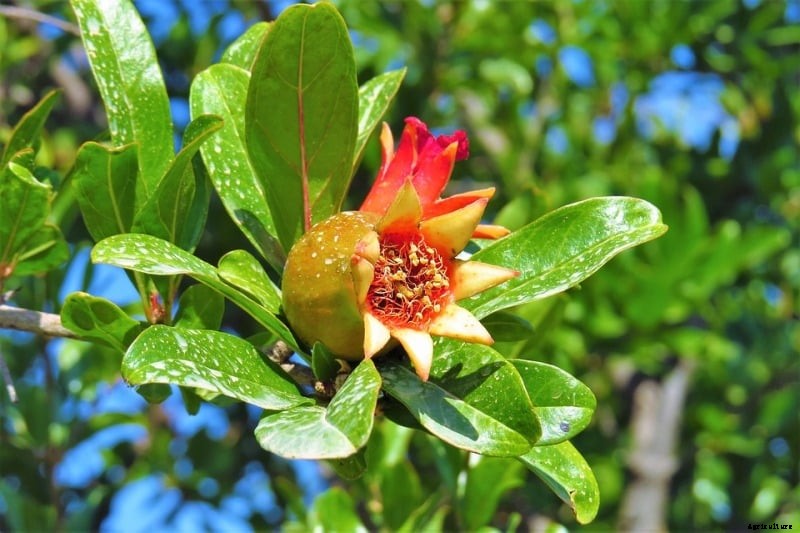
High-density planting is adopted in temperate regions. A spacing of 5-6 m. in northern India and also in the plains of the Deccan plateau is usually followed. High-density planting with a spacing gives 2 to 2.5 times more yield than that obtained when the normal planting distance of 5 x 5 m. is adopted. Farmers have adopted a spacing of 2.5 meters x 4.5 meters. Closer spacing increases disease and pest incidence.
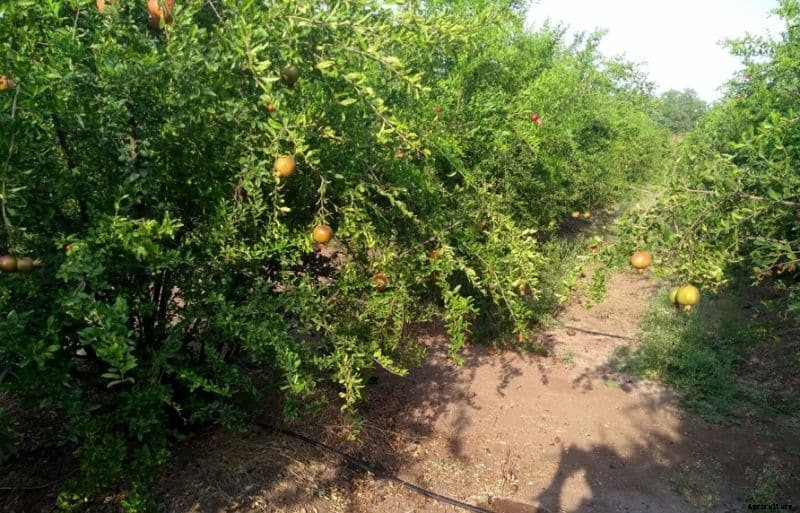
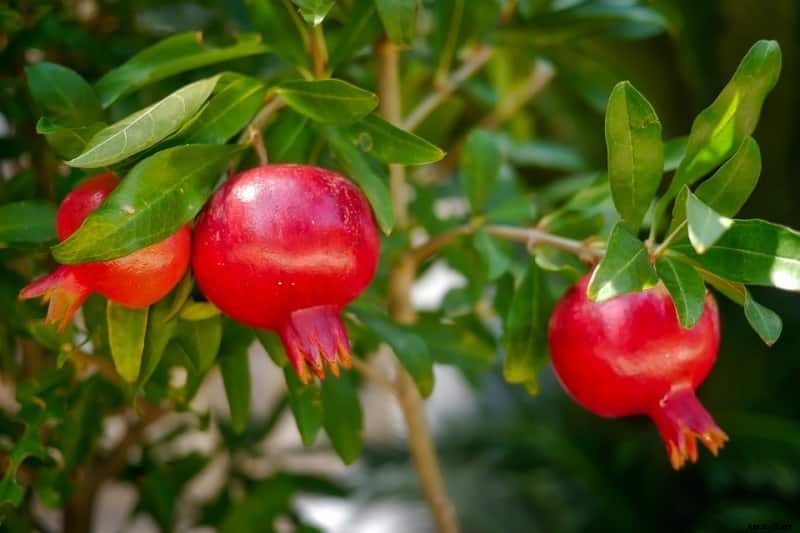
In Pomegranate Farming, Pomegranate butterfly and bark-eating caterpillar are the common pests of Pomegranate.
The fruits are susceptible to fruit fly which needs to be controlled from flowering to button stage. At this stage spray of Sevin (carbaryl) 0.2% (200 gm/100 liters or endosulfan 0.05% at 10 days interval alternatively, must be given.
Fruit spot and fruit rot are the common fungal diseases for which proper and regular spraying is made.
Read this: Growing Pomegranate In Containers.
Fruit cracking is a most serious physiological disorder in pomegranate which limits its cultivation. In young fruits, it could be due to boron deficiency but fully grown fruits crack due to moisture imbalances as there are very sensitive to variations in soil moisture and humidity. Prolonged drought causes hardening of peel and if this is followed by heavy irrigation or downpour then the pulp grows and the peel cracks. This problem can be overcome by
Irrigation maybe given depending on soil, climate, and availability of water. First irrigation is provided in case of mrig bahar crop in the middle of May followed by regular irrigation till the monsoon sets in. Weekly irrigation in summers and that during winters at fortnightly intervals is recommended. The check basin system of irrigation is usually followed. The average annual water requirement through drip irrigation is 20 cm. Drip irrigation helps to save 44% on irrigation and 64% when sugarcane trash mulch is used. It also helps to increase the yield by 30-35%.
Read about How To Perform Cleft Grafting.
Inter-cropping with low-growing vegetables, pulses, or green manure crops is beneficial. In arid regions, inter-cropping is possible only during the rainy season, whereas winter vegetables are feasible in irrigated areas.
Pomegranate plants to flower and provides fruits throughout the year in central and southern India. Depending on patterns of precipitation, flowering can be induced during June-July (mrig bahar), September-October (hasta bahar), and January-February (ambe bahar). In areas having assured rainfall where precipitation is normally received in June and continues up to September, flowering in June is advantageous; where monsoon normally starts in August, flowering during August is beneficial. Areas having assured irrigation potential during April-May, flowering during January can be taken and where monsoon starts early and withdraws by September induction of flowering in October is possible. Considering comparable yields, prices and irrigation needs it is recommended that October cropping could be substituted for January flowering.
Pomegranate flowers take 5 to 6 months to be ready as mature fruits. They should be harvested mature which can be judged by the change in skin color to slightly yellow and metallic sound when tapped. A grown-up well-kept tree should give about 100 to 150 fruits per year. A high-density system with ‘Ganesh’ 1000 plant/ha (5x2m) has been found very profitable giving a crop of 50 fruits/tree of good quality.
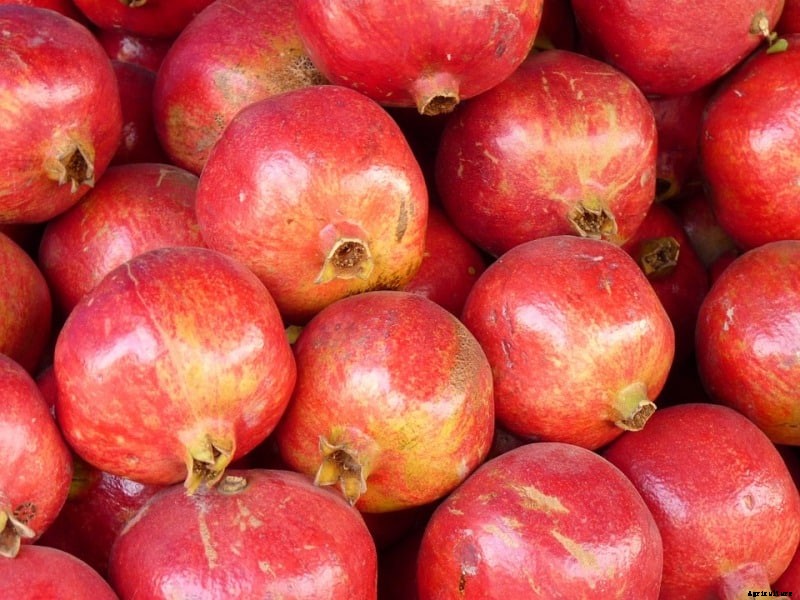
After harvesting, fruits can be cured in shade for about a week so that the skin becomes hard and fruits can stand transportation better. Thereafter, the fruits can be graded according to weight
Cured fruits have good keeping quality which can further be prolonged through cold storage. When stored at 00C to 4.50C with 80%. Relative Humidity fruit remains safe even for seven months.
The majority of the producers sell their produce either through trade agents at the village level or commission agents at the market.
That’s all folks about the farming of pomegranate fruit techniques, ideas, and tips. Keep growing fruits!.
Read this: How to Grow Cauliflower in Containers.


