
Welcome to Modern Agriculture!

Today, we discuss the topic of growing Cardamom. We also cover the cultivation practices of Cardamom which include the planting of Cardamom, Cardamom plant care, Harvesting procedure. Why wait, let us dive into the profitable commercial Cardamom farming.
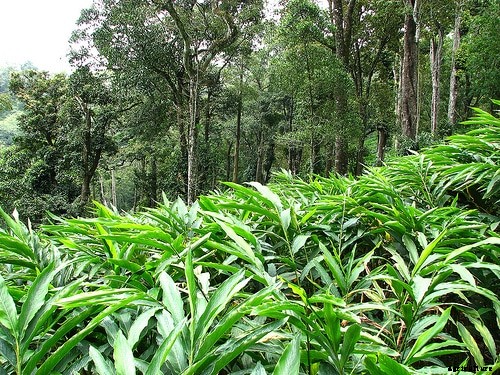
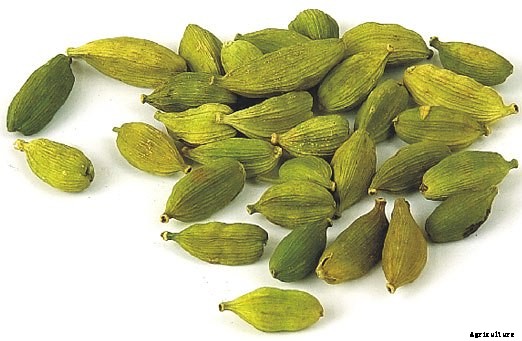
Cardamom popularly known as “ILAICHI” or “ELAICHI” in India and referred to as ‘Queen of Spices’. It is actually a dried fruit of a tall perennial plant. It is part of the ‘Zingiberaceae’ family. In India, Cardamom is cultivated in Karnataka, Kerala, and Tamilnadu. Because of its aroma and flavor, Cardamom is one of the most expensive spices in the world. India is one of the biggest producers of cardamom in the world. The useful part of cardamom is the dried mature fruit. It is usually termed as a capsule. Cardamom is used for flavoring cakes, curries, and bread and for other culinary purposes. It is also used as a masticatory and for flavoring coffee and confectionery.
Some of the health benefits of Cardamom are listed below.
Elakulu[యేలకులు] (Telugu), Elakka [ஏலக்காய்] (Tamil), Elakki [ಏಲಕ್ಕಿ] (Kannada), Elakkay [ഏലക്കായ്] (Malayalam), Ilaychi [इलायची] (Hindi), Velchi [वेलची] (Marathi), Elachi [এলাচি] (Bengali).
Below listed are some of the commercially cultivated varieties of small Cardamom in India.
You may also like Biogas Production Process.
Cardamom plants are naturally seen in the Western Ghats hilly tracts. Commercial farming of Cardamom is found in the Western Ghats as this area is more suitable for its cultivation. Ideal temperature range for this crop is 10° to 35°C. Small cardamom is well grown in areas where annual rainfall of 1,500 mm to 4,000 mm is received. This crop can be grown about 600 m to 1,500 m above the sea level.
Small Cardamom is usually thrived well in soils with rich in organic matter. The best-suited soil for small Cardamom commercial cultivation is loamy soils rich in humus. Ideal soil PH range of 4.5 to 7.0 is best suited for Cardamom plants growth.
Small Cardamom is mainly propagated by seeds and vegetative propagation. Vegetative propagation is best compared to seed propagation. In vegetative propagation, the suckers free from diseases and pests are normally used. In commercial cultivation of small Cardamom, micro-propagation using tissue culture technique can also be practiced. Small Cardamom seedlings are raised in nursery beds for 10 to 18 months and they should be moved to main field plantation.
The main field is prepared by supplementing with organic matter and clearing all undergrowth. Dig Pits of 45 × 45 × 30 cm in size in April to May season and fill with a mixture of topsoil and well rotten Farm Yard Manure or any compost. If the field is sloppy, contour terraces should be made and pits should be taken along the contour. Preferred spacing for contour Cardamom planting is 2 × 1 meters while for Malabar type, spacing recommended in rows in Karnataka is 2 × 2 meters between plants. In Kerala, a spacing of 2 m to 3 meters from row-to-row and plant-to-plant is adopted.
The best time for planting cardamom is in monsoons i.e. from June to July. Light drizzles and cloudy days best suited for its planting. One mature sucker along with a young growing shoot should be planted in a prepared pit. After planting Cardamom, pits are filled with soil and base is covered with mulch. Care should be taken while planting seedlings, to avoid deep planting. Seedlings can be planted up to collar region in the pit. The Cardamom seedlings can be by stakes and mulch. If you are considering tissue culture seedlings, hardened plants should be planted in the main field.
Organic matter like compost or cattle manure (cow dung) may be given at 5 kg per clump. Neem oil cake may be supplemented at 1kg per clump.
Recommended fertilizer NPK dose is 75:75:150 kg/ha. Application of lime enhances nitrification and corrects soil acidity, resulting in good plant growth. A fertilizer NPK dose is 120:120:240 kg /ha to the high-density Cardamom planting of (about 5,000 plants/ha) is recommended for Karnataka, whereas an NPK dose of 30:60:30kg/hectare is usually recommended in Kerala. For the split application of fertilizer, Under the rainfed condition, fertilizer can be applied in 2 splits. The first application of fertilizer helps in capsules development and in the production of suckers, whereas the second application helps in suckers and initiation of panicles. In an irrigated condition of the plantation, fertilizer application in four split doses at a quarterly interval is beneficial. Avoid applying fertilizers in heavy rains.
You may also check Solar Subsidy and Loan Schemes in India.
3 to 4 rounds of weeding is required in May to June, Aug to Sept & Dec to Jan. Plants shade should be regulated when needed. Cardamom plants base should be mulched on a regular basis. Panicles exposing over the mulch would be beneficial for bee pollination. Removal of old and drying shoots should be carried out once in a year with monsoon under the rainfed conditions and 2 to 3 times in high-density Cardamom plantation provided with alternate irrigation facilities.
Before planting of Cardamom, fast-growing shade trees like balangi, cedar, and elangi should be planted in the main field. To provide sufficient light during monsoon, shade should be regulated in May before the monsoon arrives. 2 – tier canopy is beneficial with a height max of 3 meters between the lower and higher canopy.
Frequent watering 1 week to 2 weeks interval is required during the hot summer months. Regular watering (25 mm to 38 mm/irrigation) helps in panicles initiation, the flowering of plant and fruit set. Make sure the soil has enough moisture level all the time(at least 45–50%). Overhead irrigation process/method is best suited to Cardamom plantations. Drip irrigation also found beneficial in the Cardamom crop.
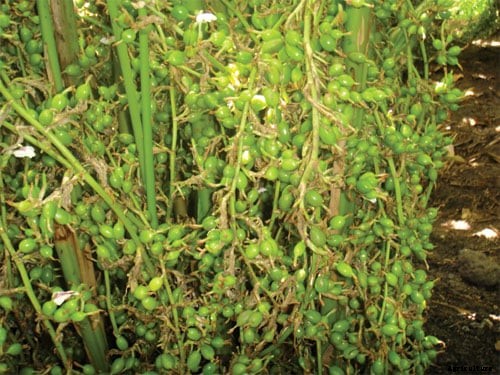
Cardamom plants start bearing the fruit in the 2nd or 3rd year of plantation. The fruits would mature @ 35 to 45 days intervals, with 5 to 6 pickings. Normally harvesting season for Cardamom is from October to November. In Tamil Nadu and Kerala, harvesting starts from Aug to Sept and continues till Feb to March. In Karnataka, it starts in July to Aug and continues up to Dec to Jan. When fruits are in the ripped stage, capsules should be harvested. Over-mature Cardamom fruits split on drying floor, whereas the unripe cardamom fruits shrivel on drying.
An average yield of dry cardamom capsules from a well-grown plantation would be around 450 to 500 kg/ha. Yield may vary from soil to soil and type of Variety.
Both machine drying and sun drying methods are practiced. After harvesting, Cardamom capsules are dried either in the sun or electrical or fuel kiln. Soak harvested green cardamom capsules with 2 % washing soda solution for 10 minutes to retain the original green color. Sorting and grading are done based on the size and color of the dried Cardamom capsules. Graded capsules should be stored in black polythene lined gunny bags to maintain the green color during storage. These bags should be kept in wooden chambers.
Can transport to local markets or Cardamom dealers.
That’s all folks about the techniques of Cardamom farming in India. Keep growing spices!.
You may be interested in Growing Hydroponic Coriander.


