
Welcome to Modern Agriculture!

Today, We learn the information about Betel leaf farming, planting methods, betel leaf plant care, and harvesting procedure. We also go through the different cultivation practices of betel leaf crop for maximum profits.
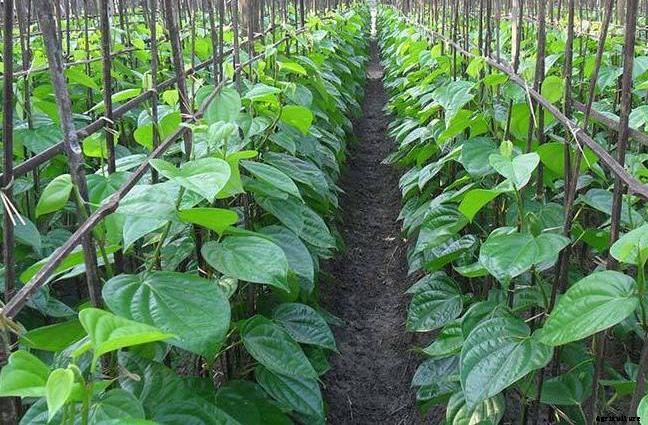
Betel leaf popularly known as “Paan” in India and the betel vine leaves are in deep green color with heart shape which is widely used in India and the scientific name of betel vine is Piper betleL. Paan belongs to the family of Piperaceae. There are more than 90 varieties of betel vine in the world, of which about 45 are found in India and 30 varieties in West Bengal itself. Betel leaf is grown in tropics and subtropics for its evergreen leaves that are used in Pooja/religious events and as a chewing stimulant.
Betel leaf is grown as a cash crop in southern parts of India, mostly in the states of AP, Telangana, Karnataka, Kerala, and Tamil Nadu. Betel leaf is also cultivated in Bihar, Assam, Madhya Pradesh, Orissa, Maharashtra, Tripura, Uttar Pradesh, and West Bengal. Paan / Betel leaves have good export potential and India exports betel leaves to the neighboring countries.
You may also like Bottle Gourd Farming, Planting, Care, Harvesting.
Some of the health benefits of betel leaves are.
Tamalapaku (Telugu), Vetrilai (Tamil) , kavala (Kannada), Beeda/Paan (Hindi), Vidyache paan, Naginiche paan ( Marathi), Vettila (Malayalam). Paan (Bengali), tamul (Assami), and Naagarvel na paan (Gujarati).
Below are some of the commercial varieties of Betel leaf or Paan cultivated across India.
Betel leaf grows very well in a tropical climate with high rainfall and shady places are the best for its vigorous growth.
Betel Leaf or Paan can be grown in a wide range of soils such as sandy loam, heavy clayey loam. Supplementing the soil with good organic matter results in best growth and higher yield. Soil should have good drainage as well. Land should be raised by 5 to 10 cm from the adjacent areas and soil should be prepared by 4 to 5 ploughings, providing proper drainage. Afterward, field beds of sizes (15 cm height and 30 cm wide) are prepared. Soil should be sterilized thoroughly before planting the betel leaf cuttings.
You may also be interested in Vegetable Farming in India for Profits.
when the soil temperature rises during the months March to May, the soil is covered by polyethylene sheets in order to eradicate the inoculum of soil-borne pathogens. Application of neem cake (0.5 tonnes/ha) or carbofuran @ 1.5kg/ha Plus carbofuran (0.75kg/ha) is also preferred to minimize early soil nematode population for new betel plantation. However, carbofuran should not be recommended or preferred in established betel plantations at any stage, because a time gap of 65 to 75 days as the safe waiting period is mandatory between the harvesting of betel leaves and the application.
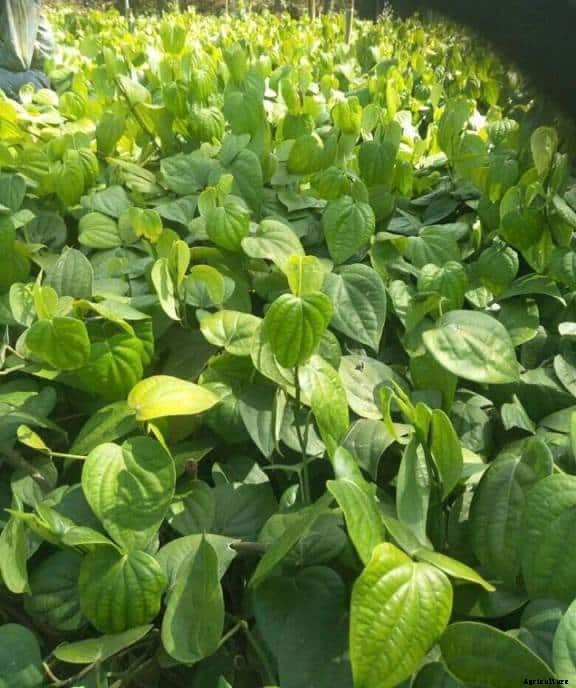
October month is best betel leaf planting season under open system cultivation. The monsoon season is ideal for planting betel leaves plants under closed system cultivation. However, planting season of betel leaves varies from state to state in India.
In betel leaf propagation, stem cuttings having 3 to 5 nodes are used and these are planted in such a fashion that 2 to 3 nodes are buried in the soil. A single node cutting with a mother betel leaf is also planted. Apical and middle portions cuttings of the betel vine are used for planting. There are 2 types of betel leaf cultivation is practiced in India: 1) open system cultivation using support plants 2) closed system cultivation using rectangular structures (artificial) called barejas.
Plants of Moringa or Sesbania or Erythrina are raised to provide support and shade. These support plants are sown in 45 to 60 cm rows at least 45 days before planting the cuttings of betel leaf.
Rectangular structures are normally made on a slightly sloppy field, near to a source of watering at a higher level than the adjoining place. Make sure to have slopes in all directions for quick water drainage. Barejas are just rectangular structures made up of sticks or bamboo which are normally having a height of 2 to 2.5 meters. These rectangular structures are covered with using straw or coconut leaves or similar kind of material.
Basically Planting is done in rows and spacing between plants varies state to state. An average spacing is 75 cm to 100 cm. 42,000 –75,000 cuttings are planted per hectare under open cultivation system whereas 1,00,000–1,25,000 cuttings per/ha are sufficient in rectangular closed cultivation system.
You may also check Almond Farming, Planting, Care, Harvesting.
One month after the plantation of betel leaf, young shoots begin appearing and these are trained along with the support and tied with them using jute fiber or banana fiber once in every 2 weeks to 3 weeks.
Since betel vine needs high soil moisture content, frequent light watering is required depending upon the season of the crop. Irrigation should be given on need- base and proper drainage should be maintained during the rainy season.
linseed cake, Oilseed cakes like Castor cake, neem cake or sesamum cake are supplemented as manure @ 15 Q / ha. The cake is first soaked in water in a big earthen pot for a week or so. Then this slurry is applied at frequent intervals of the crop. Oil cakes in powder form can also be applied in the monsoon season. Nitrogen @ 200 kg/ha per year as oil cakes or Farm Yard Manure(FMY) should be applied. A dosage of 100kg each of P2O5 and K2O/ha per year is also preferred. The manures and fertilizers should be applied in 4 to 6 split doses at 2 to 3 months interval period.
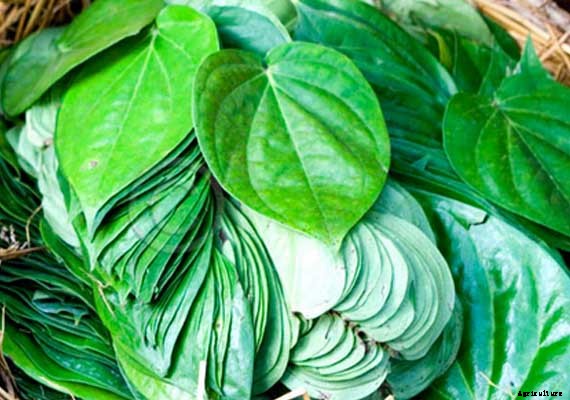
Harvesting is done from March to April in UP, Mp, and Bihar, from May to June in AP, Telangana. During Jan to Feb or April to May in Tamil Nadu. Mature betel leaves are plucked by hand along with a portion of the petiole. Harvested betel leaves are washed, cleaned and graded according to their quality and size for marketing.
You may also like Tomato Farming in Winter.
An average annual yield of a good betel leaves crop is about 60 to 75 leaves/ plant and 6 to 7 million leaves/ha. This yield also depends on cultivation methods and variety of betel leaves.
The initial investment of betel leaf cultivation including construction of an artificial rectangular structure (Bereja) may be around Rupees 1 to 2 lakhs/ha at the minimum during the first year that may come down to about Rupees 0.5 to 0.6 lakhs/ha in the subsequent years and a minimum net profit of Rupees of 0.5 to 1.0 lakhs/ha/year or more up to Rupees.5 lakhs /ha/year is not an unexpected value from a well-established betel leaves farm. These figures may vary due to several factors like location of the farm, agro-climatic condition, variety of betel leaves, current demand and supply, type of season, variation in price of the leaves in the market (which may vary significantly in the evening compared to morning), inflation etc..Such fluctuations in betel leaves prices in the market may discourage farmers going for betel leaf farming. This can be overcome or safeguarded easily by evolving a well-regulated marketing system relevant to the crop.
You may be interested in Growing Hydroponic Chives.


