
Welcome to Modern Agriculture!

The following write-up details about Cowpea farming techniques, tips, ideas and cultivation practices.
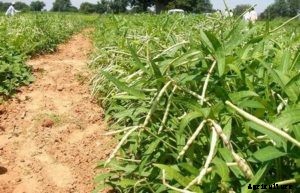
Cowpea crop is a Kharif legume crop and is grown across India for seeds, green pods, animal fodder, and organic green manure.
Pusa phalguni, which is best for sowing as a summer crop, Pusa Barsati is best for rainy season crop, Pusa Dofasli is best for summer as well as the rainy season.
Cowpea thrives very well in warm seasons, not in cold and winter seasons. Areas, where rainfall is more than average is not suitable for Cowpea Farming. Cowpea crop requires and does well in moist weather.
Cowpea can be cultivated in a wide range of soils. They do very well in sandy and sandy loam soils. You should make sure the soil is rich in organic matter, adding farmyard manure(FYM)will make the soil more fertile. The land should be prepared by giving five to six ploughings before planting the cowpea seeds.
You may be interested in reading the Cleft Grafting Steps and Procedure.
Usually, the required seed rate is 16 to 21 kg/ha.
Seeds used in Cowpea farming for sowing must be having from a genuine source. You should check for hardness and diseased, immature, shrunken and deformed seeds.
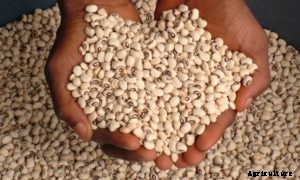
Sowing season of Cowpea seeds:
The time of sowing depends on the type of crop.
5 tonnes of well-decomposed compost (Field Yard Manure ) is used in the main fields along with a basal application of 45kg urea and 120kg superphosphate per acre.
You may be interested read the Kadknath Egg Production.
The cowpea seeds are sown by the dibbling method. In layout flatbed and spacing 45 cm X 35 cm, or 70 cm X 50 cm is practiced in cowpea farming.
Weeding is not needed for this cowpea crop. It covers the land very soon and kills the weeds by smoothing. Initial stages of growth, one weeding more than enough to control the weed in cowpea farming.
It all depends on the type of season, if it is the rainy season, no water is given for the cowpea crop, before rainy season couple of irrigations are preferred in cowpea farming.
The cowpea crop will be ready for harvesting in 3 to 4 months for short duration crop and 4 months to 5 months for long duration crop. tender pods should be harvested frequently before they become fibrous. The cowpea crop can be used as green fodder for animal or can make organic manure when they are bearing flowers.
in Cowpea cultivation, the yield can be expected around 40 to 70 quintal green pods/ha.
Cowpea cultivation is profitable as this can even be used for any animal fodder as well as food grain requirement.
Read: How To Grow Citronella.


