
Welcome to Modern Agriculture!

Jobs to do each month:
Home-grown broad beans (Vicia faba) are delicious and wonderfully tender, and one of the first crops of the year. They’re easy to grow from seed, yielding green pods of green or white beans that can be used in salads, stews and soups. They don’t take up too much space and can be grown in the ground, in raised beds and in large pots. You can also buy young plants in early spring.
Sow broad beans outside in spring or autumn, 20cm apart, in rows 60cm apart. If you live in a cold area, have heavy soil or a problem with mice, sow seeds under cover first, and plant the young plants out six weeks later. Pinch out the tips of plants to prevent blackfly, and stake taller varieties to stop them collapsing under the weight of the beans. Harvest when the pods are just 6cm long, for the most tender beans.
More on growing broad beans:
Growing broad beans: jump links
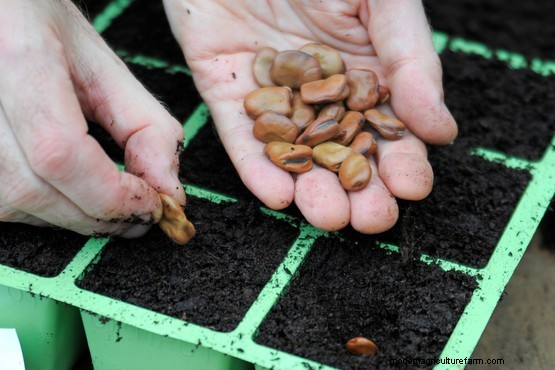
Broad bean seeds are large, so they’re very easy to sow. Hardy varieties, such as ‘Aquadulce Claudia’, can be sown in autumn (October or November) for an early crop the following May. Spring sowing is generally more reliable, especially in heavy clay soil, which can lead to the seed rotting before germinating. Sow in March or April for harvesting in summer.
How to sow broad beans outdoors
Sowing broad beans indoors
If you live in a cold area, have heavy or waterlogged soil, or have a problem with mice (which eat the seeds), then it’s a good idea to sow broad beans in deep pots or modules indoors.
In this programme clip from Gardeners’ World, Monty Don sows broad bean variety ‘Crimson Flowered’ in pots, to plant out later:

If you started off your broad beans in pots, they will be ready to plant out once the roots have filled their pots. Plant around 20cm apart and water in well.
Pea and bean weevil
Pea and bean weevils are a nuisance but rarely a major problem on the veg patch. The larvae live in the soil and feed on the root nodules. Then when the adults emerge in June and July, they climb up the plants and eat the edges of the leaves. Thankfully, these 4mm-long, brown, snout-nosed beetles rarely cause severe damage. The plants easily survive, unless they are small and seriously infested. Pick off any beetles that you see.
Broad bean chocolate spot
This fungal disease causes reddish-brown spots all over the plant. It is particularly common on plants sown in autumn, in damp, humid weather, or in plants that are crowded close together. It can cause loss of flowers (and therefore beans) and can cause the whole plant to collapse. There is no chemical control available so try to maximise air flow around plants, remove any weeds, and bin or burn any infected material – do not add to the compost heap. Do not save or store seed from infected plants.
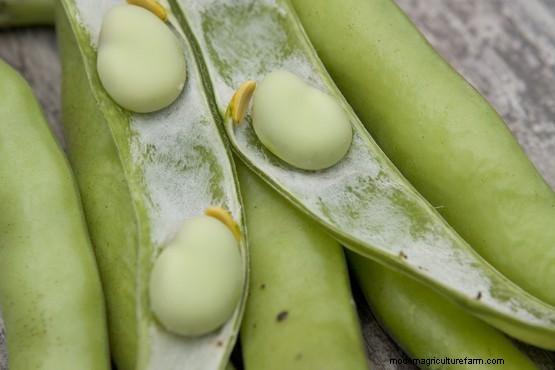
Broad bean ‘Aquadulce Claudia’ – very hardy, so the best variety for autumn sowing. Long, slender pods and white beans
Height x Spread: 1m x 45cm
Broad bean ‘Crimson Flowered’ – a heritage variety with very attractive crimson flowers, followed by short, upright pods. Can be grown in the ground or in a container
H x S: 90cm x 45cm
Broad bean ‘Bunyard’s Exhibition’ – sweet and subtly flavoured, with a delicate texture
H x S: 1.2m x 45cm
Broad bean ‘Masterpiece Green Longpod’ – sweet, nutty flavour and high yield
H x S: 90cm x 45cm
H x S: 1.2m x 45cm
Broad bean ‘The Sutton’ – dwarf variety, so a good option if you’re short on space or growing in pots
H x S: 30cm x 30cm
Broad bean ‘Witkiem Manita’ – an early cropper, producing large, well-filled pods
H x S: 1m x 45cm


