Welcome to Modern Agriculture!

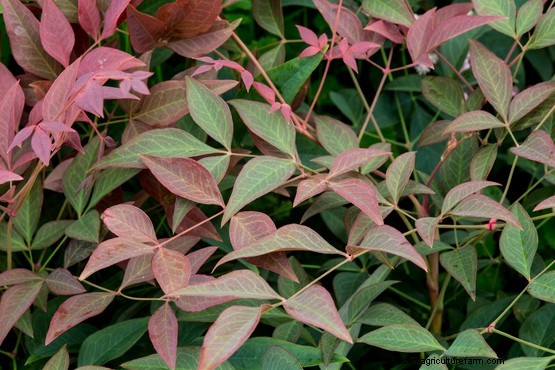
Heavenly bamboo, sacred bamboo or Chinese sacred bamboo, Nandina domestica, is an elegant evergreen or semi-evergreen shrub that looks good in every season. Its delicate, evergreen foliage has red or purple tints in spring and in summer, the plant bears sprays of tiny white flowers. In summer, the foliage turns pale green, and green berries begin to appear. These turn bright red in autumn, as the foliage takes on fiery red or bronze tints. The berries and foliage remain on the plant throughout winter, giving colour and interest.
Despite its name, heavenly bamboo isn’t actually isn’t a bamboo at all. It looks similar, but it is actually a member of the Berberis family, Berberidaceae. It is, however, a good alternative to bamboo in the garden – not only does it provide more interest but it is not invasive, as some bamboos can be.
Nandinas are compact shrubs, perfect for smaller gardens and pots. Larger varieties reach 2m, and smaller varieties less than one metre. They are low maintenance, needing just a light trim in spring. Nandina domestica looks particularly good in an urban or contemporary garden or in a jungle-style planting scheme. There are different cultivars to choose from that offer a variety of leaf colours.
Nandina domestica is low maintenance and easy to grow. Plant in spring or autumn, in a sunny, well drained spot that is sheltered from cold, drying winds. Nandinas do best in a slightly acidic soil, so mulch with bark chippings after planting. Nandina doesn’t need pruning but can be lightly trimmed and tidied up in spring.
More on growing Nandina domestica:
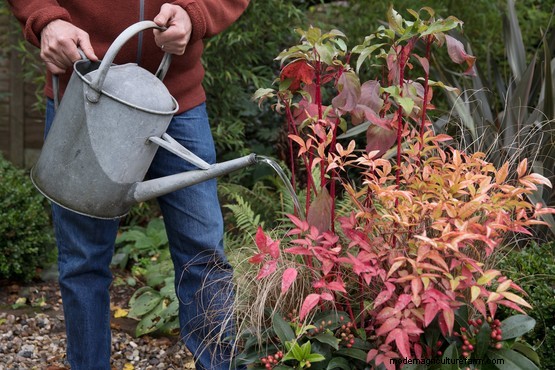
Nandina grows best in moist but well-drained soil that is slightly acidic. Choose a sheltered spot, with some sun to encourage good colouring up of the foliage.
Dig a generous hole adding in well-rotted compost and a handful of grit for added drainage as nandina does not do well in cold, wet winter conditions.
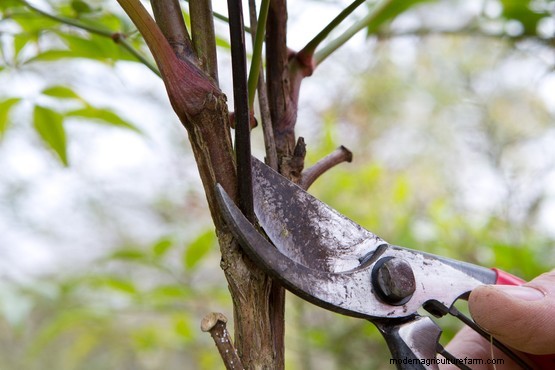
Nandina is a slow growing shrub and doesn’t need too much special care. It rarely needs pruning, bit it’s worth giving it a general trim in spring to maintain its shape and form.
The most reliable method of propagating nandina is from cuttings. Take semi-ripe cuttings in summer and keep them in a heated propagator until they root. Protect from winter weather.
It’s also possible to propagate nandina from runners that have formed roots – these can be cut and replanted.
Nandina is generally untroubled by pest and diseases. The berries can be mildly toxic for pet animals, and can kill birds if eaten in enough quantity.