
Welcome to Modern Agriculture!

Wisteria is a deciduous, climbing shrub, bearing beautiful pendants of scented flowers in May or June. There are many species of wisteria but the two most commonly grown in the UK are Wisteria sinensis and Wisteria floribunda. Wisteria sinensis grows in an anticlockwise direction and Wisteria floribunda grows in a clockwise direction.
Wisteria has incredibly strong and woody stems and, in time, the trunks can become as thick as small tree trunks – it’s not a climbing plant for a delicate trellis. Wisteria also offers valuable autumn colour and attractive pea-like seed pods.
Grow wisteria against a sturdy wall, such as up the front of a house, in moist but well-drained soil, ideally in a south- or west-facing direction. Prune in February and again in August. Feed with a high potash fertiliser in spring to encourage flowers.
More on growing wisteria:
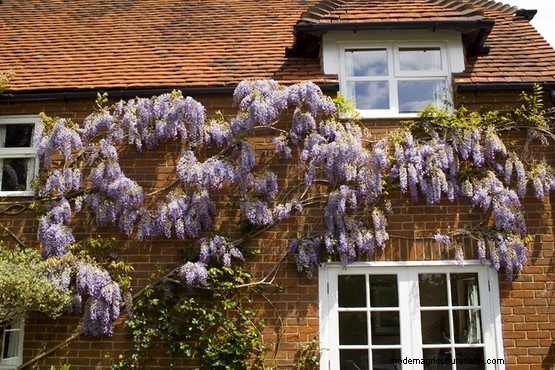
Grow wisteria against a house wall or other strong structure such as a sturdy pergola. It is possible to grow wisteria in a pot but only if growing it as a standard tree and when pruning it regularly to maintain its form – this is a very high maintenance option.
Plant wisteria in spring or autumn. Prepare the soil well to ensure a good root run, and plant at the same level as it was in the original pot and water in well. Tie the stems in to galvanised wires fixed horizontally along the wall, as you would an espalier fruit tree. If growing up a pergola, remove all but one stem and tie this to the post.
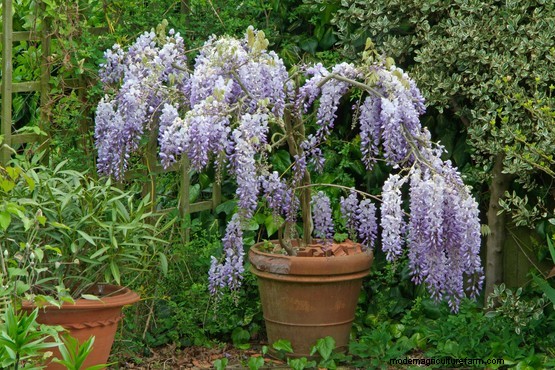
Wisterias can be grown in pots but you’ll need to feed them regularly as they are hungry plants. Only go for this option if training your wisteria as a standard. Choose the largest pot you have space for and use a good tree and shrub compost. Plant at the same level as it was in the original pot and water in well.
Wisteria is a hungry plant. Feed monthly with a high potash fertiliser during the growing season, to encourage more flowers to bloom. Water and feed pot-grown wisterias weekly. In autumn, mulch with organic matter such as well-rotted horse manure or home-made compost.
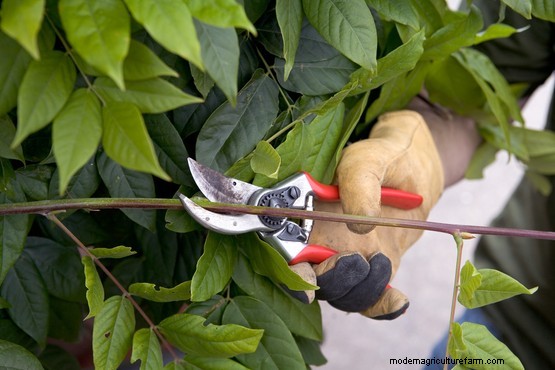
Prune wisteria twice a year, in August and February. For the first few years give your attention to training the plant into the support. This involves pruning very low branches out, training in strong side shoots and cutting back side shoots to five buds in early August.
Summer-pruning wisteria encourages the development of short-flowering spurs that will carry the blooms in spring.
In this short video, expert David Hurrion explains how to prune wisteria in summer. He shows you exactly which stems to cut and how much to remove:
By pruning in winter as well as summer, you will encourage the development of short spurs that carry the flowers in spring. Do this any time in the dormant season – late October to March.
In this video guide to winter-pruning wisteria, David Hurrion explains how to restrict vigorous, leafy growth so it doesn’t obscure developing flower buds:
It can take 20 years for a wisteria to flower from a cutting, so very few gardeners propagate wisteria, choosing to buy a plant instead. However, if you want a challenge, take softwood cuttings in mid spring.
The most common problem experienced by wisteria growers is lack of flowers. Wisterias take time to flower; expecting flowers before the plant is four years old may be unrealistic.
Here, David Hurrion offers advice on locating, pruning and feeding your wisteria, for maximum blooms.
A wisteria-clad house looks lovely in spring. But can the roots damage your foundations? Catherine Mansley, BBC Gardeners’ World Magazine, explains in our Quick Tips video:
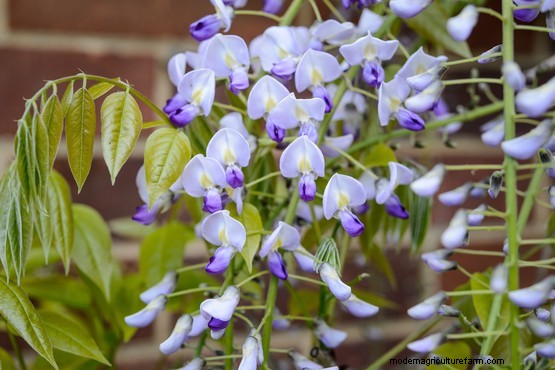
Wisteria sinensis – blue flowers in May or June before the foliage. Very fragrant. Reaches a height of 9m.
Wisteria floribunda ‘Multijuga’ (pictured) – of all the wisterias this has the longest pendants of flowers. Lilac flowers that appear with the leaves in June. Reaches a height of 9m
Wisteria floribunda ‘Kuchi-beni’ – mauve-pink flowers in June with the foliage. Floribunda types are not as vigorous as others. Reaches 8m in height
Wisteria floribunda ‘Domino’ – suitable where space is limited. Blue flowers in May or June with the foliage. Reaches a height of 6m
Wisteria sinensis ‘Alba’ – white flowers, often before the foliage. Reaches a height of 9m


