
Welcome to Modern Agriculture!

Chemical fertilizers are just like fast food — they satisfy a plant for now. But why not put your garden on a healthy diet? Your plants will grow bigger and faster and stay healthier, says Jeff Lowenfels, author of Teaming with Microbes, A Gardener’s Guide to the Soil Food Web, if you take care of the beneficial microbes in your soil, thereby improving its structure and nutrient retention. Plus, these microscopic critters help protect plants against diseases and make them more resistant to insect damage, too.
You can improve an entire garden’s beneficial microbes with just a few scoops of compost when you make actively aerated compost tea. This tea is packed with these microbes, and it’s almost free! There’s a little more to it than just soaking compost in a bucket of water, but not much. It’s as simple as water, air and compost. Here's how to make, and use, this amazing stuff.
If your compost is made mostly from green materials — lawn grass, fresh weeds, vegetable parings — it contains beneficial bacteria. If you make it from dried leaves and debris from cleaning the garden in spring — mostly brown stuff — then your compost will have more fungus in it. Why does this matter? Fast-growing veggies and annuals do best with bacteria. Perennials, trees and shrubs prefer more of the beneficial fungus microbes in their soil.
You Might Also Like:
Six Organic Products for Your Garden
How to Water Perennial Plants
Beneficial Garden Insects
You can soak compost in water and make tea, but it won’t have as many microbes in it as actively aerated tea. The brewing process pulls lots more healthy microbes from the compost. Brew on a warm day, with water that’s about 72 degrees Fahrenheit. Set the brewer in a shady spot — strong sunlight can kill microbes.
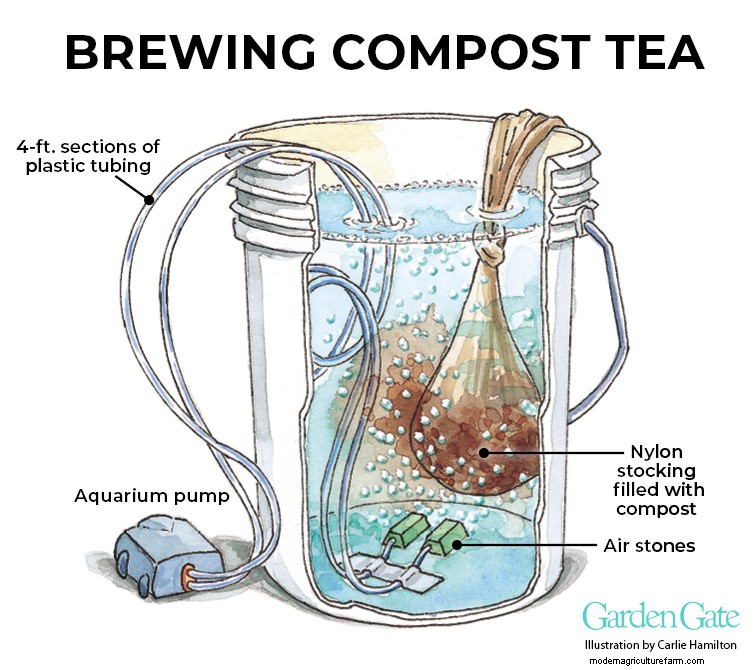
Hook up an aquarium pump with two air valves to two air stones. One rated for an 80-gal. tank will give you lots of bubbles, which help pull the microbes that are already at work in the compost into the water. Place the stones in a 5-gal. plastic bucket and duct tape the tubing to the bottom so they don’t float.
Fill your bucket with water. If you use rainwater you’ve harvested, you can start brewing your tea right away. If it’s chlorinated, let the pump run for several hours before adding compost to get rid of the chlorine, which could kill the microbes.
Microbes are already active in well-rotted compost. The tea allows you to collect them in a concentrated form. Put 4 to 5 cups of well-rotted compost in an old nylon stocking or cloth bag and sink it in the water. The nylon stocking will keep the debris out of the tea so it won’t clog up your sprayer later on.
Run the pump for 24 to 36 hours. When the tea turns coffee brown, it’s ready to use — the sooner, the better after it is brewed, because once the bubbles stop, the microbes start to disappear.
Unlike tea that’s made from compost simply soaked in water, actively aerated compost tea is brewed and will have a pleasant, earthy smell. Compost tea doesn’t store well, so if you must hold it longer than five hours, keep it refrigerated. Even so, the microbes will run out of food and start to eat each other. If it starts to smell bad, you need to make a fresh batch.
You Might Also Like:
How to Use Fertilizer in Your Garden
Garden Gate's Reading List
Wheelbarrows, Garden Carts and More Ways to Haul Stuff
The easiest application method is to pour the freshly brewed tea onto the soil. Unlike most chemical fertilizers, you can drench your plants with full-strength compost tea without any damage. In fact, you really can’t overdo it. If you want to dilute it and spray it on the foliage, just a cup or two of tea to a gallon of chlorine-free water will treat a large garden.
Late fall, before the ground turns cold, is a good time to pour compost tea on the soil. Hungry microbes will begin to break down the leaf litter and will get right to work again in spring. If you’re pouring tea as a soil drench, any time of day is fine — the microbes quickly sink into the soil.
Spray foliage just as your plants start to leaf out in spring, and later in the growing season if plants need a boost. It’ll help prevent plant diseases and insect damage. If you’re applying tea to foliage, ultraviolet rays will kill microbes. So before 10 a.m. or after 3 p.m., when the sun isn’t quite as strong, is the ideal time to spray it on.
Items You Might Find Helpful:
5-gallon Buckets
Plant Sprayer
Watering Can
As soon as you finish, make sure to flush the equipment with clean water, as a slime will form from the cmopost extract. If the slime begins to dry, you may need to use baking soda for a little extra muscle to clean it off. Don’t let the slime harden because it’ll clog the hoses and air stones.
With regular doses of actively aerated compost tea, your soil will thrive, and so will your plants!


