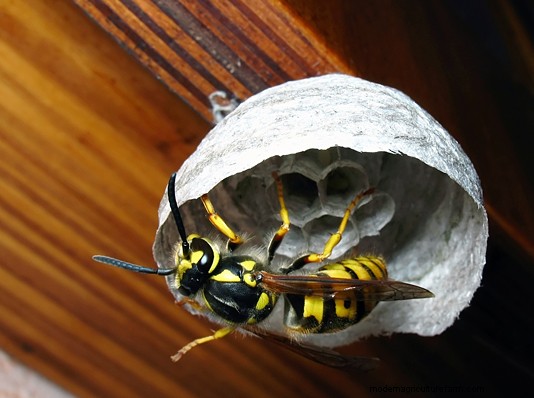
A German yellow jacket queen (Vespula germanica), starting to build a nest. Photo: Rescue pest control
Often confused with bees, yellow jackets are much more aggressive, and most reported "bee stings" may in fact be yellow jacket stings. Here are some of the most commonly asked questions, with answers from Rescue®, maker of the OrnamenTrap® Yellow Jacket Trap.
- When is yellow jacket season?
The season begins anywhere from March to May (depending upon the climate) and lasts through September or October. The queens emerge in the first warm days of spring to select a nest site to lay eggs, and the worker population grows to maximum size in late summer and early fall.
- What times of year are yellow jackets most likely to sting?
In late summer or early fall, when their nests reach maximum size.
- Do yellow jackets serve any beneficial purpose?
Yellow jackets feed on insects, including pest insects, such as houseflies, caterpillars and grasshoppers. Fall webworms and codling moths may be taken as prey by several yellow jacket species.
- Do yellow jackets die after they sting?
No. Unlike honeybees, yellow jackets do not lose their stinger, so they can sting numerous times.
- Where do yellow jackets make their nests?
Yellow jacket nests are most often built underground. The nest has a single entrance, usually no larger than the size of a nickel. Other locations include wall voids of buildings, hollow trees or logs and attics. There is also a species commonly referred to as the "aerial yellow jacket" which makes nests in trees.
- Do yellow jackets keep the same nest year after year?
In most cases, no. The nest decomposes after the season and is not reused. In some warmer climates, however, perennial nests have been found to exist.
- I think I have a yellow jacket nest in my yard. What should I do?
We recommend calling a professional pest control operator to remove the nest because of the danger involved. Yellow jackets will vigorously defend their nest if it is disturbed.
- If yellow jackets are bothering me, does that mean there is a nest nearby?
Not necessarily. Yellow jackets will travel over 1,000 feet from their nest to forage for food.
- What is the difference between yellow jackets and paper wasps?
The yellow and black coloring may appear similar, but paper wasps have more slender abdomens and longer legs that dangle down while they are in flight. Their nests are usually built under eaves, while yellow jackets most often will build their nests in the ground.
The appearance of yellow jacket and paper wasp nests also differs. Paper wasp nests look like honeycombs with multiple openings, while yellow jacket nests have a single opening.
- How do you treat a yellow jacket sting?
Wash the wound carefully with soap and water. This will help remove the venom. Apply cold water or ice in a wet cloth. Or apply a paste of meat tenderizer with water, which may help neutralize the venom and decrease pain.
- Take a pain reliever or an oral antihistamine to reduce swelling
- Apply a calamine product to reduce itching
- Lie down
- Lower the stung arm or leg below the heart
- Do not drink alcohol or take sedatives
- If the sting is to your throat or mouth, seek medical attention immediately because swelling in these areas can cause suffocation.
- How do you know if you are allergic to a yellow jacket sting?
Some signs you may be allergic:
- Severe swelling in parts of the body distant from the sting site
- Widespread skin irritation
- Constriction in the throat and chest, or difficulty breathing
- Dizziness or fainting
- If you experience any of these symptoms after a sting, you may be having a life-threatening allergic reaction. Seed medical attention immediately.
Shop Wasp Traps


