
Welcome to Modern Agriculture!

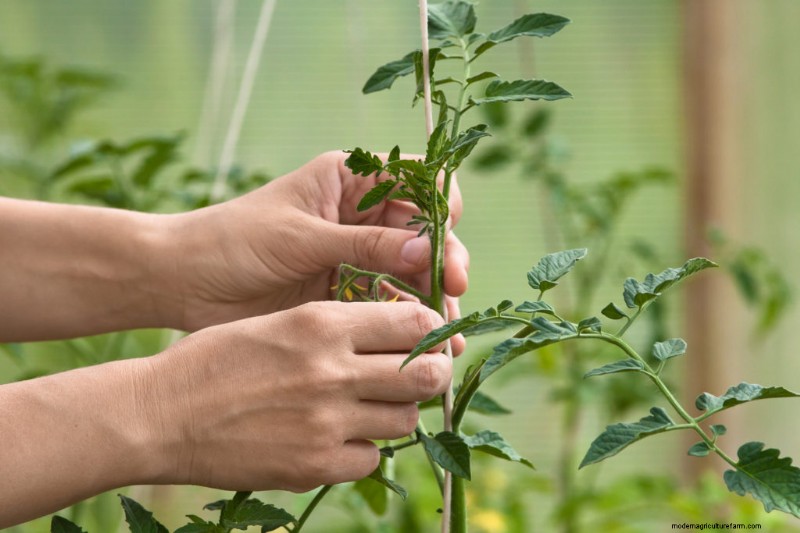
Growing indeterminate tomatoes is not easy. Allowing them to do their own thing will result in a tangled mess and diseased plants. But even if you decide to train them vertically and prune them regularly, if you don’t use the right type of support, you’ll still be facing challenges.
For a couple of years now I’ve been single-stemming my tomato plants and supporting them with tall bamboo stakes. As the tomatoes grew and grew, they reached impressive heights, and the bamboo stakes started snapping under all that weight. And the ones that didn’t break started tilting in random directions, which left my tomato bed looking messy and uneven.
This year, I changed strategies. I decided to string train my tomato plants the way they do in commercial greenhouses. Yes, you can still do that even if you grow your tomatoes outdoors, and it works great for growing single or double-stemmed tomatoes (or even more, but I recommend with sticking with one or two stems).
So let’s dive into this topic together and learn how you, too, can grow clean-looking, disease-free tomato plants, and how to set things up.
A string trellis is a piece of string hanging from a sturdy framework that’s designed to support lightweight or medium-weight plants such as tomato plants, cucumbers, or eggplants. You can grow climbing plants (peas, beans) up a string trellis as well, but traditionally, it’s used for training tomatoes and cucumbers vertically.
You can get creative with the framework of a string trellis:
You can also get creative with A-frame structures and arched trellises – if you already have them and they’re tall enough, you can hang string from the top.
Whatever you decide to build, make sure your framework is sturdy and tall enough because indeterminate tomatoes can grow as high as 8 feet (2.5m) or more.
The string also needs to be strong enough to hold all those tomatoes, and you can choose from synthetic or natural twine. I’d recommend going with synthetic twine since natural twine can wear or stretch.
You need something resistant enough to endure scorching sun, wind, and storms, and thin enough to guide it around the tomato plant’s stem.
Ideally, you should have your strings already hanging from the vertical support the moment you decide to plant your tomato seedlings outside. The string should be long enough to touch the soil, with a couple of extra feet at the bottom.
Some gardeners also leave excess string at the top, spun onto a hook or the top beam. The purpose of this extra string is to lower the tomato plants when they get too tall and have access to the tops for pruning and harvesting.
You can choose from these 4 methods of securing the string to the tomato plant:
Follow along with this video inside my tiny garden for more inspiration:
You’re almost there. The supporting structure is up, the string is secured, and now it’s time to guide your tomato plant up the string trellis. How exactly do you do that? Easy, here are two ways to do it:
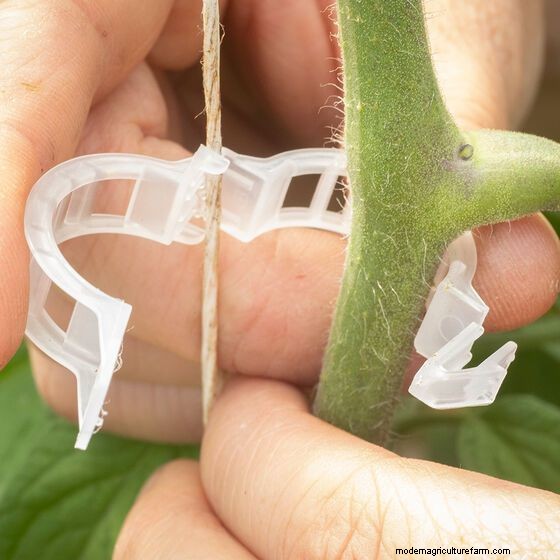
With both methods, it is CRUCIAL that you prune your tomato plants regularly so that they don’t grow suckers (or side shoots, which turn into new stems). You can allow a second stem on cherry tomatoes, but any more than that and it will quickly get overwhelming.
The whole point of this string trellising method is to create a clean, spaced look to your tomatoes that allows airflow and sunlight to reach all the parts of the plant, so single stemming your plants is best.
If you’re reading this and wondering – “suckers”, “pruning”, “single-stem” – what does all this mean…don’t worry. We have a few articles explaining what suckers are, and exactly how and when to prune them to achieve a single-stemmed plant:
Hopefully, I’ve inspired you to give string trellising a try. There are many benefits to this method of tying up tomato plants:
And if you’re the lucky owner of a greenhouse or polytunnel, even better – I can’t imagine a cheaper and more efficient way of growing tomatoes. Let the tomato season begin!


