
Welcome to Modern Agriculture!

I've been gardening and writing about gardening for more than 20 years, yet I find I'm always learning new things about the plants, insects and other critters that call my backyard home. That's the great thing about gardening — it's never boring! I've worked as a landscaper, on an organic farm, as a research technician in a plant pathology lab and ran a small cut-flower business, all of which inform my garden writing. Someone once asked me when I'll be finished with my gardens, to which I replied, "Never!" For me, gardening is a process, not a goal.
If you've never bitten into a fragrant, vine-ripened, sun-warmed tomato harvested fresh from your own garden, you haven't tasted a real tomato. And once you do, you'll never again be satisfied with the mealy supermarket imposters. Fortunately, tomato plants are easy to grow and remarkably productive.
Tomatoes are long-season, heat-loving plants that won't tolerate frost, so it's best to set them into the garden as transplants (young plants) after the weather has warmed up in spring. You can purchase tomato transplants, but there's something especially rewarding about starting your own plants indoors. Plus, by growing your own transplants you can choose from among hundreds of tomato varieties that are available as seed but rarely sold as transplants.
Quick to germinate and grow, tomato seeds are best sown indoors about six weeks before your average last frost date. (To determine your last frost date, ask a gardening neighbor or contact your Master Gardener program.)
Here's what you'll need to start tomato seeds indoors:
There are hundreds of tomato varieties available as seed, and choosing a few for your home garden can be a daunting task. Here are a few things to consider:
Even though it's known as "potting soil", the best medium for seed starting has no soil at all. Use a sterile, soilless mix that's labeled for seed starting. Never use garden soil, which often drains poorly and may harbor disease organisms.
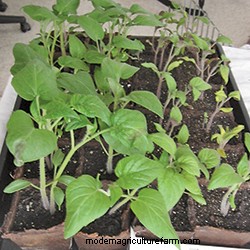 The seedlings on the left were grown in our Organic Seed Starting Mix. The seeds on the right were grown in ordinary potting soil.
Related Article: Choosing the Right Soil for Seed Starting
The seedlings on the left were grown in our Organic Seed Starting Mix. The seeds on the right were grown in ordinary potting soil.
Related Article: Choosing the Right Soil for Seed Starting
You can start your seeds in just about anything that holds soil and has drainage holes — I've used small yogurt containers and even egg cartons with holes poked in the bottoms and waterproof saucers underneath. However, I've found it more convenient to use purchased pots, such as biodegradable pots and seed-starting trays.
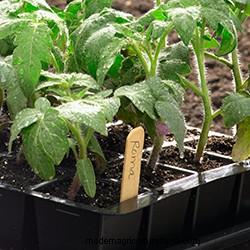 Tomato seedlings in a self-watering seed starting tray.
Seeds germinate best at warm room temperature (70-75 degrees F); you can speed germination by providing bottom heat with a heat mat. Once they're up and growing, seedlings grow best in cool room temperature, about 65 degrees F.
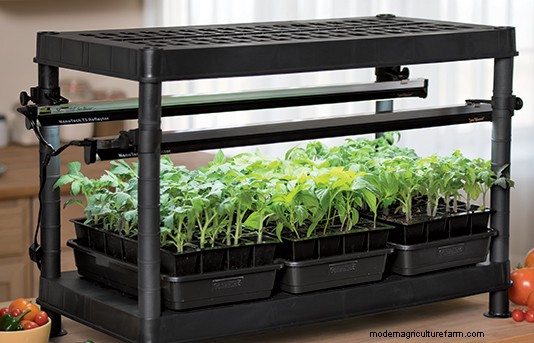 This Stack-n-Grow light stand has adjustable LED bulbs to ensure strong, sturdy seedlings.
Although you can start your tomatoes on a sunny windowsill, you'll get better results growing them under some type of LED grow light. Winter and early spring sunlight isn't nearly as intense as summer sunlight, and there are fewer hours of daylight. Insufficient light can lead to weak, spindly plants. A light garden with adjustable lights is ideal for seed starting.
Related Article: Gardening Under LightsContinue to keep the soil moist but not saturated. Dry seed-starting mix is lighter in color than moist mix — a good indication that it needs water. Some gardeners run a fan in the room with their growing seedlings; good air circulation reduces the chances of disease problems, such as damping off.
If you're growing plants on a windowsill, rotate pots daily so plants grow upright instead of leaning toward the light. If you're growing under lights, raise the lights as the plants grow, keeping them just a few inches above the plants.
For the strongest, healthiest plants you'll want just one seedling per pot or cell. Thinning (removing extra seedlings) is a tough task for many gardeners who hesitate to dispatch the seedlings they've been nurturing. But it has to be done. Select the strongest, healthiest seedling and use a pair of scissors to snip off the others at the soil line. You can try to transplant the extras into different pots, but you risk disturbing the roots of the remaining plant and, realistically, how many tomato plants can your garden accommodate?
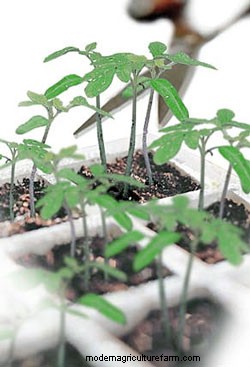 Use scissors to thin out crowded seedlings.
Once the second set of true leaves appears, it's time to begin fertilizing. The first two leaves are called "seed leaves;" subsequent leaves are called "true leaves." Once or twice a week, apply a water-soluble fertilizer that's been mixed at half the recommended rate.
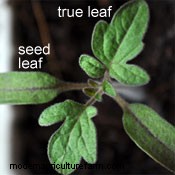 The difference between a seed leaf and a true leaf.
Your tomatoes may need to be transplanted to larger containers if they outgrow their pots before it's time to set them outdoors. Don't allow the plant to get pot-bound, with the roots filling the container, or growth may be stunted. For step-by-step instructions, read How to Repot a Tomato Seedling.
Wait to transplant your tomato seedlings into the garden until after the average last spring frost date. Be prepared to protect the seedlings with season-extending garden fabric, row covers or plant covers) if a late frost threatens. If all goes well, you'll be harvesting ripe tomatoes in eight weeks or less.
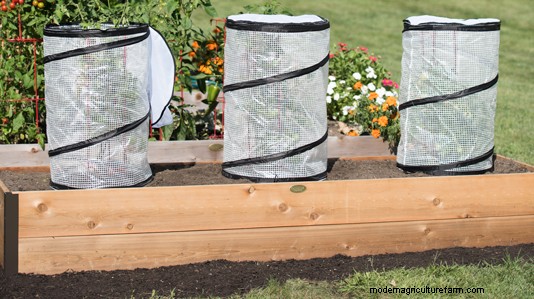 Special covers protect young plants from springtime frosts.


