
Welcome to Modern Agriculture!

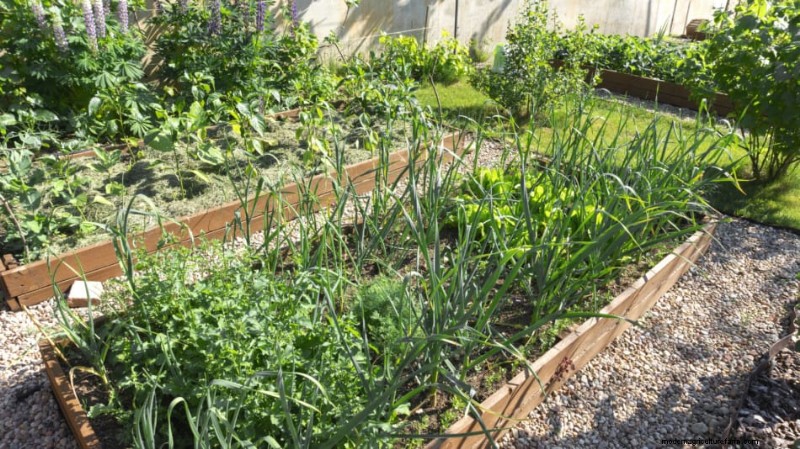
Crop rotation can be very confusing for a beginner hobby gardener. There are already so many rules to follow, so much information to absorb. During my first year of gardening, I focused on learning more about seedlings and plant care. Crop rotation was something I was going to worry about in the following year. But, as it turns out, on a small scale garden, rotating your crops is not nearly as important as I thought.
The purpose of crop rotation is to avoid soil depletion. But in a small garden, good soil is our main focus. If you practice a no-dig method and generously amend your soil with nutrient-rich, organic compost every year, there will be no need for crop rotation.
This might seem counterintuitive, as crop rotation is a practice that has been around for a long time, but in a small garden, we are in better control of our soil conditions. Small-scale, intensive gardening is very different from what agriculture used to be, and we should adapt our practices to our new realities. So why do we still believe crop rotation is a good thing for our gardens?
The crop rotation method has been introduced in the 16th century, and by the 18th century, it became standard practice. In today’s modern agriculture, crop rotation is an essential part of farming, and this is mostly due to monocultures.
Large-scale agriculture occupies sometimes hundreds of acres with the same crop, and this depletes the soil of certain nutrients. Because of the lack of diversity, certain resistant pets and weeds can develop and crop rotation can help with this.
But in spite of rotating crops, soil erosion eventually occurs because the soil never gets the chance to rest. Nutrients get depleted with this method of agriculture, so farmers add synthetic fertilizers to their crops, which are really meant to feed their plants, not enrich the soil.
In modern times, crop rotation is really a method to minimize risk from pests and disease, not enrich the soil’s biodiversity or help with its fertility.
My family owned land in a rural area and we used to sow corn and potatoes on a sizeable plot of almost an acre. Every fourth year or so, my grandparents would leave at least some part of the field to lie fallow.
Fallowing is simply leaving a plot rest for a certain period of time, usually a year. When doing this, grass and weeds can grow freely, and animals can graze this new pasture. Cow and sheep manure will enrich the soil’s structure, as well as the green material that decomposes back into the ground.
Fallow ground is an age-old principle. In fact, it’s even mentioned in the Old Testament:
Whether farmers actually applied this principle throughout centuries is up for debate, but it’s undoubtedly a great thing for the soil.
Fallowing is a way for nature to build back soil, and that’s exactly what we’re doing to our small gardens when we add a generous layer of organic compost or well-rotted manure every year, according to Scott Head.
What makes for a year-long process of decomposition in nature, or even more, is done quicker in our gardens, with hot compost, or compost that we bring from other sources. We put back what we take from the soil, and then some. In fact, this nutrient-rich method of gardening gives plants much more resources than they even need.
Crop rotation in small gardens is complicated. Firstly, crops of the same family should never follow each other. Here is an example of a 4-year crop rotation: Potatoes and cucurbits are followed by roots and alliums. Roots and alliums are followed by legumes and salads. Legumes and salads are followed by brassicas. In year 5, you start again with potatoes and cucurbits.
You can see why moving your crops around in this way can get confusing. Not only do you have to keep in mind where your plants were during the past year, but you also have to visit your notes 3 years back.
There’s a better way than crop rotation, and that is succession planting. Intensive gardening in small spaces already uses this principle found in nature. Throughout the seasons, nature has a way of growing different kinds of plants that thrive and flower during different times of the year. Some like the cold weather, while others thrive in summer.
We can apply this short term succession throughout our garden by never leaving our beds empty. As soon as we harvest our first crops in June or July, we should already have the next seedlings ready to go in the ground for autumn cropping.
Another essential thing we need to do to avoid crop rotation is amending our soil with good organic compost and/or well-rotted manure. A one-inch layer is an absolute minimum, while 3 inches are even better. The key here is to be patient and avoid disturbing the soil microorganisms by digging it. Soil building takes a long time, and if your base soil wasn’t very good, it will take a few years until your topsoil is almost entirely made up of fluffy compost.
We can learn a lot from observing our plants and seeing how nature works. For example, you’ll never find bare soil in nature. Weeds will grow and take over it, or leaves will form a thick mulch and decompose into hummus on the forest floor. You can emulate this by careful mulching, especially in hot, dry climates.
Another way you can keep your soil covered during times when you’re not planting anything is through sowing green manure on it. Green manures are fast-growing crops, like mustards, for example, that shade the soil and keep it moist. Some of the green manures can benefit the soil by fixing nitrogen, as well as protecting it.
I’m not saying you should keep your potatoes in the same bed if you had a bad case of blight the past year, although moving them 50 feet away won’t make much of a difference.
A good way to avoid blight with potatoes, especially in wet climates, is focusing on growing first earlies and second earlies, and get them out of the ground as soon as possible.
From different gardeners’ observations, such as MIgardener, blight has more to do with the time of year, and less with the soil-borne pathogens. Take tomatoes for example. In my first year of growing tomatoes, I lost them all to blight in early August, although I had a newly established garden. There are ways to prevent this, such as improving airflow, making the leaves inhospitable for blight, and mulching. Rotation won’t help.
The point is to create an ecosystem within the soil, where organisms keep a healthy balance, and by adding lots of organic matter, we are doing just that.
Another thing we could do to suffer less from pest damage is to focus on the quality of our seedlings. Strong, healthy, stocky seedlings that have been well-transitioned will have a much better chance of survival than week leggy seedlings. The quality of our seeds has a lot to do with germination and pest resistance.
If certain crops are particularly susceptible to pest damage, you can try growing those plants in containers for as long as possible, so that they are strong when you finally plant them in the ground. Or you can use row covers, fleece, and mesh to protect them from insects.
As small-scale organic gardeners, we are headed towards a different path than what we have been used to. It’s only natural that we adapt. When it comes to organic gardening, we can indeed make it efficient, less time consuming, and more productive, all while maintaining the health of our soil and our plants.
Many gardeners practicing the no-dig method have concluded that there’s no need for crop rotation on such a small surface. Charles Dowding has, in fact, proven this year after year by comparing two plots – dig and no-dig – in which he planted the same vegetables time and time again. His crops didn’t suffer in the least, if anything, the no-dig method was far more productive.
If, however, you notice that your plants have been affected after being in the same place for a few years, consider the weather first. How has that year been – was it very rainy or very hot and dry? Climate has a lot more to do with the success of your harvest than crop rotation.
I hope I’ve convinced you not to worry too much about crop rotation and just enjoy your gardening experience. Move plants around whichever way you need to and your space will allow.


