Poppy flowers–members of the Papaver genus–are bright additions to the summer garden. Poppy flowers bear solitary or double cup-shaped flowers from 2 to 4 inches (5-10cm) across. Flowers often have a crepe-papery texture. Colors can be white, yellow, pink, red, orange, salmon, and purple.
There are annual and perennial poppy flowers. Best known are the Iceland poppy, Oriental poppy, and Flanders poppy, also called Shirley poppy. The Iceland and Oriental poppies are short-lived perennials, often grown as annuals. The Flanders poppy is an annual. (See the list of varieties below for fuller descriptions.)
Poppies have long flowering stems that grow from a mound of divided foliage. Leaves are lance-shaped.
Poppies are best grown in mixed borders, meadows, or rock gardens, and also make good cut flowers.
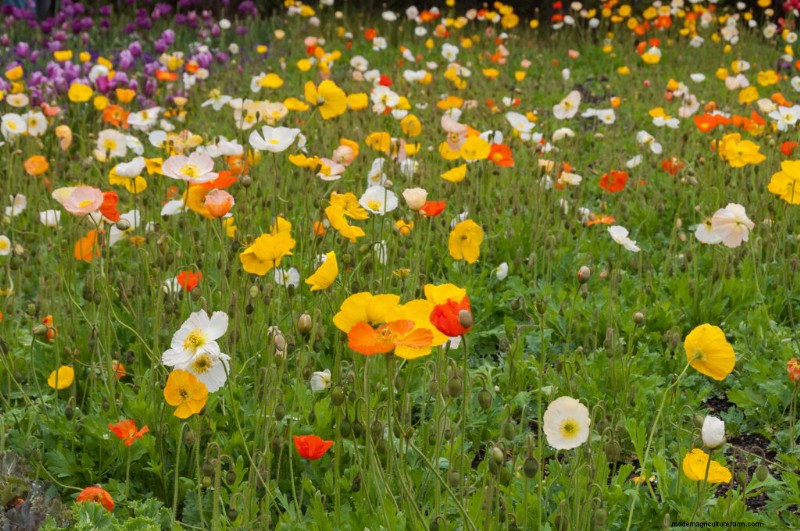
Oriental poppy flowers,
Papaver orientale
How to Use Poppies in Garden Design
1. Cottage Gardens
Poppies, such as Oriental (Papaver orientale) and Shirley poppies (Papaver rhoeas), are quintessential in cottage gardens. Their soft, papery petals and vivid hues blend seamlessly with roses, lavenders, and other perennials, creating a romantic and informal aesthetic .The Guardianseasonalwisdom.com
2. Wildflower Meadows
Integrate poppies like the California poppy (Eschscholzia californica) into wildflower meadows for a naturalistic look. They pair well with native grasses and other wildflowers, offering a low-maintenance option that supports pollinators .Reddit+1Gardenista+1
3. Mixed Borders
Use taller poppy varieties to add vertical interest in mixed borders. Their bold colors can create striking contrasts when planted alongside plants like irises, alliums, and sages .Gardenia
4. Container Plantings
Poppies can thrive in containers, making them suitable for patios and small spaces. Combine them with trailing plants like lobelia or alyssum to soften edges and add depth .Plant Addicts
5. Seasonal Highlights
Poppies bloom in late spring to early summer, providing a burst of color during this period. After blooming, their seed pods add architectural interest and can be left to self-seed for future seasons .
Design Ideas Featuring Poppies
- Color Themes: Choose poppy varieties that complement your garden’s color scheme. For instance, pair orange California poppies with blue cornflowers for a vibrant contrast.
- Textural Contrast: Combine the delicate petals of poppies with plants that have contrasting textures, such as the spiky foliage of irises or the soft leaves of lamb’s ear.
- Succession Planting: Plan for continuous bloom by pairing early-flowering poppies with later-blooming perennials. This ensures that as poppies fade, other plants take center stage .
- Pollinator Gardens: Poppies are excellent for attracting bees and butterflies. Incorporate them into pollinator-friendly gardens alongside other nectar-rich plants.
Get to Know Papaver–Poppy Flowers
- Plant type: Hardy annual or perennial
- Growing Zones and range: Zones 2 to 9
- Hardiness: Resistant to cole, not tolerant of excessive heat
- Height and width: 12 to 24 inches (30-61cm) tall or more; 6 to 18 inches (15-45cm) wide
- Foliage: Deeply cut
- Flowers: Wide spreading bowl-, cup-, or saucer-shaped single, semi-double, double flowers, crepe-papery texture 2 inches across or more
- Flower colors: Shades of red, pink, orange, yellow, white, and bicolor
- Bloom time: Early spring and summer depending on the variety
- Uses: Seasonal bedding, meadow gardens, cottage gardens, containers
- Common name: Annual poppy, Iceland poppy
- Botanical name: Papaver
- Family: Papaveraceae
- Origin: Central and South Europe and temperate Asia
Where to Plant Papaver–Poppy Flowers
- Plant poppies in full sun in Zones 2-6; plant in partial shade in Zones 7-11.
- Grow poppies in average to humus-rich, well-drained soil.
Papaver Uses
- Papaver can be added to beds and borders; flowers make a dramatic statement when massed.
- Smaller cultivars are suited for a rock garden or annual border.
- Poppies are excellent cut flowers; cut when flowers are in bud and set the stem ends in boiling water or over a flame to prolong the bloom.
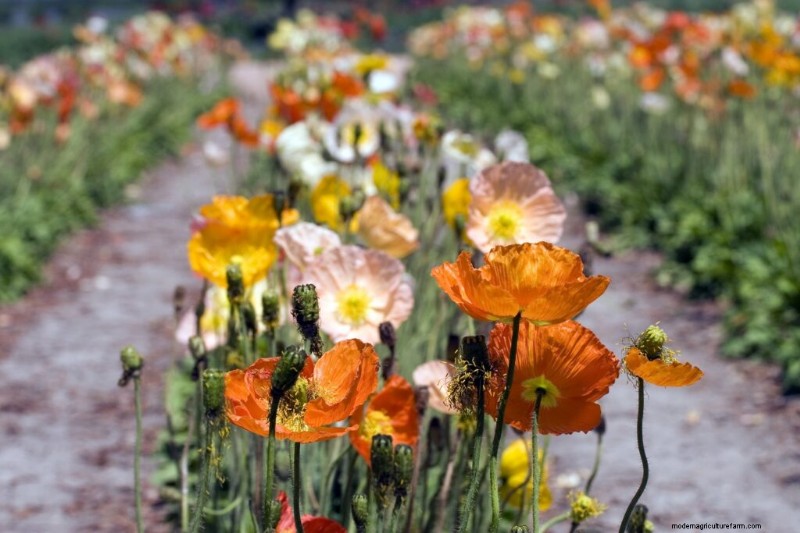
Iceland poppy,
Papaver nudicaule
When to Plant Papaver–Poppy Flowers
- In Zones 3-7, sow seeds directly onto prepared soil in early spring, 2 to 3 weeks before the last frost. In Zones 8-10, sow seeds in late autumn. The seeds can be lightly covered with soil.
- Start seeds of annual varieties indoors in early spring, 6 to 8 weeks before the last frost; start perennial varieties any time spring through summer up to 3 months before the first frost in fall.
- Set transplants outdoors in mid-spring; transplant carefully as poppies do not want their roots disturbed.
- Annual poppies do not have long blooming periods, so sow seed successively every two weeks for continual color.
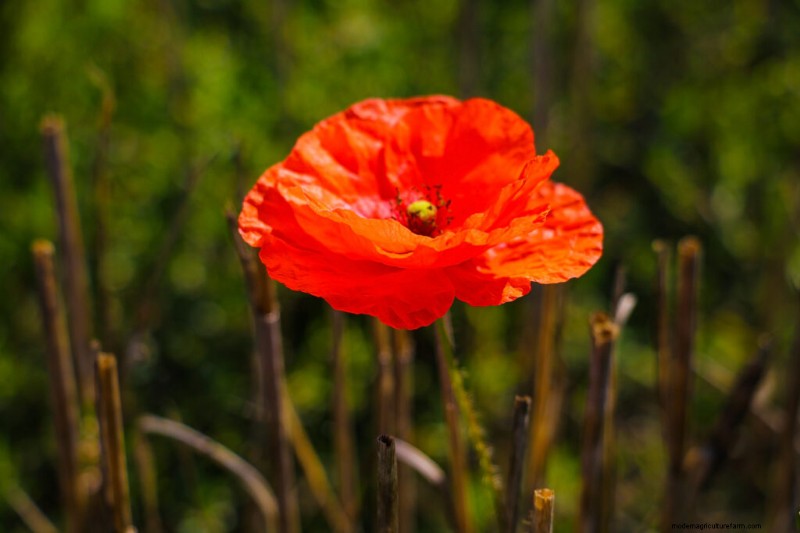
Shirley poppy,
Papaver rhoeas
Planting and Spacing Papaver–Poppy Flowers
- Press seeds into the soil, but do not cover them with soil; instead, cover the flat or pot with black plastic until they germinate; all except Oriental poppies need darkness to germinate.
- Set the flats or pots in a cool place (55°F/12.8°C) to germinate; germination will occur in 10 to 15 days.
- Grow seedlings in bright sunlight or a few inches below fluorescent light.
- Move poppies to individual pots when they become crowded.
- Space annual poppies 6 to 12 inches (15-30cm) apart; sow plants in groups of a dozen or more for best effect.
How to Water and Feed Papaver–Poppy Flowers
- Poppies require moderate water; keep the soil evenly moist.
- Mulch around growing plants with aged compost or chopped leaves to keep moisture in the soil and the soil cool.
- Fertilize poppies lightly at planting time; poppies do not need fertilizing during the growing season.
Care of Papaver–Poppy Flowers
- Keep faded flowers picked to prolong blooms.
- Oriental poppies lose their foliage in midsummer; the foliage will reappear in autumn. Fill the blank spots in the garden with other annuals until the oriental poppies reappear.
- Avoid overwatering; roots that are too wet can rot or become diseased.
- Pests are usually not a problem.
- Protect perennial poppies from winter cold; place 3 to 5 inches (7.6-12cm) of shredded leaves over plants in winter.
Papaver–Poppy Flowers Pests and Diseases
- Powdery mildew, leaf smut, gray mold, root rot, and damping off can occur.
Papaver–Poppy Flowers Propagation
- Sow seed in the garden in spring for annuals and biennials.
- Sow perennials in containers in autumn or spring.
- Seeds germinate in 7 to 12 days at 65° to 70°F (18-21°C). Plants will be large enough for transplanting in 16 to 25 days. Flowers usually appear 18 to 19 weeks after sowing.
- Divide perennials in spring or take root cuttings in late autumn or early winter.
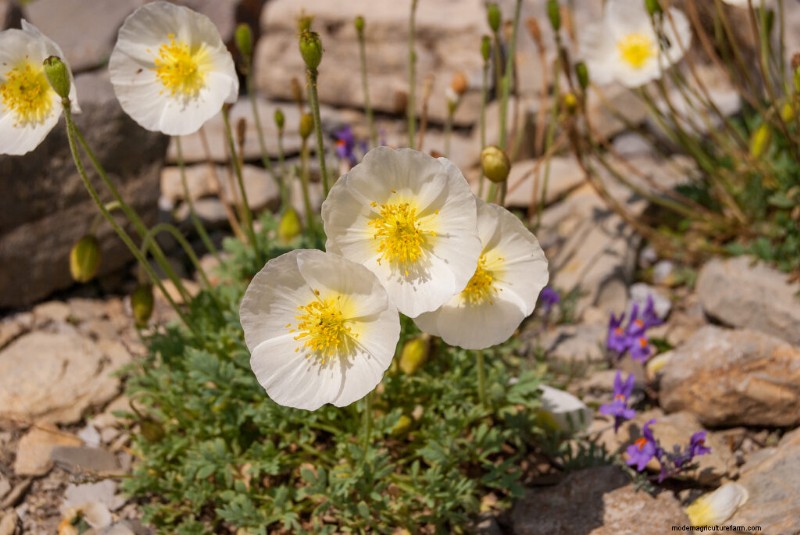 Papaver alpinum
 is known as Alpine poppy
Papaver–Poppy Flower Varieties to Grow
- Alpine poppy, Papaver alpinum, is a perennial. It grows 5 to 10 inches (12-25cm) high and has 1.5-inch flowers of white, yellow, and pink. The Alpine poppy blooms in spring.
- Papavar commutatum is a hardy annual that grows to 18 inches (45cm) tall; its flowers are dark red with a black center. This poppy blooms in summer.
- Iceland poppy (Papaver croceum or P. nudicaule) is a perennial in mild-winter regions; it is commonly grown as an annual. It grows 12 to 24 inches (30-61cm) tall. Flowers are fragrant, 1 to 4 inches (2.5-10cm) across, single or double, and white with yellow, red, orange, rose, or apricot markings. It blooms in spring and will not tolerate summer heat in most zones.
- Oriental poppy, Papaver orientale, is a perennial. Flowers are 3 inches (7.6cm) across; they are white, orange, pink, red, or salmon with a black center. Plants grow to 4 feet (3.2m) tall and bloom in early summer.
- Shirley or Flanders poppy, Papaver rhoeas, is an annual. Flowers are 2 inches (5cm) across and red, purple, white, pink, salmon, or orange. It blooms in summer. Plants are 2 to 3 feet (61-91cm) tall.
- Papaver somniferums is the opium poppy.
Poppy Frequently Asked Questions
Q: When do I plant Iceland poppies?
A: Iceland poppies can be grown in all zones. In Zones 2-7 sow seeds in early spring; the plants will likely bloom the first summer but will be especially striking in the second year. In Zones 8-10, sow seeds in late summer for flowers the following spring. Iceland poppies in bloom are commonly sold in garden centers in spring.
Q: Will Oriental poppies planted in spring bloom the same year?
A: Yes, if you purchase large, established plants that are two years old, you will get blooms the same year. Set out established plants in mid-spring and blooms should come in summer.
Q: What care do Oriental poppies need?
A: Oriental poppies do not need much attention. Give them a side-dressing of a balanced fertilizer such as 5-10-5 in spring. Remove spent flowers as they wither.
Related Articles:
- 20 Perennials That Bloom for 6 to 8 Weeks
- Shrubs with Showy Flowers Season-by-Season
- Trees in Garden Design
- Growing Annuals for Summer Bloom
- Trees—click here for more articles
- Shrubs—click here for more articles
- Perennials—click here to see more
- Annuals—click here to see more


