Hello green farmers, We are back with a comprehensive “Spirulina Commercial Production Report” focusing on a 1-acre open-pond system in India. A “miracle crop” that has the ability to address India’s combined concerns of malnutrition and environmental degradation, spirulina is a nutrient-dense blue-green microalgae that has emerged as a “miracle crop.” An alternative to conventional cattle production that is more environmentally friendly and requires 30 times less water and 50 times less land than soybeans, it is the food that contains the highest percentage of protein in the world (60–70% dry weight). Because of its tropical warmth, ample sunlight, and rising demand for health foods, India has become a global hub for the cultivation of spirulina.
The lack of awareness, technical expertise, and access to finance, on the other hand, continues to be a barrier to widespread adoption, despite the fact that it has great promise. Using case studies, cost-profit analysis, and government programs as supporting evidence, this research investigates the economic viability, environmental benefits, and scalability of spirulina cultivation in India. This project intends to empower farmers, entrepreneurs, and policymakers to exploit the potential of spirulina for ensuring nutrition security, rural livelihoods, and climate resilience. This will be accomplished by bridging the gap between invention and implementation.
1-Acre Spirulina Commercial Production Report in India: Cost and Profits Included
Step-by-Step Spirulina Cultivation in India
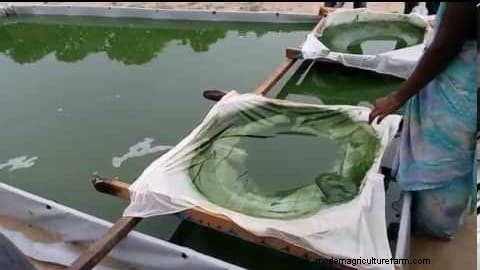
Growing Conditions For Spirulina.
Preparation of the Pond
- Build ponds with a depth of twenty to thirty centimeters by using cement, food-grade containers, or plastic lining that is resistant to ultraviolet light. Open ponds are the best option for small-scale systems, while photobioreactors are the best choice for high yields.
Getting Ready for the Culture Medium
- In order to keep the pH between 8.5 and 11, combine water with components such as sodium bicarbonate, nitrates (such as potassium nitrate), phosphates (such as sodium phosphate), magnesium sulfate, and trace metals (such as iron and zinc).
Inoculation
- A pure spirulina starting culture belonging to the species Arthrospira platensis should be introduced into the pond. 1–2 kg of live culture should be used for every 1,000 liters of medium.
Phases of Growth
- Shade or solar heaters can be used to keep the water temperature between 25 and 35 degrees Celsius. To ensure that nutrients are distributed evenly and that oxygen is present, water should be circulated using pumps or aerators.
Observation on a Daily
- pH (8.5–11), temperature, and nutrient levels should be checked on a daily basis. If the pH decreases, adjust the solution by adding sodium bicarbonate or diluted nutrients.
The act of harvesting
- Spirulina should be harvested using fine mesh filters or cloth screens after seven to ten days have passed. In order to collect biomass, water should be drained and then rinsed with fresh water.
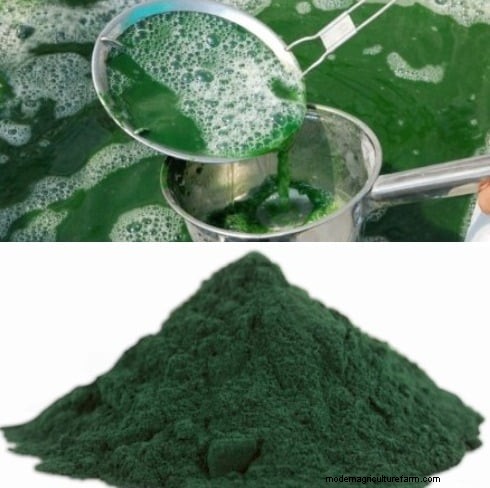
Harvesting Spirulina.
Getting dry
- Place the biomass on clean trays and allow it to sun-dry for eight to twelve hours (or use a mechanical dryer set to forty to fifty degrees Celsius) until the moisture content falls below ten percent.
Processing
- Utilizing either a manual or an automatic press, the dry biomass should be ground into a fine powder or compressed into tablets.
The packaging of
- Keep the nutrients intact by storing them in containers that are airtight and lightproof. Note the batch number and the expiration date on the label.
Post-harvest cleaning tasks
- Ponds should be refilled with new culture medium, and the cycle should be restarted. In order to avoid contamination, equipment should be sanitized.
You can check spirulina farming for complete practices.
2. Cost Breakdown for Spirulina Cultivation
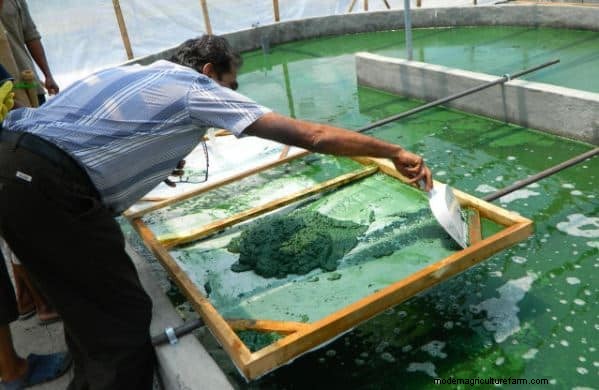
Spirulina Farming (Pic Source: orchidsasia.com).
2.1 Initial Setup Costs
Note: This project assumes that the commercial production system is an open-pond system measuring one acre.
ItemCost (INR)DetailsLand Preparation50,000-100,000Leveling, pond construction (plastic lining, cement tanks).Cultivation Tanks/Ponds2-5 lakhOpen ponds (1,000–2,000 sq. ft.) or photobioreactors (for high-tech setups).Starter Culture10,000-30,000Purchase of pure spirulina strain (e.g., from IARI or CSIR labs).Nutrients & Chemicals20,000-50,000Sodium bicarbonate, nitrates, phosphates, and micronutrients.Pump & Aeration System50,000-150,000Solar-powered pumps for water circulation.Harvesting Equipment30,000-100,000Filtration systems, drying racks, and packaging machinery.Total Initial Cost₹4.5-12 lakhVaries with scale and technology.
2.2 Monthly Operational Costs
ItemCost (₹/month)DetailsWater & Electricity5,000-15,000For pond maintenance and aeration. Nutrients10,000-20,000Replenishing nitrogen, phosphorus, and trace minerals.Labor15,000-30,000Skilled workers for monitoring pH, harvesting, and drying.Maintenance5,000-10,000Repair of pumps, liners, and filters.Marketing & Packaging10,000-25,000Branding, labels, and distribution costs.Total Monthly Cost₹45,000-1 lakhScales with production volume.
2.3 Cost Reducing Tips
- Use open ponds instead of photobioreactors because they are less expensive.
- A local source of nutrients (for example, agricultural lime for pH regulation) should be utilized.
- Utilize solar power to cut down on your monthly electricity costs.
- When it comes to labor support, collaborate with local non-governmental organizations or self-help groups.
3. Projected Profits
3.1 Yield and Pricing
- The average yield is approximately 10-15 grams per square meter per day, with one acre being approximately 4,047 square meters.
- The dry weight of the monthly production ranges from 1.2 to 1.8 tons.
- Depending on the quality and certifications, the selling price ranges from ₹2,000 to ₹3,500 per kilogram.
3.2 Revenue Calculation
- The monthly revenue is calculated by multiplying 1.5 tonnes by ₹3,000 per kilogram, which is ₹4.5 lakh.
- The annual revenue is calculated by multiplying ₹4.5 lakh by 12, resulting in ₹54 lakh.
3.3 Profit Margins
- The gross profit each month is calculated by subtracting the operational cost of ₹1 lakh from the revenue of ₹4.5 lakh, which results in a total of ₹3.5 lakh.
- Net profit per year: ₹3.5 lakh multiplied by 12 minus ₹12 lakh (initial setup) equals ₹30 lakh (break-even point in four to six months).
Note: One thing to keep in mind is that profit margins increase with volume, organic certification, and value-added products (like spirulina tablets and protein bars, for example).
4. Challenges and Solutions
4.1 Common Challenges
- Contamination: development of bacteria and fungi in open ponds.
- Solution: pH monitoring and UV therapy should be performed on a regular basis.
- Water Scarcity: The high demand for water in agriculture is a result of water scarcity.
- Solution: Reciprocating systems and collecting rainwater are the solutions to this problem.
- Market Competition: Imports from China are the dominant force in the market competition.
- Solution: To solve this problem, you should concentrate on organic certification and specialty markets (for example, vegan protein).
5. Government Schemes and Subsidies for Spirulina Cultivation in India
Because of India’s commitment to sustainable agriculture and nutritional security, the country’s government has launched a number of programs to encourage the cultivation of spirulina. These programs lower the costs associated with starting a business, offer support with technical matters, and boost profitability. Here are some important programs:
5.1 PM-KISAN (Pradhan Mantri Krishi Sinchai Yojana)
- Goal: Encourage water-efficient farming practices and microirrigation.
- Relevance of Spirulina: Funding for water management systems and pond building.
- Benefits include a 50% subsidy for pond construction, with small and marginal farmers eligible for up to ₹5 lakh.
- pumps that run on solar energy for water circulation and aeration (30–50% subsidy).
- SHGs, FPOs (Farmer Producer Organizations), and individual farmers are all eligible.
- How to Use It:
- Go to the PM-KISAN website.
- Send in a proposal via the agriculture department in your community.
5.2 NABARD Loan Programs for Spirulina Production
- Goal: Give agribusinesses access to low-interest loans.
- Relevance of Spirulina: Working capital and infrastructure funding (photobioreactors, ponds).
- Benefits: Spirulina entrepreneurs can expect loan rates as low as 5-7 percent.
- Loan terms might last up to seven years.
- MSMEs, cooperatives, and farmers with a strong project report are eligible.
- It is possible that loans above ₹50 lakh may require collateral.
- Apply by contacting NABARD or a partner bank, such as HDFC Bank or State Bank of India.
- For approval, provide a thorough project report (DPR).
5.3 MIDH (Mission for Integrated Development of Horticulture)
- Objective: Enhance the production of high-value horticultural crops, particularly nutraceuticals.
- Spirulina Significance: Funding for organic certification and the development of value-added products.
- Benefits include a 75% subsidy on organic certification, capped at ₹2 lakh.
- Support for packaging, branding, and export promotion.
- Eligible participants include individual farmers, startups, and Farmer Producer Organizations (FPOs).
- To apply, please reach out to the State Horticulture Department.
- Submit a proposal for the “Nutri-Cereals and Superfoods” component.
5.4 Rashtriya Krishi Vikas Yojana (RKVY)
- Objective: To support innovative agricultural projects that are in accordance with state priorities.
- Spirulina’s significance lies in securing funding for pilot projects, research and development, and training initiatives.
- Benefits include funding of up to ₹25 lakh for rural entrepreneurship programs focused on Spirulina.
- Funding opportunities for the incorporation of spirulina into aquaculture or poultry feed.
- Eligible entities include state governments, non-governmental organizations, and private organizations collaborating with farmers.
- Proposals should be submitted to the State Level Sanctioning Committee (SLSC).
5.5 Startup India Seed Fund Scheme
- Goal: Assist early-stage food and agriculture technology entrepreneurs.
- Relevance of Spirulina: Financial support for creative uses of Spirulina (e.g., biofuels, cosmetics).
- Benefits: Up to ₹50 lakh in seed money.
- exemptions from taxes under the Income Tax Act’s Section 80-IAC.
- Startups that have registered with the Department for Promotion of Industry and Internal Trade (DPIIT) are eligible.
- Indian ownership must be at least 51%.
- How to Apply: Create an account on the Startup India website.
- Make a pitch to incubators such as T-Hub (Hyderabad) or CIIE (Ahmedabad).
5.6 State-Specific Schemes
- Pond construction subsidies in Tamil Nadu are 75% (up to ₹3 lakh) under the “Blue-Green Algae Mission.”
- Incentives for the Arid Region of Rajasthan: 50% off solar pumps for spirulina farms in regions vulnerable to drought.
- Maharashtra: Spirulina cooperatives managed by women are eligible for grants from the Maharashtra State Rural Livelihoods Mission (MSRLM).
5.7 Key Points for Utilizing Schemes
- Write an in-depth project report (DPR): Bring up the effects on the planet and on people.
- Work together with research institutions: Join forces with ICAR, CSIR, or state agricultural colleges to build your technical credibility.
- Use approaches that are based on clusters: Groups (FPOs/SHGs) can apply for bigger funding.
- Keep up to date: Use sites like Digital India or state farming websites to keep up with new programs.
6. Climate Resilience in Spirulina Cultivation
Because spirulina thrives in warm, sunny temperatures (between 25 and 35 degrees Celsius), the tropical environment of India is ideal for its cultivation. But because of the variances between regions, individualized techniques are required:
- High humidity is associated with an increased risk of pollution in coastal states such as Kerala, Odisha, and others. Farmers utilize closed greenhouses and water that has been treated with ultraviolet light to limit the growth of bacteria.
- Saline groundwater is recycled for agricultural purposes in desert locations such as Rajasthan and Gujarat, which reduces the amount of freshwater that is considered necessary. Certain strains, such as Spirulina platensis, are able to endure salinities of up to 35 parts per thousand.
- During the monsoon season, farmers in the states of Karnataka and Maharashtra construct rain shelters in order to prevent their culture ponds from becoming diluted during periods of high rains.
7. Value-Added Products: Beyond Raw Biomass
Indian growers are broadening their product lines to include high-margin spirulina items in order to optimize their revenues.
- Tablets and capsules are nutritional supplements that are sold in the market.
- Face masks and serums containing spirulina, developed in partnership with Ayurvedic brands, are included in the cosmetics category.
- Spirulina meal, which is high in protein, is used as animal feed for poultry and aquaculture.
- Functional Foods: Spirulina-enriched snacks are aimed at consumers who are concerned about their health and live in urban areas.
Conclusion
In conclusion, the “Spirulina Commercial Production Report” offers a detailed road map for the establishment of a Spirulina farming system in India that is comprised of an open-pond arrangement that is one acre in size. This venture gives a lucrative potential for environmentally responsible algae farming, as there are government incentives available to help early setup costs. By utilizing production processes that are both cost-effective and able to capitalize on the growing demand for health supplements and environmentally friendly products, business owners have the potential to make significant revenue while also contributing to the preservation of the environment. The purpose of this article is to provide comprehensive guidance for individuals who are interested in entering the spirulina manufacturing industry. It provides information regarding the establishment of a business, operational methods, and financial planning. Spirulina farming not only holds the potential to yield financial benefits, but it also matches with India’s objective of fostering environmentally responsible and sustainable enterprises if it is carried out correctly and according to well-established best practices.