
Welcome to Modern Agriculture!

Gypsophila (pronounced jip-sa-fe-la) are annual, hardy perennial or alpine plants that are grown for their airy sprays of tiny, star or trumpet-shaped flowers in shades of white or pale pink. The flowers of taller growing gypsophila are borne in such abundance as to form a cloud, giving rise to the common name of baby’s breath.
Gypsophila flowers are much loved by flower arrangers because they combine well with pretty much any bloom, and are a favourite in bridal bouquets. Taller gypsophilas do exactly the same in a border, where their thin, wiry stems and clouds of flowers make them an excellent 'filler', bridging the gap between different plants and bringing an airy feel to a planting scheme. Alpine and miniature forms of gypsophila are low growing, and useful for rockeries, alpine troughs and for edging borders.
Gypsophilas are ideal for cottage gardens, white gardens, gravel gardens and, of course, cutting gardens – just give them plenty of sunshine and room to spread. Around five stems are perfect for a good display in a bouquet or vase and the blooms should last at least seven days in water. Dried gypsophila is excellent for arrangements, too.
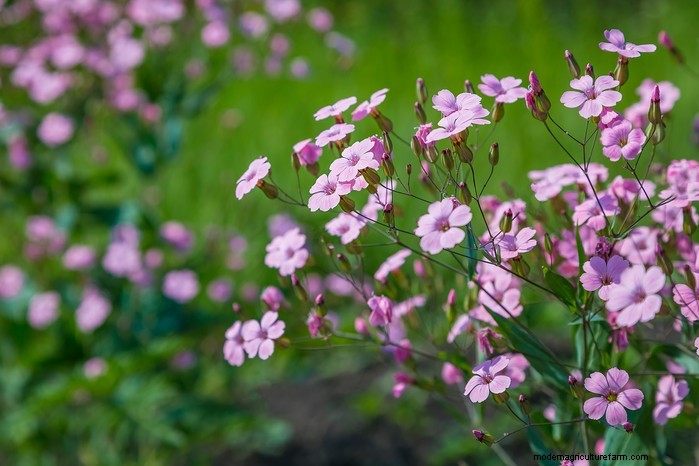
Pink gypsophila flowers growing in a border. Getty Images
For best results grow gypsophila in moist but very well-drained, slightly alkaline or neutral soil, but avoid acid soil. Grow gypsophila in full sun.
Sow seeds of annual gypsophila in spring, directly into the soil where they are to flower, as they struggle with root disturbance. If you're growing gypsophila for cutting, sow successionally every few weeks from April until June, to give a harvest of blooms for months.
Sow perennial Gypsophila paniculata in early spring in trays of moist seed compost. Surface-sow as light is needed for germination, putting containers in a propagator or in a polythene bag to keep moist. Once seedlings are large enough to handle, prick out into modular trays then, when established, transplant into pots until large enough to plant out.
Plant shop-bought gypsophila in spring to early summer. Spring planting helps perennial gypsophila become established before winter.
Plant gypsophila into well-prepared soil with the top of the root ball at the same level as the soil surface. If your soil is heavy, mix in some coarse grit and mound up the soil a little to plant your gypsophila on top, so excess water drains away readily.
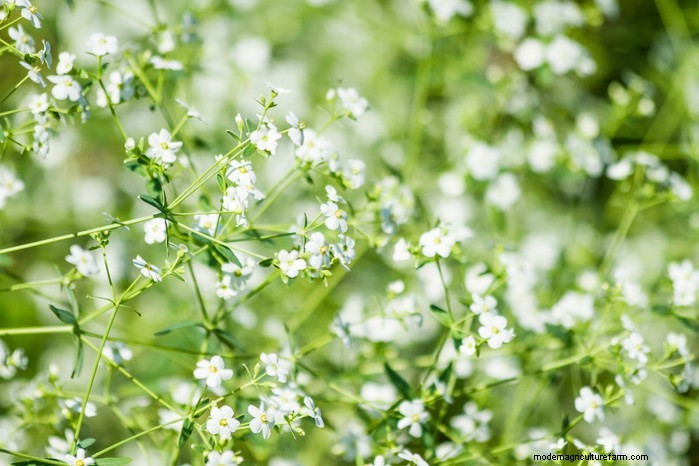
White gypsophila flowers. Getty Images
Water well – around two to three times per week – until established, and then only during dry spells.
Support taller plants as they grow, either with grow-through plant supports or use pea sticks or brushwood for a more natural look. If you want to increase the number of blooms for cutting, feed every few weeks with a general liquid fertiliser.
After flowering has finished, cut down the flower stems, which may produce a second flush of blooms later in the season. Once growth of perennial gypsophila dies back in autumn, you can cut the stems back to the ground or leave them to decay over winter. Likewise with annual annual gypsophila – either pull up dead plants in autumn and add to the compost heap, or leave in place to support insects and rot back naturally.
Annual gypsophila self-seeds readily but you can save seed to sow in autumn or the following spring. Sow seeds where they are to flower, as they struggle with root disturbance.
Propagate perennial varieties of gypsophila by taking basal cuttings. Alpine varieties can be divided in March.
Only the perennial species of gypsophila can be propagated by cuttings, taken from basal shoots in spring. Detach entire shoots, dip the base in hormone rooting powder, and insert in modular trays of cuttings compost with added perlite to improve drainage.
Gypsophila are generally free of most pests and diseases. The main problem you are likely to encounter are problems with winter wet – gypsophila struggle when sitting in cold, wet soil. Add plenty of grit when planting to avoid root or stem rot.
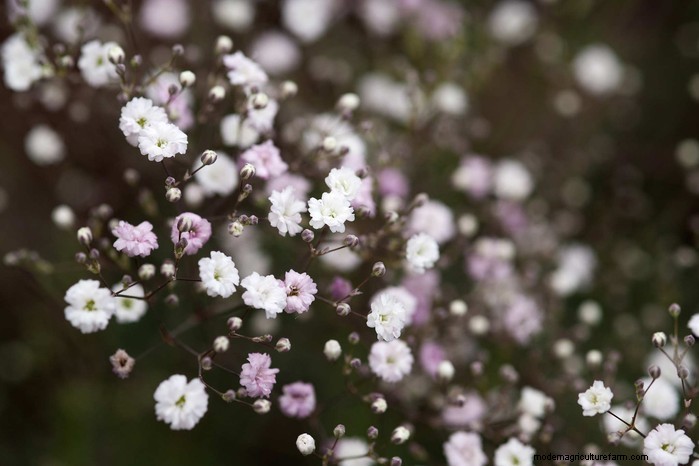
Gypsophila paniculata. Torie Chugg
Gypsophila paniculata ‘Snowflake’ – masses of snow-white flowers blooms on strong stems, in early summer. A perennial variety that is perfect for bouquets, dried flower arrangements and filling gaps in the border. Height x Spread: 90cm x 40cm
Gypsophila paniculata 'Bristol Fairy' – a perennial variety with double white flowers, also good for filling gaps in the border, cutting and dried flowers. H x S: 1.2m x 1.2m
Gypsophila 'Rosenscheier' – a compact, perennial variety. The white flowers fade to pink as they mature. H x S: 50cm x 40cm
Gypsophila elegans 'Covent Garden' – a pretty white annual variety that's excellent for cutting. H x S: 45cm x 45cm
Gypsophila cerastioides (mouse-eared gypsophila) – a dwarf, semi-evergreen alpine type with a creeping habit. Green-grey, hairy leaves contrast with masses of small white trumpet-shaped flowers in spring and summer, loved by pollinators. H x S: 5cm x 15cm
Gypsohila repens 'Rosea' – a pretty, creeping pink variety, ideal for rockeries or planting in stone walls.
H x S: 10cm x 45cm


