
Welcome to Modern Agriculture!

Papaya farming is a common and popular business in many countries around the world from the ancient time. It is a very popular and nutritious fruit which has numerous health benefits. It is also known as Papaw or Pawpaw in some areas.
Papaya actually is the plant Carica papaya and it is one of the 22 accepted species in the genus Carica of the family Caricaceae. Origin of the papaya is in the tropics of the Americas (perhaps from Central America and southern Mexico).
Papaya is actually a small, sparsely branched tree, usually with a single stem growing from 16 to 33 feet tall, with spirally arranged leaves confined to the top of the trunk. The lower trunk is conspicuously scarred where leaves and fruit were borne.
The leaves of the papaya plant are deeply palmately lobed with 7 lobes, large in size 20-28 inches in diameter. The fruit is a large berry about 5.9 to 17.7 inches long and 3.9 to 11.8 inches in diameter.
The fruits ripe when it feels soft, when it’s skin has attained an amber to orange hue and along the walls of the large central cavity are attached numerous black seeds.
Currently papaya farming is very common and the fruit is being cultivated throughout the world. It is mainly used as a fruit, but in some countries it is also used as a vegetable.
Papaya plants grow in three types: male, female and hermaphrodite. The female produces small, inedible fruits unless pollinated with pollen from the males. While the male plants only produces pollen, never fruit.
But the hermaphrodite type of papaya plants can self-pollinate since it’s flowers contain both male stamens and female ovaries. Most of the commercial producers prefer only hermaphrodites types for profitable papaya farming business.
Papaya was actually originated from Central America, but now it is cultivated in most of the tropical countries. Global production of papayas was 13.3 million tonnes in the year of 2018, led by India with 45% of the world total.
Global production of papaya grew significantly over the early 21st century, mainly as a result of increased production in India and demand by the United States.
Papaya is very nutritious and it is very good for health. Papaya leaves have been used in traditional medicine as a treatment of malaria, an abortifacient, a purgative or smoked to relieve asthma.
Raw papaya pulp contain 11% carbohydrates, 88% water and negligible amount of protein and fat. A 100 grams raw papaya pulp serving provides significant amount of vitamin C (about 75% of DV), 43 kilocalories, and a moderate source of folate (10% of DV).
Papaya is loaded with antioxidants that can reduce inflammation, fight disease and help to keep you looking young. It is a highly nutritious fruit for all aged people.
As we you can see above, “papaya is a highly nutritious fruit” and it is also an incredibly healthy tropical fruit.
There are many health benefits of consuming papaya on a regular basis. Here we are trying to describe the top health benefits of consuming papaya.
Commercial papaya farming is a very easy and lucrative business. Growing papaya plants is very easy and the beginners can also start this business easily.
Large scale papaya farming is a very popular business in many countries. Here we are trying to describe more about the top advantages of papaya farming business.
As we have mentioned previously ‘papaya farming is very easy and simple’, so you can start immediately even if you are a beginner. The plants generally require less caring.
Although, we recommend learning practically from existing farmers before starting commercial production. Here we are describing more about profitable papaya farming business from planting, caring to harvesting and marketing.
Papaya plants can be grown in almost all types of soils, except sandy and sticky or heavy clay soils. Roots of the papaya plants are very sensitive to water-logging or standing water.
As less as 2 days of submergence can be fatal for these plants. Water accumulates during high rainfall in heavy soils, and diseases like foot rot and root rot occur, which may cause the plantation to be wiped out in a short time.
So, try to select a slightly sloppy land which is perfectly leveled. And the selected land must have to be fertile. High soils of the hilly region is best suited for papaya farming, being well drained in organic matter.
Avoid commercial papaya production in sandy or heavy soil. pH level of the soil ranging from 6.5 to 7.0 is considered best for papaya farming business.
Preparing the land perfectly is very important for successful papaya farming business. Because, very well prepared land is required for papaya farming.
Leveling is required to bring the soil to fine tilth. Apply enough farm yard manure at the time of last ploughing, and then your land is ready for the papaya plants.
Papaya is actually a tropical fruit that grows well in the mild sub-tropical regions (up to 1000 meters above sea level). Deep, well drained sandy loam soil with warm climate is considered idea for commercial cultivation of papaya.
Night temperature below 12° C to 14° C for several hours during winter season affects the growth and production of papaya plants. These plants are very much sensitive to frost, strong winds and water stagnation.
Generally two kinds of papayas are grown. One type has sweet, red or orange flesh, and the other type has yellow flesh. These two types are normally called ‘red papaya’ and ‘yellow papaya’ respectively.
The large-fruited, red-fleshed Maradol, Sunrise and Caribbean Red papaya varieties are often sold in the United State markets. And these types are commonly grown in Mexico and Belize.
There are also many hybrids available. But you should choose those breeds which grow well in your area. You can consult with your local producers for having better recommendations.
The papaya plants are propagated through seeds. For commercial papaya production, you can prepare the seedlings in polythene bags (having dimensions of 25 X 10cm). In these polythene’s, 8-10 holes are done having 1mm diameter on lower part for proper drainage of water.
Then fill the bags with equal proportions of FYM, soil and sand. And then sow the seeds in polythene bags. Treat the seeds with Captan before sowing at the rate of 3 grams per kg seeds.
Planting papaya plants is very easy and simple. For commercial production, the papaya plants are propagated through seeds in polythene bags (seed rate is 250 to 300 grams per hectare).
They become ready for planting in the main field when they reach between 15 and 20 cm tall. Light irrigation is required immediately after planting the transplants.
Papaya plants are generally planted thrice a year. First in February to March, second in June to July and then October to November.
A spacing of 1.8 x 1.8 m. is normally followed for commercial papaya farming. However higher density cultivation with spacing of 1.5 x 1.5 m./ha enhances the returns to the farmer and is recommended.
Papaya plants generally require less caring and other management. Although, taking additional care will help the plants to grow well and produce more. Here we are trying to describe more about caring the papaya plants.
Papaya plant needs heavy doses of manures and fertilizers. Apart from the basal dose of manures (@ 10 kg./plant) applied in the pits, 200-250 g. each of N, P2O5 and K2O are recommended for getting high yield.[2]
Application of 200 g. N is optimum for fruit yield but papaya yield increases with increase in N upto 300 g. Applying adequate organic fertilizers will also ensure good production of papaya.
The papaya plants are heavy feeders, and they require a lot of water. Fix the irrigation schedule depending on the type of soil and weather conditions in your region. Provide protective irrigation in the first year of planting.
During the second year, irrigation is provided at fortnightly interval in winter and at an interval of 10 days in summer. Basin system of irrigation is mostly followed. In areas having low rainfall, sprinkler or drip system can be adopted.
Mulching helps to retain moisture into the soil and also prevent weeds. You can use organic materials as mulch, such as straw, hay etc.
Weeds will consume nutrients from the soil and your papaya plants will suffer. So, control weeds timely. You can use either manual or chemical methods for controlling weeds.
Intercropping leguminous crops after non-leguminous ones, shallow rooted crops after deep rooted ones are beneficial. But no intercrops are taken after the onset of flowering stage.
About 10% of the male plants are kept in the orchards for good pollinatino where dioecious varieties are cultivated. You can uproot the extra male plants as soon as the female plants start to flower.
Like many other commercial crops, the papaya plants are also susceptible to many diseases. Here we are describing about the top diseases of papaya plants.
The symptoms of the papaya mosaic disease appear on top young leaves of the plants. Spraying with Malathion at the rate of 300ml in 150ltr water will be effecting for controlling this disease.
Common symptoms of powdery mildew disease are patchy, white powdery growth on the upper surface of leaves and also on main stem of infected plant. This disease can be controlled by spraying of Thiophanate methyl 70% WP at the rate of 300 grams in 150-160ltr water per acre.
Root rot or wilt disease causes rotting of roots which ultimately result in plant wilting. Drenching with Saaf at the rate of 400gm in 150ltr water will be effective for controlling this disease.
Water like wet spots are seen on plant stem. The symptoms get spread on all sides of the plant. Plant leaves fall apart before it is fully developed. Spraying the plants with M-45 at the rate of 300gm in 150ltr water will be effective for controlling this disease.
Aphid and fruit fly are the common pest of papaya plants. Here we are describing more abut these two common pests of the papaya plants.
Aphids suck the sap of the plant and also help in spreading specific disease in plants. Spraying with Malathion at the rate of 300ml in 150ltr water will be effective for controlling this pest.
The female fruit fly lay eggs in the mesocarop, after hatching the maggots feed themselves on fruit pulp which will destroy the fruit. You can spray with Malathion at the rate of 300ml in 150ltr water for controlling this pest.
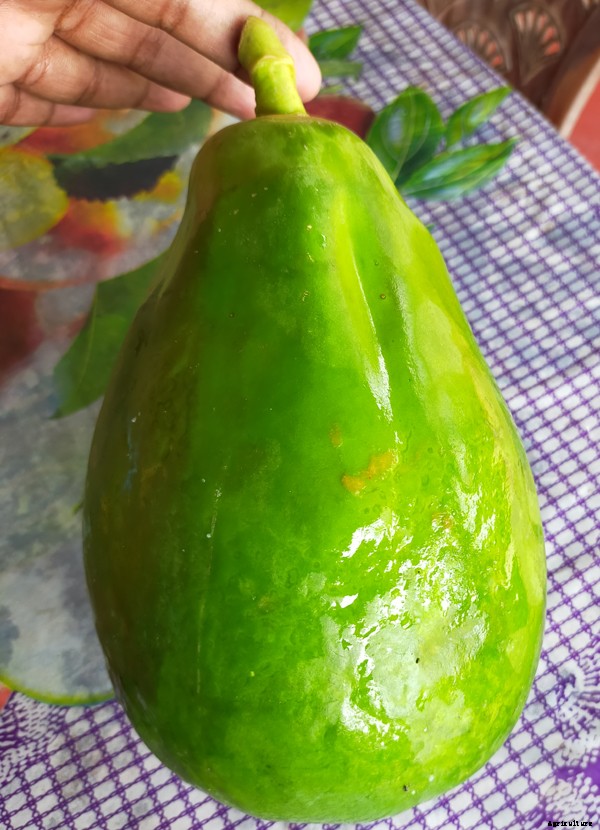
Generally the papaya fruits are harvested when they are of full size, light green in color with tinge of yellow at apical end. But fruits of certain varieties turn yellow on ripening, while some of them remain green.
When the latex ceases to be milky and become watery, the fruits are suitable for harvesting.
Grading, storage, packing and transportation are post-harvesting tasks. The fruits are generally graded on the basis of their weight, size and color.
The papayas are highly perishable in nature. They can be stored for a period of 1-3 weeks at a temperature of 10° C to 13° C, and 85% to 90% relative humidity.
Road transport by trucks or lorries is the most convenient mode of transport due to easy approach from the papaya field to the market.
It’s very hard to tell the exact number. The economic life of papaya plant is only 3-4 years. The yield varies widely according to variety, soil, climate and management of the orchard.
Average yield of 75-100 tonnes per hectare is obtained in a season depending on spacing and cultural practices.
This is the most important part of papaya farming business. Your production will not be profitable if you can’t market your products well. So, determine the marketing strategies before starting this business. Most of the farmers generally dispose off their produce to the wholesalers and middleman at the farm gate.
These are the common steps and ways for commercial papaya farming business. Hope this guide has helped you! Good luck & may God bless you!


