
Welcome to Modern Agriculture!

Are you ready to grow Papaya in a controlled environment such as a playhouse or a greenhouse setting? Here’s some basic information about Polyhouse Papaya farming. The papaya plant is a member of the Caricaceae family. Papaya botanically called Carica papaya and is also known as papaw or pawpaw. Papaya originated in tropical America and has become a very common fruit thanks to its rapid growth, high yield, and high nutrient value. Papaya is primarily grown in the Andhra Pradesh, Karnataka, Gujarat, Orissa, West Bengal, Assam, Kerala, Madhya Pradesh, and Maharashtra states.
In tropical climates, the papaya trees grow. The optimum temperature is 25 to 30 ° C and a minimum temperature of 16 ° C. For Papaya the appropriate pH value is between 6 and 6.5. The well-drained or sandy loam soil with sufficient organic matter is the primary essential for Polyhouse Papaya cultivation. In high rainfall areas, if the drainage is low and the roots are continuously drenched for 24–48 hours, the plants can die. Sticky and calcareous soils aren’t ideal because rainwater can collect even for a few hours in the soil. Higher raised beds and drainage ditch are highly recommended in this situation.
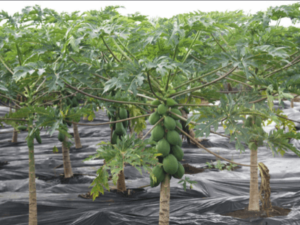 The growing field must be irrigable and maintained at the appropriate soil moisture required for the growth of Papaya plants, although the dry climate is good for the quality of Papaya fruits at the time of maturation.
Continuous cropping in the same field can lead to poor growth and can cause Papaya trees to disease problems. The strong, cool, hot, dry, or salty wind doesn’t like a papaya tree. Papaya is better to grow in a sheltered place but full of sunshine. Staking and windbreak will diminish plant damage under strong wind.
For the cultivation of Papaya, a well-drained upland is chosen. Papaya plants are vulnerable to strong winds or storms in open and high lying areas. Consequently, appropriate windbreaks should be planted at the orchard boundary for the proper establishment of the Papaya plantation.
The seed should be from a reliable source and sown at the earliest opportunity. The remaining seeds should be tightly sealed and kept in place at cool (5 -10 ° C) and dry (40% under relative humidity). For one hectare of planting 500 g of seeds are needed.
During the monsoon, winter, and spring season papaya trees are planted. It is not planted during the winter season because the frost can cause crop damage or injury. This means that papaya trees are planted during June-July (monsoon), October-November (autumn) or February-March (summer) months. The first few things to consider while farming in Papaya are heat, frost, and hot air, since all three cause plant injury.
The papayas are usually grown from seed. Germination can take anywhere from 3 to 5 weeks. It is expedited to 2 to 3 weeks and by washing off the aril the percentage of the germination process increased. The seeds then want to be dried and powdered with a fungicide to prevent damping-off, a common cause of seedling failure.
Well-prepared seeds can be kept for up to three years but germination rate declines with age. Dip at 158oF (70oC) in hot water for 15 seconds, and then soak for 24 hours in distilled water after removal from storage, germination rate will improve. In some seasons, if germination is sluggish, gibberellic acid treatment may be required to get faster results.
Seeds can be planted directly in the field, or seedlings can be transplanted in beds or pots when they are 6 weeks old or up to 6 months old. Although great care should be taken in handling and the longer the delay the greater the risk of roots being dehydrated or twisted. In windy locations, transplantation often results in trunk curvature.
The optimum range of temperatures is 21-27 ° C and 19-29 ° C of radical emergence. Depending on the temperature it takes 1 to 4 weeks from sowing to emerge. Thiram (TMTD) W.P can treat the seed. Until sowing for prevention of young plant fungal diseases.
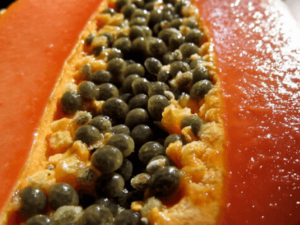 Facts of Papaya Farming in Greenhouse
Because of its short youthful period, a Papaya tree needs more nutrients. This favors excellently organic soils. Apply 20 kg of farmyard manure each year per plant by mixing with 200 g of urea 400 g of potash muriate in February months or March. The mixture of manure and fertilizer must be spread about the plants within a radius of 40 cm.
Water requirement for Papaya farming depends upon the area’s environmental factors such as sun, temperature, wind, type of soil, etc. This varies from the plant’s generation. A young plant in Papaya would want more humidity than the older ones. This is because of the slower vegetative growth of older Papaya trees. The seedlings are therefore irrigated once or twice a week while the fruit-bearing trees need irrigation once in every 15 days.
Watering Papaya normally takes place every 10 days in winter or every week in summer, but practice varies depending on the soil, climatic conditions and irrigation method. It is possible to do a ring method, furrow method, or irrigation by drip. Though, make sure that the water does not come into contact with the stem. Irrigation can avoid frost damage to the plants.
Seedlings are around 6 to 8 weeks after germination ready for transplantation into the field. Transport the seedlings to the field 3 to 4 days prior to the planned planting date to reduce planting tension. Protect them from the winds when transported to the sector. Avoid holding the seedlings in the plastic bags, by the stem. This can cause severe damage to the stem and root and the plants do not simply establish themselves in the field.
Anthracnose, powdery mildew, stem rot, and damping-off are the main diseases that damage the Papaya trees. Waterlogging around roots is the main reason for the incidence of rots. Wettable sulfur, carbendazim, and mancozeb are the most effective controls for these diseases.
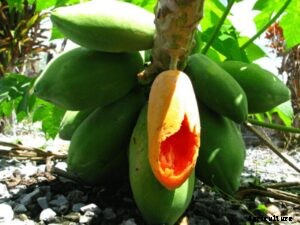 The insects targeting Papaya trees are aphids, red spider mites, stem borers, fruit flies, black weevils and grasshoppers. The removal of the contaminated component and the application of prophylactic spray such as 0.3% dimethoate will help control them.
In general, it takes Papaya 6 months to bloom and another 5 months to harvest; however, it may vary depending on the climate conditions and management. The fruits must be harvested for shipment to distant markets when the apical starts turning black, and the latex is no longer milky. The Papaya fruits can be left on the tree during the cold months to develop deeper color and get a better flavor.
Papaya fruits are harvested when they are of full size, light green at the apical end with a tinge of yellow. On maturation, some types of papaya fruits turn yellow while some stay orange. The Papaya fruits are ideal for harvesting when the latex stops being milky and becomes watery.
The Papaya plant has an economic life of 3 to 4 years. The yield of Papaya varies widely depending on the orchard’s variety, soil, environment, and management.
Click Here to Connect to Agri Traders


