
Welcome to Modern Agriculture!

Growing Amla at Home for Beginners
Here, today we are going to discuss growing Amla at home (Indian Gooseberry).
Introduction to Growing Amla at home
Amla is also known as Indian Gooseberry. Amla is an important plant in Ayurveda. They have the richest source of vitamin-C. It is vertical striped, round-shaped in structure. It is greenish-yellow in color and features a sour taste. Due to its sour taste, is mostly used in the preparation of pickles and with other ingredients. It is an important tropical plant with high medical value. The skin is tough, but the crisp flesh. The fruit has high antioxidant content. This fruit can be eaten fresh, though it tastes sour. It has many health benefits. Dried and powdered Amla powder can be sprinkled on fruits.
Topics going to cover in this article;
There are mainly four types. They are;
The other varieties are;
Light and medium-heavy soils except purely sandy soil are ideal for Amla plantation. The tree is well adapted to dry regions and may even be grown in moderate alkaline soils. Owing to its hardy nature it’s grown in a sort of soils. It has grown in slightly acidic to saline soils and may be grown in calcareous soil. It gives the best result when grown under fertile-loamy soil with a good system. It also can tolerate moderate alkaline soil. It requires the pH of soil ranging from 6.5-9.5. Avoid cultivation in heavy soils.
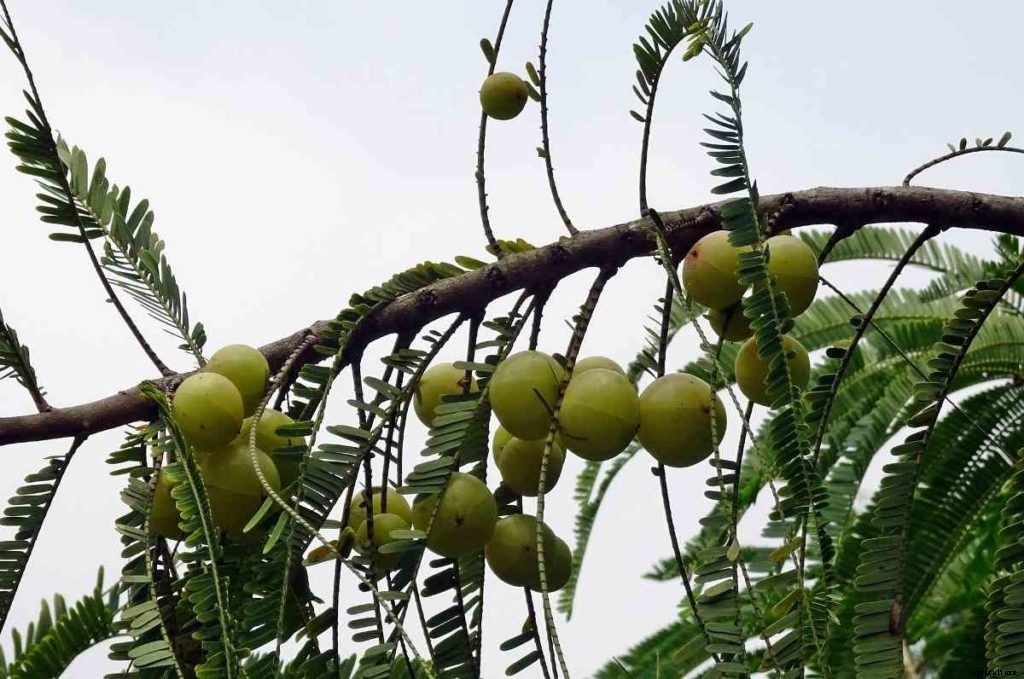
It is a tropical plant. Annual rainfall of 630-800 mm is right for its growth. The young plant up to the age of three years should be shielded from hot wind during May-June and frost during the winter months. The mature plants can tolerate freezing temperatures also as a heat up to 46 degrees C.
Amla is commonly propagated through seeds, but seed propagated trees bear quality fruits and have an extended gestation. Shield budding is completed on one-year-old seedlings with buds collected from superior strains yielding big size fruits. Older trees of inferior types are often rejuvenated and simply become superior types by top working.
The pits of a 1meter cube are prepared during May-June at a distance of 4.5 m spacing and will be left for 15-20 days exposed to sunlight. Each pit should be crammed with topsoil mixed with 15 kg farmyard manure (FYM) and one kg of superphosphate before planting the grafted seedling.
Growing Amla from seed is a very slow process but growing a tree from seeds is a tricky thing to do
Amla plants hardly require more water during monsoon. Young plants require watering during the summer months at 15 days intervals till they need fully established. Watering of mature fruit-bearing plants is suggested during summer months at bi-weekly intervals to extend fruit set and to reduce fruit drop. It responds alright to drip irrigation. After the monsoon rains, during October and December, about 25-30 liters of water per day per tree through drips should tend for the Amla plant.
Plant Amla in a location where there is less windy and sunny. The well-draining and sloppy positions are better for their growth.
It is better to leave only 4-5 well-shaped branches with the best angle at about 0.75 m from the bottom level, other dead, diseased, week crisscrossing branches and suckers should be pruned off at the top of December. Then the development of the Amla tree will be amazing.
The main branches should be allowed to seem at a height of 0.75-1 m above the bottom level. Plants should be trained to modify the central leader system. Two to four branches with wide crotch angle, appearing within the opposite directions should be encouraged in the early years.
Do thick mulching with any organic matter at the top of the spring to assist the substrate in retaining moisture.
In case if you miss this: Growing Plants in Grow Bags.
Insect pests are;
Favorable conditions – Attacks in April at the initiation of new growth.
Symptoms- Make tunnels in the main branches and trunk.
The favorable condition is the rainy season.
Symptoms- Terminal shoots swell.
Attacks during monsoon season on the onset of new growth.
Favorable condition- These pests are mainly seen from July to October with a peak period in September.
Symptoms- Yellowing the flowers with honeydew.
Favorable condition- Moist and warm conditions are more favorable for natural enemies of bugs.
Symptoms- Premature shedding of fruits and yellowing of flowers.
Favorable conditions mainly in warm conditions.
Symptoms- Leaf turns pinkish or purple then later leaves may dry out.
Favorable conditions- Mainly during September and October.
Symptoms- The extraction of larva around the entry holes are seen.
Favorable conditions- Mostly favor moist conditions.
Symptoms- Newly emerged leaves are preferred for feeding sites.
Diseases are;
Favorable conditions- After monsoon in September.
Symptoms- On Fruits Few Black Pustules Appear That Later Develop Into A Ring.
Favorable conditions- Hot and wet weather.
Symptoms- smoke brown round lesions appear on the fruit.
Favorable conditions- Second and third week of September.
Symptoms- Internal in Amla fruit is caused by a boron deficiency.
This tree is extremely common throughout tropical and subtropical parts of India, normally the plant should start fruiting by 4-5 years, and its flowers during the months of March-April. As far as my observation cares it grows well in regions where there’s good organic matter content in soil and therefore the annual rainfall is more than 700 mm once a year. Since these plants are produced by budding the interior factors like meristem size and external factors like photoperiod, water availability, C: N ratio of soils should be checked. a perfect situation should be checking all those parameters concerning two treatments like flowering versus non-flowering.
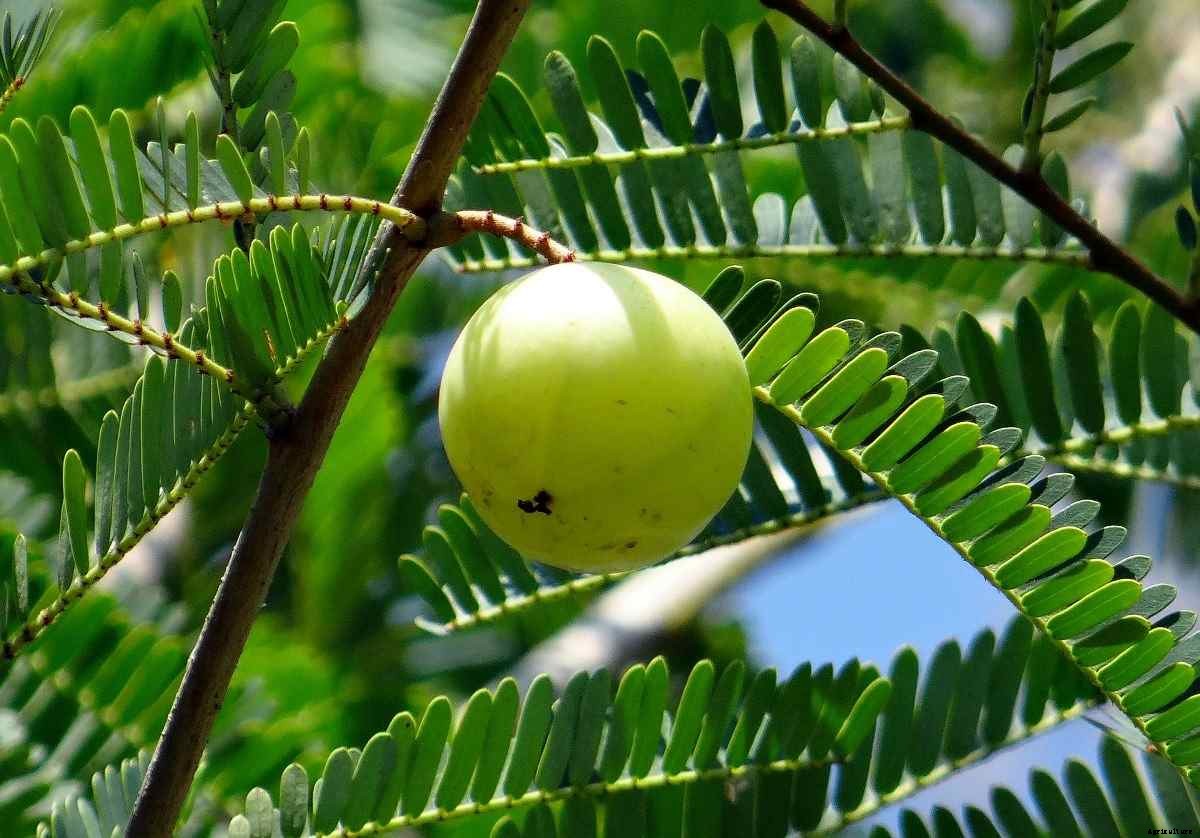
Growing an Amla tree from seed takes around five years to supply fruits. Fruits are hard and glossy, of lifeless green color and usually appear from January to March in the tropics. The mature fruits are hard and that they don’t fall at gentle touch and thus vigorous shaking is required. Fruits also can be harvested using long bamboo poles attached with hooks.
Well, Amla is one of best fruits has excellent uses and benefits. Some of them are given below;


