
Welcome to Modern Agriculture!

Introduction to growing sapota in containers: Sapota or Chikoo is a delicious tropical fruit that belongs to the Sapotaceae family that goes with the scientific name Manilkara zapota. Sapota has a grainy texture and a mildly musky flavor. The soft fleshy Sapota fruit is scooped out to make smoothies, jams and delectable desserts. Sapota fruit is high on calories providing 83 calories per 100 grams. A good source of dietary fiber, the pulp of this Sapota fruit functions as an excellent laxative. It is loaded with a rich array of vitamin A, vitamin C, niacin, folate and pantothenic acid and minerals iron, potassium, and copper.
Sapota is also known as Chicku, Sapote, Sapodilla, and Lamut. Sapota is a tree that can grow to more than 30 m tall with an average trunk diameter of 1.5 m. Sapota is sweet like a peach. If you want to enjoy it in the house then you can develop it by propagation the Sapota plant. You can germinate Sapota seeds or grafting also.
Sapota trees do not grow very well in cold weather, however mature trees tolerate the cold, as long as the temperature is not falling regularly. The fruit of the sapodilla is yellowish-brown and its leaves are shiny evergreen, and the flowers are white. Mature sapodilla generally produces fruits twice a year. After 4 to 6 months of flowering, mature Sapota fruits are obtained. Sapota plant requires well-drained sandy soil.
The important and widely adopted Sapota varieties are Kali Patli and Cricket Ball (Calcutta Large). The other Sapota varieties are pili patti, Bangalore, Baramati, Dwarapudi, and Chhatri, etc.
Cricket Ball – Also called as ‘Calcutta Large’ bears large round fruits. The pulp is gritty and granular and sweet.
Kalipatti – It has dark green broad and also thick leaves. These fruits are oval-shaped with sweet pulpy pulp.
Pala – It is a very popular variety in Andhra Pradesh and Tamil Nadu. The fruits are very small to medium with oval or egg shape borne in clusters.
Kirthibarti – It is a popular variety in Andhra Pradesh. The fruits are medium-sized, oval and the peel is rough and thick.
Baramasi – It is a popular variety in West Bengal, Bihar, and Uttar Pradesh. The fruits are medium-sized and round.
Pilipatti – This variety has unique small fruits found in Maharashtra and Gujarat. These fruits are oblong, elongated with soft sweet pulp.
Gutthi – Fruits are small-sized and oval, with apex broadly pointed. The pulp is sweet and fruits are borne in clusters.
Jonnavalasa – This fruit variety if from Andhra Pradesh has medium to large ovate fruits with light-colored peel and pulp which is sweet.
The commercially cultivated Sapota varieties are CO1, CO 2, CO.3, PKM 1, PKM 2, PKM 3, PKM-4, PKM -5, Kallipatti, Cricket Ball, Pala, Guthi, Kirtibarathi, and Oval.
Sapota is grown in a variety of soil but deep alluvial, sandy loam soil and black soil having good drainage are ideal for doing Sapota farming. Soil pH having 6.0-8.0 is optimum for growing Sapota. There are two ways to grow the Sapota plant. One way is from seed but by planting seeds it takes 6 to 7 years for fruits to come and the quality of fruit depends on the seed quality so it is a time taking process. The other method is to purchase a grafted Sapodilla (Sapota) plant from a nursery. Grafted Sapota plant starts to bear fruits in 2 to 3 years. Growing Sapota is not particular when it comes to water requirements. They may do equally well in arid or humid environments, although more severe conditions can result in a lack of fruiting.
You should not miss the Growing Fenugreek Hydroponically.
Sapota trees grow well in containers as long as you provide an adequate size pot for root development. Select a pot 18 to 24 plus inches in diameter and 20 plus inches in height, with adequate drain holes. Glazed pots need far less watering than raw terracotta pots due to their porous nature.
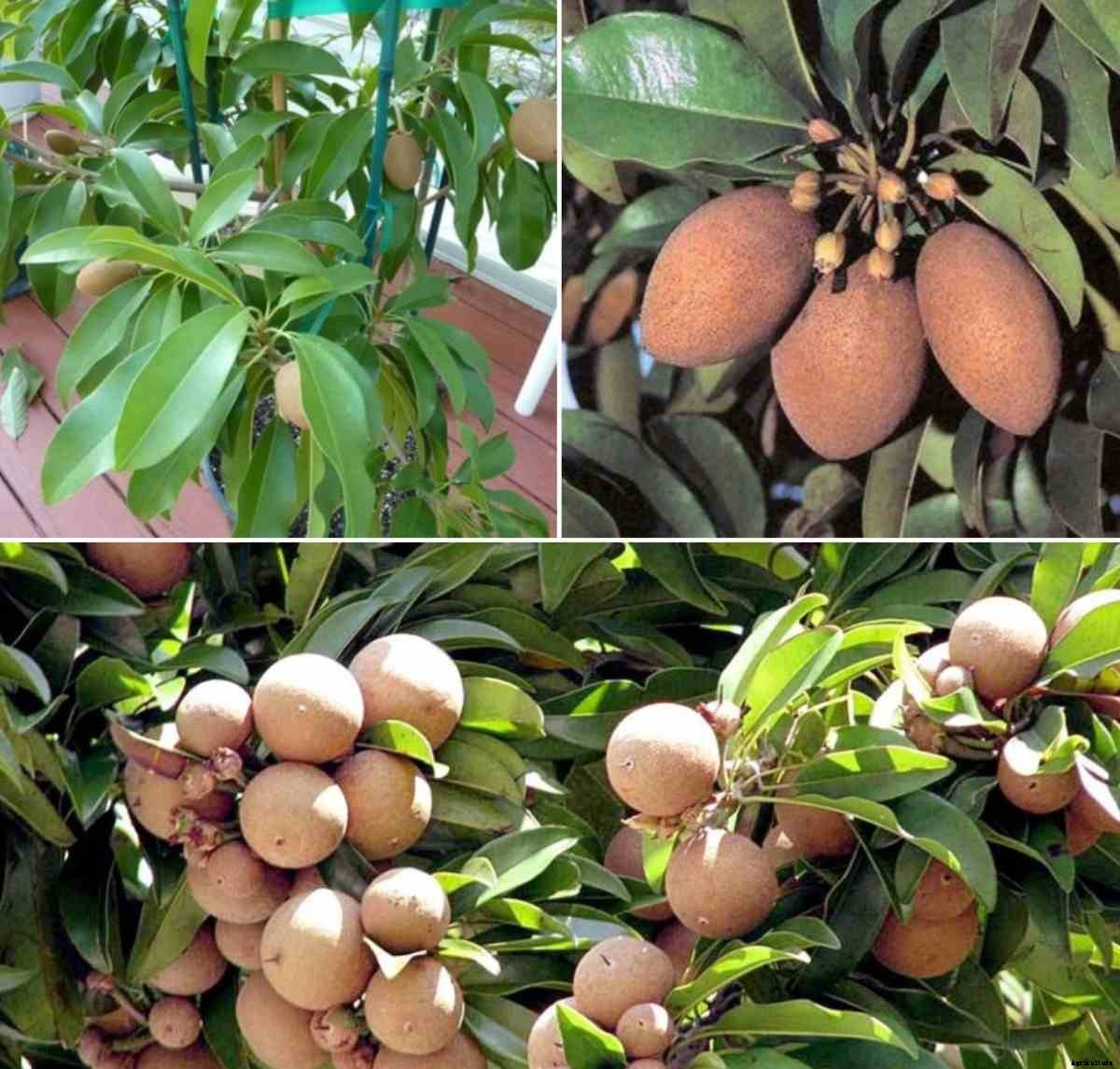
Indoor light – A bright and sunny solarium or window location with more southern exposure is best for plant growth and fruit production. Many customers have reported fruit harvesting from trees that live-in home and patio environments.
Outdoor light – Sapota trees prefer bright light and direct sun. If possible 12 hours of bright sunlight is best for plant growth and fruit production.
Sapota trees may be propagated by seed or vegetatively. Seeds must be planted within 3 weeks of harvesting from the fruit, and seedlings may begin to bear in 7 to 8 years. Sapota varieties do not come true to seed and should be vegetatively propagated by grafting or budding onto seedling rootstock. Grafting and budding are most successful during the warm season when trees are actively growing.
To plant the Sapodilla tree, select a healthy tree from a nearby nursery that looks insect free and strong. Select a large container for this. In the container, make a hole equal to 3 times the length of the root ball. Make the Sapota tree straight in the center and Push down on the dirt slightly to fill the hole. After dirt fills a thin layer of compost, then it works as a fertilizer and mulch for the young tree. Then fill surrounding soil on the root ball. Choose the full sunny place of the container. Its plant requires about 6 to 8 hours of sunlight.
Incase if you miss this: Growing Spinach on Terrace from Seeds.
Water the roots after planting, save tree trunk and plant leaves from wetting. Also, the water completely dries out, otherwise, there is a root of the rot. Give water to every other day for 2 weeks, and then water it once or twice a month for 3 months. Provide extra water in the dry period. After this, add fertilizer to the young plants, whether you wish to give fruit according to the instructions given in the compost.
It is recommended that you fertilize at the same time as you water using a time-released fertilizer 8-3-9 or similar to help your Sapota trees grow and produce a substantial crop. These Sapota trees are moderate feeders and require multiple feeding during the growing season. It is very important to follow the fertilizers labeled instructions as to not burn or kill the tree.
Sapota is almost insect resistant but it is compulsory to save it from the cold. There are some insects that trouble sapodilla such as Banana spotting bugs, Caterpillars. This problem can be tackled by pesticide spraying and there are no major diseases of Sapodilla, the rust of a leaf, which causes the small leaves to be destroyed.
Sapota is difficult to say that seeing cropped, that crop is ready for the time of harvest. However, the maturity of the crop is about 8 to 10 weeks. To know the maturity of the crop scratch the skin, the pulp color should be brown like cinnamon. Sapota should be kept at room temperature for 5 to 10 days to ripen sapodillas. The fruit must be eaten when it is a slightly firm, not mushy. Good condition of fruits can be kept in the fridge for one week.
You may apply the above information for growing chikoo on terrace, growing chikoo fruit in backyard, growing chikoo fruit in balcony, growing chikoo fruit indoors, growing chikoo fruit outdoors, and growing chikoo fruit in polyhouse. You might be interested in Growing Vegetables in Winter.


