Growing Parijat, Brahma Kamal, Raat Ki Rani from Seed
Introduction: Well, today we disscuss wonderful flowering plants of Growing Parijat, Brahma Kamal, Raat Ki Rani. Many people are showing interest in growing these plants in their indoor, backyards or terrace garden.
A step by step guide growing Parijat, Brahma Kamal, Raat Ki Rani
Now, we loook into growing Parijat, Brahma Kamal, Raat Ki Rani plants on your own at home.
Growing Parijat plant
The Parijat plant is a beautiful and mysterious plant whose flowers fall on the ground after blooming. Parijat flower is also known as Night-flowering Jasmine and Coral Jasmine worldwide. Its botanical name is Nyctanthes arbor-tristis and is a species of Nyctanthes and it is native to South Asia and Southeast Asia.
Parijat flowers have 4 to 8 petals arranged above a vibrant orange tube in a pinwheel pattern. These highly fragrant Parijat flowers open at night spreading their fragrance in the surrounding area with a sweet floral aroma.
The flower oil is also prominently used as a perfume. The Parijat flower has a very strong fragrance, hence it is used for making incense sticks. Now let us look into growing Parijat plant.
Planting process for Parijat
Choose a pot with holes at the bottom to drain excess water from the pot.
Add a sufficient amount of water and organic manures on a regular basis for normal growth and health.
Always keep the soil just moist and not waterlogging to avoid water stagnation thus responsible for root rot.
If possible spray humic acid @ 5 ml in one liter of water directly on the plant leaves.
You can expect the flowering when the plant reaches at least 5 to 6 feet in height.
Parijat plant care may require a bit of effort, but the results are well worth the work. Not all plants are fragrant, but the most regular and hardy do produce a sweet, carrying fragrance. Common is a vine and it has larger glossy green leaves than Royal. Both can survive in temperate climates if they are planted in a sheltered area.
Every leaf has a growth bud, so removing old flower blossoms encourages the Parijat plant to create more flowers instead of using the energy to make seeds. Clean away from around the base of the plants any trimmed debris that can harbor disease and insects.
Growing Parijat plant from seed
Try Paper bag method for growing Parijat
Put 10 to 15 seeds in a moist paper towel.
Put the paper towel in a zip-lock bag and puffed it up by blowing air in it.
Left the zip-lock bag by the window.
After about 10 days the seeds will start sprouting.
This paper bag method has been the fastest and most successful method for growing Parijat from seed.
Parijat plant care
The greatest enemy of this Parijat plant is standing water, which causes the roots to rot and die. Periodic deep watering, well-rotted flower compost, and judicious pruning is enough for this Parijat plant and is enough to make it bloom and make your garden beautiful and fragrant.
Fertilizing the Parijat plants once a year will be beneficial. The Parijat plant needs trimming as the shoots grow in different directions. It is better to grow the Parijat plant in the shaded area of the garden which receives a few hours of direct sunlight. That’s all about growing Parijat.
You should not miss the Vastu for Planting Trees at Home.
Growing Brahma Kamalam
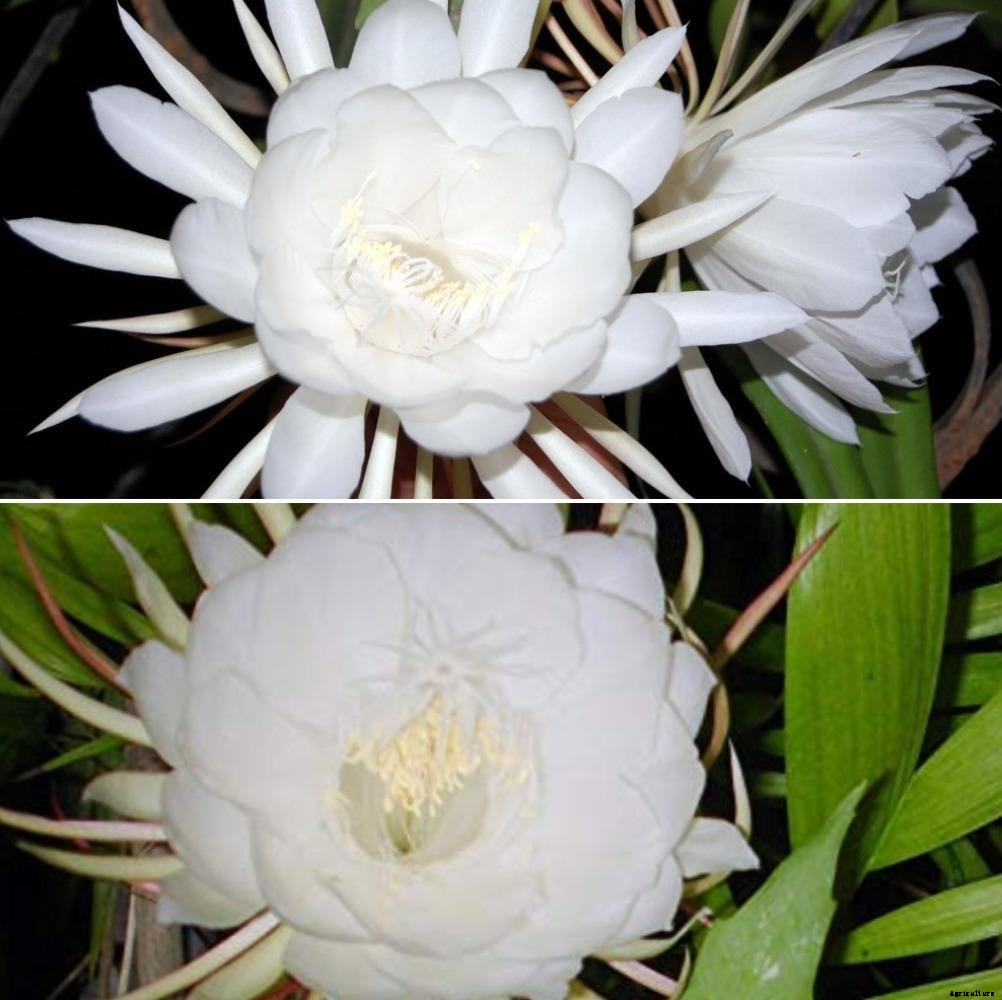
The Brahma Kamalam produces midnight-blooming, fragrant, cup-shaped flowers. These plants have large pure white star-like flowers with high fragrance and the flower starts blooming after sunset from 7 pm onwards and it takes about 2 hours to full bloom, approximately about 8 inches in diameter and remains open throughout the night. It is generally known as Night-blooming Cereus, Queen of the night, Lady of the night as its beautiful Lotus like flower blooms late night. It is popularly known as Orchid Cactus as the flower has orchid-like beauty and the plant resembles cactus inhabit. It is believed to bring in loads of good luck and prosperity and a home where the flowers bloom is auspicious and lucky.
Soil type and fertilizer for growing Brahma Kamalam
Choosing the right soil type is very important. In the case of this night-blooming plant, it is advisable to use soil that is slightly acidic and you can use a potting medium that has peat moss, sand, and pine bark in the ratio of 2:1:1. And, make sure that the soil is well-drained. This plant will produce better if it is slightly root-bound. The planting soil can be amended by applying fertilizer. You can use organic matter to replenish the soil or apply a balanced 20-20-20 liquid houseplant fertilizer or a fertilizer that has less nitrogen. Apply the fertilizer once a month from spring through fall and dilute the fertilizer to ensure that the plant doesn’t get excess nitrogen. Excess nitrogen can cause the stems to grow, though reducing the number of blooms. The application of fertilizer can be gradually avoided during winter and late fall.
Light and temperature requirements
It must be noted that Brahma Kamal prefers bright, indirect light. It doesn’t grow well in direct sun. So, you could place it around a south-facing window, where the plant can obtain indirect light for at least 6 hours a day. This Brahma Kamal plant doesn’t tolerate temperatures above 100°F. Being a tropical plant, it mainly prefers temperature within the range of 50 to 90°F. Therefore, it must not be exposed to temperatures below 35°F. It is advisable to bring the Brahma Kamal plant indoors if the temperature falls below 40°F. Make sure that the Brahma Kamal plant is not kept around cooling or heating vents, as exposure to cold or hot drafts can cause a fluctuation in temperature.
Planting of Brahma Kamal
This flowering plant is easy to start from a cutting in the early spring season. Re-pot with some proportions such as 3 parts of potting soil, 1 part of grit (pumice), 1 part of the horticultural-grade sand, 1/2 part of the compost, etc.
Propagation of Brahma Kamal
Brahma Kamal plant is propagated by rhizome, herbaceous stem, and leaf-cutting or layering. It prefers acidic soil and filtered sunlight. To grow the Brahma Kamal plant, a Phyllocade is planted in the soil or is placed horizontally on the soil. The cut phylloclade can be dipped in water. In about three weeks adventitious roots come out and then planted in a pot containing soil.
Water for Brahma Kamal plant
Brahma Kamal plant is a type of cactus; it does not need too much water. You should water it once in two to three days unless you are in a really dry place. Never over water this Brahma Kamal plant as it will get waterlogged and die.
Tips for growing Brahma Kamal plant
Avoid repotting the Brahma Kamal plant and feed the plant regularly for flowering.
Do not trim leave let them dry on the Brahma Kamal plant itself.
Do not over water, Brahma Kamal plant has fleshy stem leaves and can do away with less water.
Cow dung is best for flowering as manure and finally, most importantly, do try to get a healthy mature Brahma Kamal plant, growing plant from leaves cuttings takes lots of years for the plant to mature and give your blooms.
You may also like the Growing Carissa Carandas.
Caring for Brahma Kamal
Keep Brahma Kamal plant in a bright sunny location.
Try not to water the plant leaves, give water to soil only.
Avoid overwatering as the roots can get rot.
Water the Brahma Kamal plant in a morning, between 8 to 10 am.
Avoid keeping Brahma Kamal in suffocated areas or in a dark room.
While re-potting or propagating try not to disturb the roots.
Save a dying Brahma Kamal plant
If you see plant edges drying off, trim them, this saves the whole leaf from dying.
If the soil is cloggy and you see the leaves of the Brahma Kamal plant drooping, transplant immediately.
Remember each plant leaf can grow in a new plant. Select well-draining soil.
Though you cut a Brahma Kamal leaflet it dry for some time to heal, otherwise the leaf rots.
If the plant looks like dying if you see a single erect leaf give that leaf some support, it will immediately bring out roots and new leaves.
The Brahma Kamal plant needs strong soil and firm support, if you pull out the plant, an old plant will not come out and a sick plant will immediately leave the soil.
For the transplanted cuttings Brahma Kamal plant, do not water heavily and spray water carefully or else they die.
Raat Ki Rani Plant or Night-Blooming Jasmine Plant
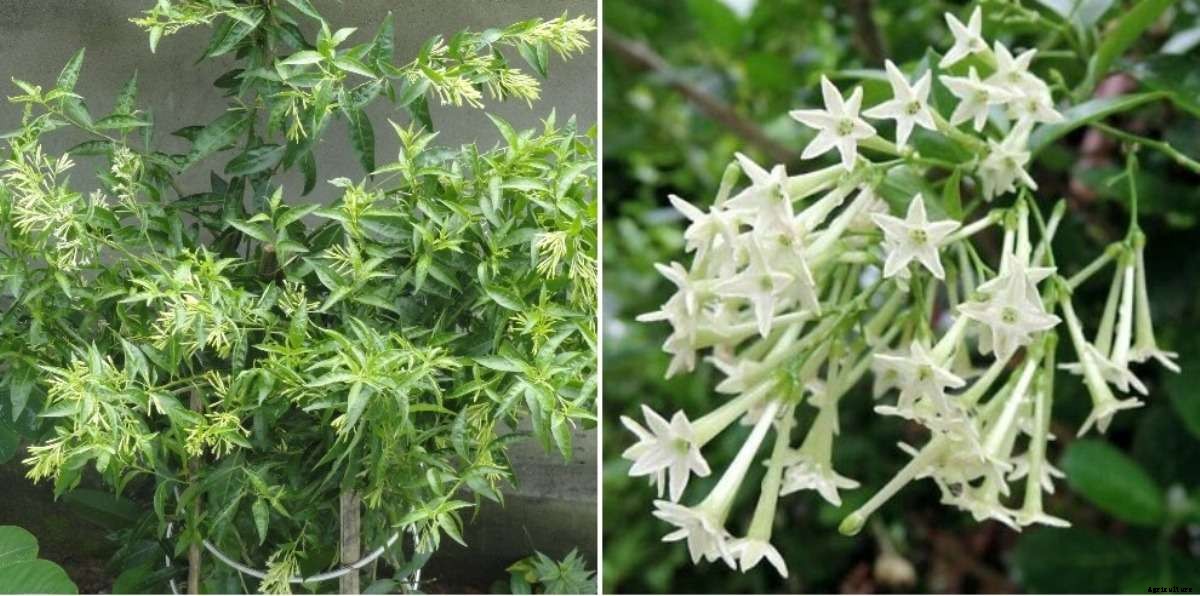
Raat Ki Rani is commonly known as Queen of Night or Night-blooming jasmine is a fragrant flowering bush. The scientific name of Raat Ki Rani Plant is Cestrum nocturnum, it is a flowering bush that can grow in all climates and is an evergreen flowering bush. Raat Ki Rani plant is a species of Cestrum in the plant family Solanaceae.
Sun and Soil for growing Raat Ki Rani
Raat Ki Rani grows best in well-draining, sandy soil, preferably somewhere with a lot of space for its roots to spread out. This plant does well in partial to full sun but is sensitive to temperature extremes. So, place it in a location filtered from intense sun and protected from damaging freezes, if needed. If you grow Raat Ki Rani in a container, bring it indoors when the forecast calls for extreme cold. A moderately fast grower, the Raat Ki Rani plant reaches 8 to 10 feet tall and 3 feet wide at maturity. An ideal option for screening, it can easily be trained to grow up a trellis or pruned into a hedge.
Keep your Raat Ki Rani plant healthy
Before Raat Ki Rani is well established, it needs deep, weekly watering though beware of soggy or excessively salty soil conditions. If the weather is hot, or if you have a potted plant, check each day for dry soil, and water accordingly. Potted plants can be pruned more often when not in bloom to maintain their shape. Raat Ki Rani in a container will require repotting every two to three years so it doesn’t become root-bound. The Raat Ki Rani plant doesn’t require much feeding; once a year in early spring is sufficient. Keep in mind that feeding plants too much nitrogen can cause over-salty soil and impede the plant’s growth.
You may also consider to read Soilless Tomato Gardening.
General Tips for Growing Raat Ki Rani
If there is a Raat Ki Rani already growing in your neighborhood, you might like to ask the owner for a cutting. If not, don’t worry because you can easily find them at a local nursery or online.
The plants like sunlight, but not all day. An east or west facing position is fine for them.
Water the Raat Ki Rani plant well in the summer, but leave them on the dry side in winter.
Replace their compost every year if plant grown in pots. Raat Ki Rani is hungry plants that can soon sap all the nutrients out of the compost.
Raat Ki Rani makes very good insect repellants, especially for mosquitoes.
Growing Raat Ki Rani in pot or ground
The Raat Ki Rani grows best in a garden bed, or it can also be grown in pots or containers. Select a pot of size about 75 liters (20 gallons) with a number of holes to provide drainage. It is better to start with a smaller pot and transplant it in the next bigger size as the roots produce.
Propagation of Raat Ki Rani from seeds
Following are the steps for growing Raat Ki Rani from seeds;
The seeds of Raat Ki Rani are very small, about 2 mm so they are surface sown to germinate. The seed germination requires a temperature range of 75°F (23°C).
Fill a small pot or container with seed planting soil and water it until water comes out the bottom.
Put 2 seeds on the soil surface and cover with a thin layer of soil and press down on the seeds gently.
Place the pot where it receives full sun and keep the soil moist but not wet.
Pinch out the weaker seedling and the seedling is at least 6 inches tall, transplant to a larger container.
Propagation of Raat Ki Rani from cuttings
Following are the steps for growing Raat Ki Rani from cuttings;
It is easy to root a Raat Ki Rani from a stem cutting.
Early in the morning, cut a semi-hardwood thin stem, pencil length from the plant above a node and do not take cutting which has flowers or buds.
Remove the lower set of plant leaves from the cutting. Put the cutting in a rooting media and insert it into wet soil in a small pot or container. Enclose the container in a polythene bag and tie the top.
Place in shade location. You can put 3 to 4 cuttings in the same pot to root.
The cutting will be rooted in a couple of weeks and then transplant them in a bigger pot.
Caring for Raat Ki Rani Plant
Raat Ki Rani plant grows best when trimmed and kept in the size and shape of a bush otherwise it grows thin developing a long stem trailing like a climber and taking over the other pots.
It also looks good when the white flowers grow on the bush and the sight is wonderful to see the round shape of the Raat Ki Rani with tiny tubular white flowers growing in bunches drooping down with its weight.
Raat Ki Rani or Night-blooming jasmine blooms only when the weather is warm.
The Raat Ki Rani grows well in full sunlight or partial shade.
The plant will die if exposed to frost but will produce again in the spring.
Carefully add topsoil or organic peat humus to the hole when you plant. You can add composted cow manure, which enriches the soil around the root ball, to the mix.
Fertilize 3 times a year with a good quality granular fertilizer. You can supplement feedings with periodic applications of bone meal and liquid fertilizer to promote heavier bloom.
You may be interested in How to Grow Basmati Rice from Seed.