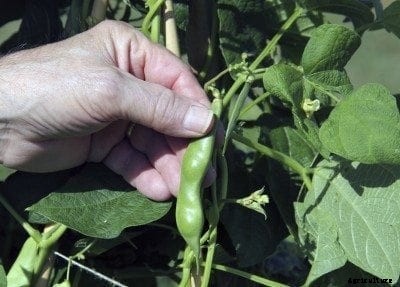
Whatever you call them — green beans, string beans, snap beans or bush beans, this vegetable is one of the most popular summer veggies to grow. There is a huge array of different varieties suitable to most regions, but nonetheless, beans have their share of problems — among them are stunted bean plants. Read on to learn more about beans not growing larger.
Why are My Beans so Small?
If you’re dealing with beans too small, you’re not alone. There are a number of things that can lead to plants and bean pods too little for your taste. First of all, beans are a warm weather crop that require a short growing season, with most major commercial production occurring in Wisconsin, western New York and Oregon in the United States.
While all growing beans need full sun and fertile, well-draining soil for optimal production, too much sun or rather high temps may have an adverse affect on the bean plot. High temperatures during certain parts of the growing season may be one reason for stunted bean plants or bean pods that are too little.
On the other side of the spectrum, while bean plants require adequate irrigation, overly wet weather may interfere with a successful harvest, causing pod diseases which may result in beans that are too small.
How to Avoid Stunted Bean Plants
To avoid bean plants that are too small, proper care must be taken in the selection of beans suitable for your region, soil condition, spacing, and the timing of planting.
- Soil – Bean plants like well-drained, fertile soil, which should be amended with plenty of organic matter (2-3 inches) (5-7.6 cm.) and a complete fertilizer (1 lb. of 16-16-18 per 100 sq. feet) (454 gr. per 9m˄²) prior to planting. Work both the compost and fertilizer into the soil at a depth of 6 inches (15 cm.). Thereafter, beans do not need additional fertilizer. Most bean varieties fix nitrogen from the air through soil bacteria via the plants root system. Therefore, additional fertilizer will over stimulate foliage growth, delay bloom time and reduce pod set, resulting in beans that are not growing to their full potential.
- Temperature – Beans like warmth and should not be planted until soil temps are at least 60 degrees F. (15 C.). Cooler temperatures may result in seeds not germinating due to rotting or inferior plant growth, such as low production. Begin planting beans one week before the last frost date in your region.
- Spacing – Proper spacing should be adhered to and pole type beans should be staked or trellised. This will also aid you when it is harvest time. Rows should be spaced 18-24 inches (46-61 cm.) apart with seeds down 1” (2.5 cm.) deep and 2-3 inches (2.5- 7.6 cm.) apart. You want plenty of aeration to thwart diseases that may result in beans that are too small, but not so much that it will foster root rot diseases or slow plant growth.
- Water – Beans need regular irrigation during the entire growing season. Stress caused by lack of water will influence not only production, but may engender bean pods too little and lacking in flavor. This is where incorporation of good organic mulch will help to conserve water and facilitate the growth of plentiful harvests of large tender beans. Regular water is at its most crucial during and after flowering when pods are maturing to avoid bean pods that are too little.
- Mulch – Additionally, plastic mulches can help to conserve water, provide some protection from frost and allow for an earlier planting season. Row covers may also be used to protect seedlings from frost. Organic mulches made of straw, shredded paper, or grass clippings can be applied during the summer to improve water retention, control weeds, and increase nutrition absorption.
- Weed/Pest control – Control weeds surrounding the plants which may provide homes for pesky insects and/or fungal disease. Root knot nematodes are common pests that live in the soil and feed on the nutrients of the roots, resulting in yellow and stunted plants. Monitor and control any insect infestations with appropriate insecticides if need be, and do not over water and allow plants to dry between watering.
- Harvest time – Lastly, to prevent bean plants or pods that are not growing fully, be sure to plant at the correct time and harvest at the correct time. Pick pods about seven to 14 days after flowering.
The next time someone asks, “Why are my beans so small,” look toward one’s growing conditions in the garden. Making simple corrections to your bean plant’s environment could mean the difference between a bountiful bean harvest or a pitiful batch of beans not growing.


