
Welcome to Modern Agriculture!

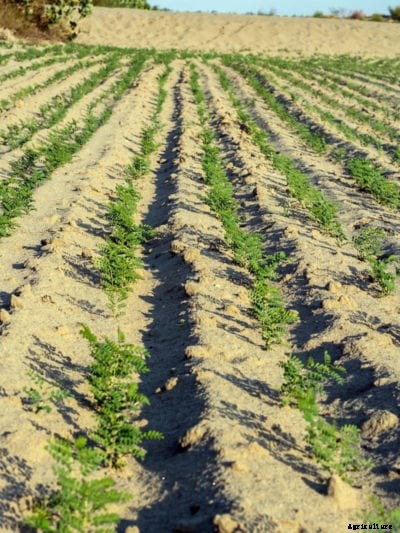
Using the shape of the land to maximize water capture is a time-honored tradition. This practice is called contour gardening. While straight beds may be visually appealing and easy to harvest or hoe between, they are not always the best to conserve moisture.
Read on to learn more about contour gardening.
You don’t always get land that is perfectly flat or has straight lines. Sometimes, you just have to wing it and get creative to make garden beds. Don’t force beds where they aren’t naturally fitting into the landscape. Instead, use the oddness of the land’s configuration by building contour beds.
Developing contour garden rows makes sense. It allows you to work with the land rather than against it. Consider the rice paddies of Japan which arch and angle as they tiptoe down the hills. Great examples of contour gardening are often found in commercial crop fields where every inch of land is valuable and topsoil loss must be avoided.
There are many ways to develop contour garden rows. Often using existing soil is sufficient, but on deep slopes, swales and trenches are needed. Sometimes, wood is buried under the beds to increase water absorption in poor soils.
The four main benefits of contour gardening are:
These are important in any cropping situations but especially areas where soil is light, and rain is plentiful. Much of our cropland has been drained of its nutrient rich topsoil. Heavy rains drive deep trenches in soil and cause landslides. Even in controlled irrigation, much of the water is lost to runoff when there is nothing to catch the moisture.
In situations where fertilizer and herbicides are used, this means the chemicals flow down into moving water systems, causing algae and creating a toxic environment for wildlife. Without contour garden rows, crop and land losses can occur. Planting across the natural lines of the site reduces rain gullies and runoff.
If your site is small, all you will need is a shovel to start the process. Take a look at the curves of the land and consider how pitched the slope is. You may want to eyeball the situation or map it out with a laser or A-frame level for a professional job.
If the slope is not steep, simply scoop out soil following the curve of the land and deposit it on the downward sloping side of the trenches, making berms. You can choose to shore these up with rock or stone. Alternatively, you can build raised beds to confine the soil. These create microclimates that encourage a diversity of plants.


