
Welcome to Modern Agriculture!

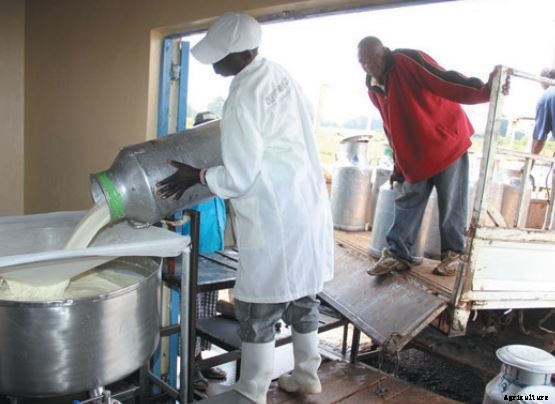
MILK HYGIENE IS IMPORTANT FOR OUR HEALTH : Milk is one of the few products with a no-recall chance once it is sold. It is highly perishable and has a short shelf-life. The tests taken on samples of milk require a few days before results are available. By this time the milk has already been sold and consumed. Therefore it is only by taking preventive measures within dairies that we can ensure the safety of our milk. Formal processors are expected to adhere to milk standards of quality and hygiene recommended by regulatory institution.
They are expected to test their milk regularly. This is to ensure that they can trouble shoot effectively and efficiently if contamination is detected. This is not expected or affordable in the informal sector. There is however, a serious drive to ensure milk producers all over the country have access to information on dairy hygiene, to ensure safe milk and other dairy products. Milk straight from a healthy cow carries
a bacterial load of 8 parts per ml. This in itself is not a problem at all. The bacteria, some of which are good and others harmful, can however double every 20 minutes given the right conditions. If you do the calculation, you will see that within 6 hours of milk sitting at ambient temperature, the bacterial load can reach 2,000,000 parts per ml. It is thus extremely important that raw milk from healthy cows is
consumed as soon as possible.
If milk must be kept, the temperature must be dropped as soon as possible and maintained at a cool temperature of 4 to 7 degrees centigrade. Fresh raw milk that is cooled to these temperatures has a 3-4 day shelf life. Most contamination occurs after milking! Bacteria are picked up from dirty hands, contaminated dirty milk
WHAT YOU SHOULD OBSERVE:
• Have hot water available when milking;
• Wash the cow’s udder with warm water
• Wash the milk bucket with hot water before commencing milking;
• Wash your hands with hot soapy water before milking;
• Ensure that the cow’s tail and legs do not contaminate the milk;
• Remove the milking bucket from splashes if the cow urinates or defecates
• During milking; the bacteria E. coli (Escherichia coli) for instance, which are rarely harmful, but can cause diarrhoea, are transmitted by manure;
• Use a good milking salve during milking;
• Check the udder for mastitis; if the udder is hot or the milk clotted. In such a case, discard the milk and treat the cow. If milking more than one animal clean the bucket with very hot soapy water and rinse it thoroughly;
• Ensure that all milking utensils are cleaned with hot water before and after milking;
• Sieve milk through sterilised gauze into milk churn or container;
• Drop the temperature as soon as possible after milking by refrigeration, or raise temperature to pasteurisation and then drop to 4-7 degrees centigrade.
• Respect your animal and the consumers of your milk.
WHAT YOU SHOULD AVOID:
• Do not smoke while milking or in between milking.
• Do not leave milk in churns or mitungis in the hot sun.
• Do not use unboiled water to clean milking utensils.
• Do not add contaminants like hydrogen peroxide to extend milk’s shelf life.
• Do not add water to milk.


