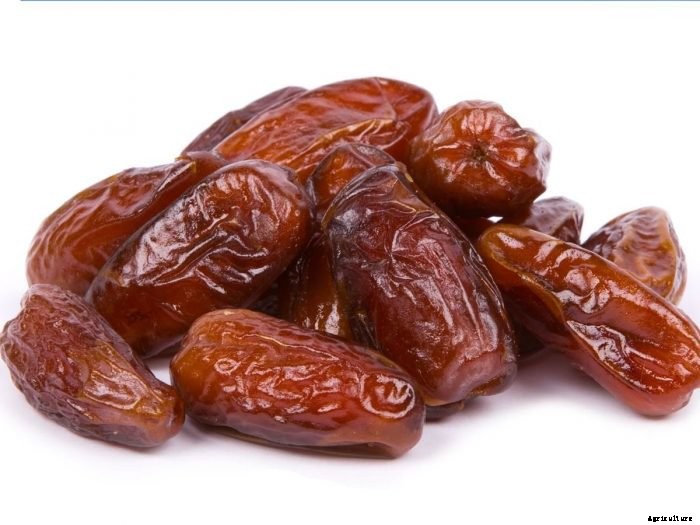
Adaptation
The following ecological conditions in Pakistan are suitable for date cultivation:
- Elevations ranging from 100-200 m.
- Suitable temperatures range from 3 to 45 degree centigrade.. Date palms like a warm climate where summers are considerably longer than winters. It is generally said that its feet should be in water and its head in the fire.
- Date palms prefer a rainfall of 200 to 250 mm. Late rains during flowering and ripening periods are harmful for date palm. Date palms require sandy loam and clayey loam soils and can tolerate soils with high levels of salts.
Areas of production
- Punjab Distt. Jhang, Multan Muzafargarh & D.G. Khan
- Sindh ” Sukhur & Khairpur
- Baluchistan ” Turbat & Punjgoor
- NWFP ” D.I. Khan.
Varieties
- Punjab Hillavi, Khudravi
- Sindh Asil, Fasli.
- NWFP Dhakki, Basri, Halini and Zahidi
- Baluchistan Muzawati, Begum Jangi, Halini ,Sabzo.
Sowing, Planting, Growth
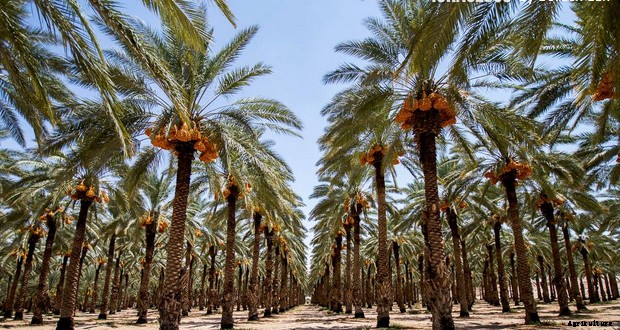
Propagation is done by means of suckers, i.e. shoots arising from the base of the tree. To separate the suckers from the tree first remove the earth from the base and then separate very carefully from the trunk in a manner that the rudimentary roots at the base of the sucker are not injured otherwise chances for success will be very low.
- Suitable age of suckers for transplanting: 2-3 Years.
- Time of transplanting: Spring: Feb to Mar, Autumn: Sept/Oct
- Time to start bearing: 4-5 years
- Time to full production: 6-8 years
- Normal economic bearing life: 50 years
- Time of flowering: Feb to March
- Time of harvest: Aug to Oct
Pits are prepared one month before transplanting in Jan/Feb for a spring planting and Aug/Sep for an autumn planting. Normal pit size is 75 x 75 x 75 cm. The suckers are placed in the pit in the same position as it was attached with the mother tree.
Datepalm is a unisexual tree. Pollination in date is therefore absolutely essential. In wild plantation, there are already male trees growing in abundance that can supply pollen for fruit formation. In commercial orchards, plant male trees in the ratio of 1 male to 20 females for better yield, otherwise artificial pollination by hand will be necessary to obtain good production.
Planting : Orchards are planted on a square system.
Spacing: trees are spaced as 6 x 6 m or 20 x 20 feet or 112 trees/acre.
Pruning
No training or pruning is required except removal of dried and diseased leaves.
Intercropping
Datepalm trees provide enough space for intercropping even if they are fully grown as they do not cover much area being a very tall tree. It is possible to grow a mixed fruit orchard, such as date intercropped with citrus. Field crops, such as fodders and vegetables may also be grown together with datepalms.
Pest and Diseases
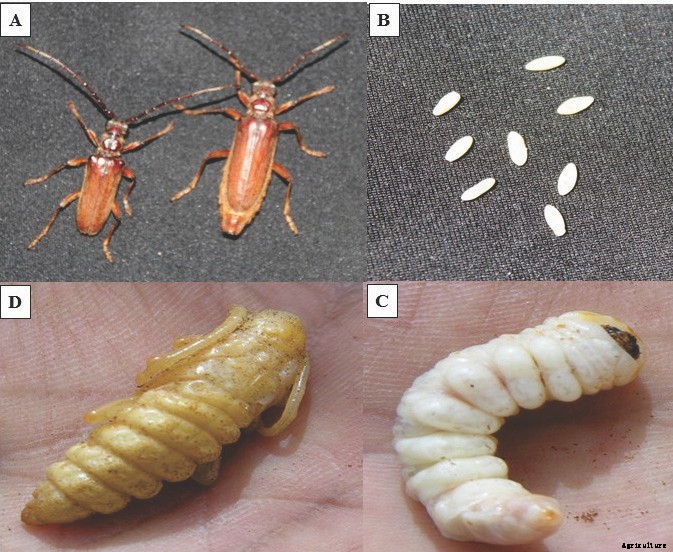
- Borer: Borers enter into the truck of the tree and make tunnels. The tree appears green but gradually it bends over and breaks. Use any recommended emulsion or carbon bisulphide granules which should be dropped into the holes and plugged with cotton wool and plastic.
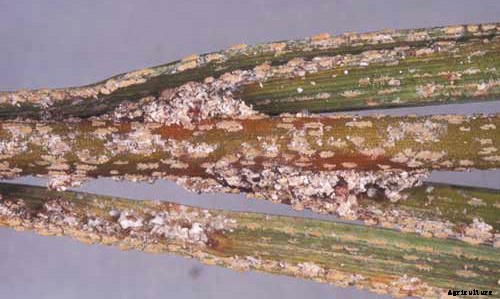
- Scales: All the recommended varieties are attacked by this insect. It sucks the slap from the leaves and small brown spots appear on the leaves. Use Folidol or Metasystox at the rate of 1 litre in 450 litres of water per acres for its control.
There are no major diseases of date palm observed in Pakistan.
Water Management
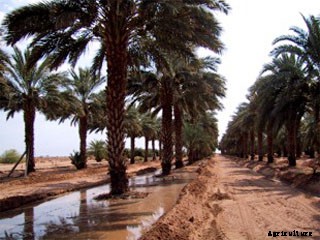
- Annual Crop water demand: 900-1300 mm
- Rooting depth: 1.5 to 2.5 m
- Allowable depletion of soil water from the root zone: 50%
- Range of suitable gross application depths of water : 75-90 mm.
- Irrigation intervals: 15-25 days
Dates will also tolerate a longer irrigation interval of 30-40 days with gross applications of 130-140 mm. Irrigation depths and intervals will depend on the water requirements of the intercross grown with the datepalm.
Fertilizers and Manures
Apply FYM 15-20 days before flowering in January at the rate of 30-40 kg per tree. At the same time, also apply 2 kg of SSP sand 1 – 1.5 kg of Urea per tree. At fruit setting in Mar/Apr, apply a further 1 – 1.5 kg per tree of Urea.
Harvesting
The fruit is picked at three stages:
- Doka stage when the fruit is 50% ripe fruit and yellowish in colour.
- Dang stage when the fruit is fully developed and the tip of the fruit begins to soften.
- Pind stage when the fruit is fully ripe and dark reddish and the fruit is soft.
- Expected yield is about 100-150 kg per tree.
Production Constraints
- Lack of high yielding and better quality varieties.
- Slow and unsure offshoots propagation methods resulting in high mortality.
- Lack of know how with respect to cultural practices, processing and marketing.
- Proper ratio of male and female pollens (4:100) is not maintained. As good male plants have not been identified.
Future Strategy
- A lot of research data generated on different government date farms should be compiled and published.
- Desired male palms with respect to time of blooming, compatibility, amount of pollens, identify of pollens and their effect on productivity, quality and maturity should be studied.
- Pollen banks should be established in order to make pollen available to the farmers at critical times.
- Micropropagation of date palm through tissue culture may be strengthened at NARC and similar facilities in the provinces.
- Technology for producing more off shoots and their survival after transplanting should be improved.
- Agronomic research on water management, spacing and fertilization should be updated.
- Control against palm weevil fruitfly and diseases like graphiola leaf spot and bunchy top virus may be ensured.
- Improved solar dryer needs to be used for drying.
- Lining of baskets with food grade plastic film is needed.
- The existing chohara cottage industry may be improved Datepalm syrup industry from inferior dates be established.
- Determination of different datepalm varieties for fresh fruits and cold storage are needed.


![Can Palm Trees Survive Snow? [The answer may surprise you!]](https://modernagriculturefarm.com/article/uploadfiles/202211/2022111621512325_S.jpg)