
Welcome to Modern Agriculture!

Introduction to Organic Pistachio Farming
In India, Pistachio cultivation mainly grown for its edible nuts and it is a deciduous tree in the family Anacardiaceae. Pistachios are the fruits of the Pistachio tree. On the tree, Pistachios grow in grape-like clusters and the shell has the Pistachio inside. The leaves of the Pistachio tree are pinnate and composed of five individual oval leaflets. The Pistachio tree flowers are small, brownish-green in color, and lack petals. The fruit of the Pistachio tree is a drupe with an oblong kernel covered with a thin, bony shell. Then, the shell splits along its long axes when mature. Pistachio trees can reach up to 20 feet in the wild but are generally smaller under cultivation.
The scientific name of the Pista or Pistachio tree is Pistacia vera. It is a small tree that belongs to the family of Cashews and native to the central or Middle Eastern parts of Asia. This plant can grow up to a height of about 10 meters. The seeds of these trees are referred to as Pistachios or Pista. It is a famous dry fruit, widely loved by people in India. Pistachio is a nutritious nut that has a different variety of uses and apart from being used as a snack, it is used to add crunch to a variety of Indian dishes. Organic Pistachios production is a holistic system designed to optimize the productivity and fitness of diverse communities within the agro-ecosystem and using organic fertilizers, organic control of pests, and diseases. The main principle goal of organic Pistachios production is to develop enterprises that are sustainable and harmonious with the environment.
Pistachio is one of the important nuts in the world due to its special organoleptic characteristics. This plant species has been used as a savory snack or as a major ingredient in many traditional desserts, pastries, fermented meats, and puddings throughout human history. Now, let us get into the details of Organic Pistachio Farming.
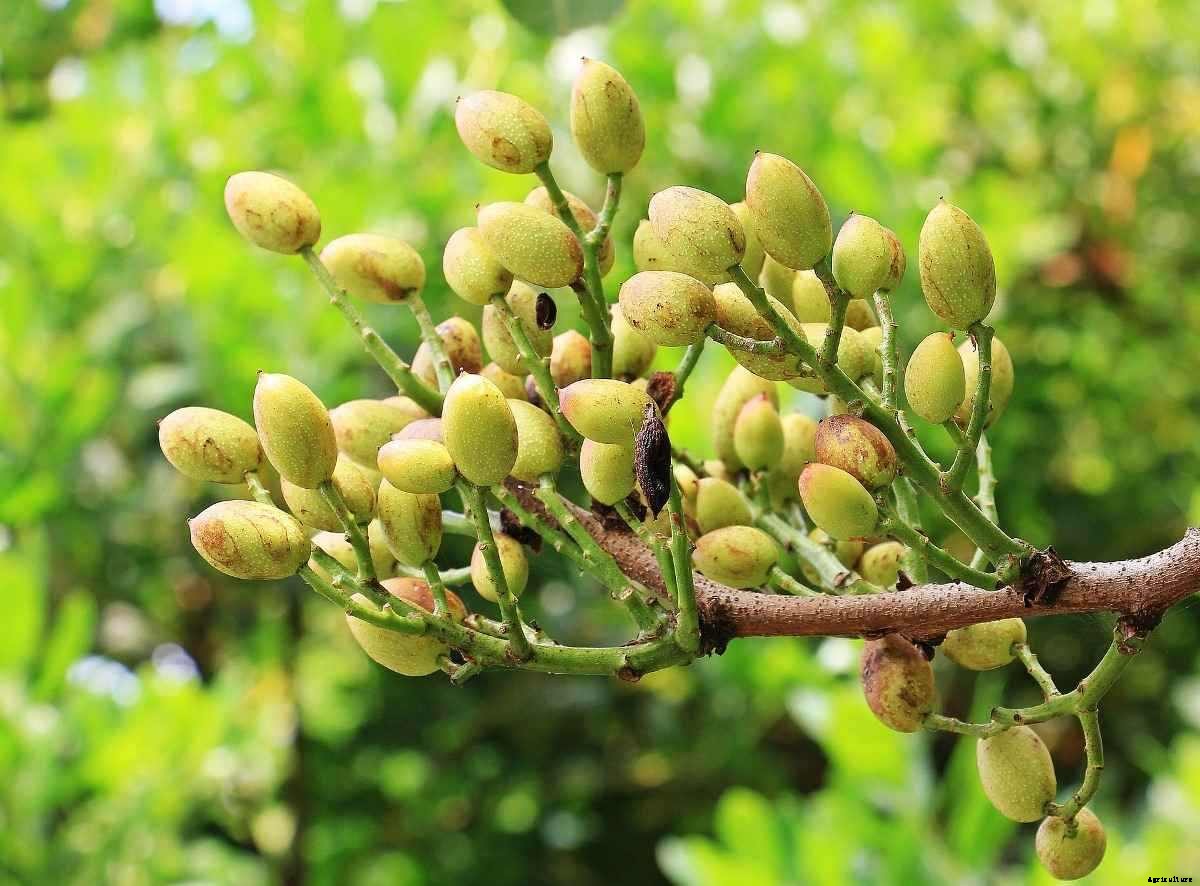
High production of Pistachio in India is grown in Jammu and Kashmir. Pistachio is mainly originated from central Asia and the Middle East country. Pistachio nuts have been used for ice cream decoration or other foods item. In India, the Pistachio production areas are Kannada, Tamil, West Bengal, Punjab, and Kashmir.
Pistachio tree thrives in areas with a long hot summer and a cold winter season. Commercially Pistachio trees are grown mostly in California about 98% of production, but also in New Mexico, Arizona, and Texas in the United States.
The Pistachio tree mainly originated from Central Asia. Nowadays, Pistachio cultivated areas mostly characterized by hot and dry climates like the US (California), Lebanon, Syria, Iran, India, Turkey, South Europe, and other countries of Asia and Africa.
If the cultivation area is affected by a certain disease and pest is very common, using diversification on it will help to facilitate agricultural warfare in the future. Generally, tillage, pruning, fertilization, irrigation, and aggression should be cautious in the subject. Also, if some of the live and inanimate materials with the following names using organic fruit clusters are needed, they can be evaluated in cultural measures in Pistachio farming practices. These are stable, compost, agricultural lime, phosphate rock, potas rock, poultry waste, bordeaux slurry, tobacco water, organic wastes, pit and peat, perlite, garlic water, milkweed water, raw milk, odor calcium polysulphide, pyrethrum, mineral oils, thyme oil, rose essence, Arabic soap, paraffin oils, pigment oils, food traps, visual traps, hunter insects, some copper compounds, sulfur, rock flour and Bt (bacillus thuringiensis).
The largest producer of Pistachio in the world is Iran with approximately 480.000 tons. After Iran, Pistachio-producing countries are the USA, Turkey, China and Syria produce 240.000, 144.000, 80.000, and 57.000 tons annually, respectively.
Weather condition is very important for cultivating Pistachio crop. These nuts prefer a temperature level of the day that is above 36°C, and in the winter season, it is preferred to maintain the temperature level of 7°C. Pistachio trees do not grow well in high altitudes due to cold temperatures. Jammu and Kashmir is the best location for cultivating Pistachio nuts.
The well-drained deep soil along with sandy loam is the best soil for Pistachio cultivation. These types of nut trees are quite drought-tolerant whereas some of the areas high humidity. The high quality of the Pistachio tree has been produced where soil pH level has kept a range of 7.0 to 7.8 accordingly. High alkalinity soil is good for Pistachio cultivation.
The soil must be selected according to the requirements of organic Pistachio farming. Climatic evaluation for agricultural purposes, by matching the climatic conditions of a certain region with the climatic requirements of desired crops, is an essential part of land suitability studies. Assessment of the climatic conditions before performs a project may decrease the occurrence of unfavorable events. Climatic properties are necessary to be considered through land suitability evaluation for Pistachio crop.
Climate conditions are crucial when growing Pistachio trees and ideal temperatures for Pistachio trees are above 37°C during the day. Pistachio trees need winter months cold enough to complete their dormant period, 7°C or below. Also, Pistachio trees do not do well at high elevations due to the cool temperatures.
If you are wondering when to plant the Pistachio tree in India. You can plant Pistachio trees twice a year, in the months of June-July just before the arrival of the monsoon.
The Pistachio tree is dioecious, that’s meaning male and female flowers are formed on separate trees. Normally, insufficient pollen is a primary cause of crop failure. One male (pollinator) tree for about 8 to 10 female trees (producer) is recommended. Though, a good orchard layout will be to plant a pollinator in the middle of a nine-tree block throughout the orchard. Border rows on the upwind side must be planted with pollinators, too. Female flowers do not have nectar petals that attract bees for insect pollination. Pollen transfer depends entirely on the win.
Apart from planting, digging, the holes large encourage to accommodate the plant roots to some extent. In this regard, plant spacing mainly depended on irrigation and spaced while planting a crop for cultivation. In some cultivated areas irrigation is not available in a proper way; it required space for about 6 x 6 meters for grid pattern. It has been bearing Pistachio nuts, which should be planted in the ratio of about 1: 8 to 1:10.
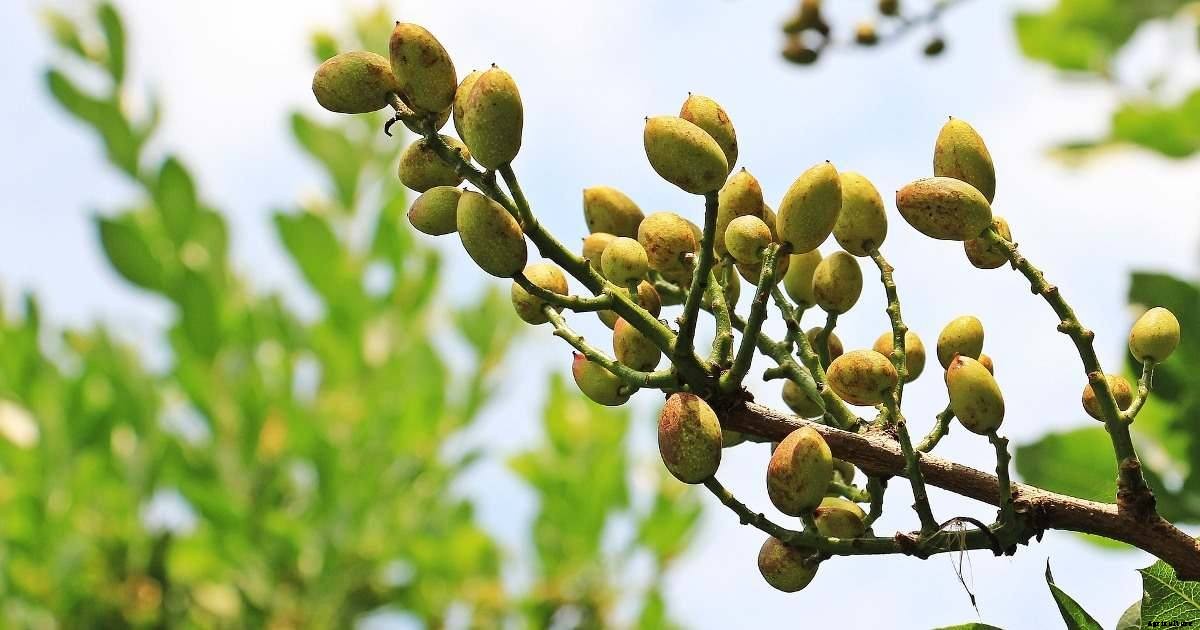
Step 1) As part of the planting Pistachio, dig the holes large enough to accommodate the roots. Pistachio trees must be planted about 1 inch lower than it was raised in nurseries or containers. When it comes to Pistachio plant spacing, it depends on irrigation. In the case of irrigation, plants should be spaced at 6 meters * 6 meters for grid pattern.
Step 2) In areas where irrigation is not available, Pistachio trees can be spaced at 8 meters * 8 meters.
Step 3) As it happens in many fruit trees like citrus, and apple, etc Pistachio trees are grown from seed may not bear fruits for the whole of their lifetime for various reasons.
Step 4) Also, to harvest Pistachios, we have to plant in the same yard at least 1 male and 1 female Pistachio tree, so that the pollen can travel through the wind from the Pistachio male tree to the female tree. But you want to feel the joy of growing your tree from seed, let’s get started.
Step 5) The first thing we have to do is search for natural fresh harvest Pistachios. Remember that most of the Pistachio cultivation we can find in the market is roast, so these seeds will not sprout. In all cases, we need to find Pistachios seeds that have not been processing in any way. They should be entreat, unrest, unheated, and unsold seeds. All done properly, only 50% of the Pistachio seeds will germinate, only a few of those will make it to a small seedling and young tree. We break carefully the shell and we collect the Pistachio seeds. Then, place them on a wet towel and put the towel in a transparent plastic bag.
Step 6) The key from now on is to place the bag at a room temperature level, but next to a window with access to direct sunlight. When done professionally and at a large scale, the plastic bag with seeds is first stored in the fridge for 6 weeks, before returning at a room temperature level.
Step 7) The Pistachio tree is long-lived, possibly up to about 300 years. The Pistachio trees are planted in orchards and take approximately 7 to 10 years to reach significant production. Peak production is reached about 20 years. Pistachio trees are usually pruned to size to make the harvest easier. One male tree produces enough pollen for about 8 to 12 drupe-bearing females. Harvesting is done by using equipment to shake the drupes off the tree. After the hulling and drying process, Pistachios are sorted and then roasted or processed by special machines to produce Pistachio kernels.
Pistachio trees are drought-tolerant; they should be maintained with enough moisture whenever needed. Mulching is the best practice to retain the water and drip irrigation can be adopted for proper utilization of water. Avoid any water logging conditions and the rainy season doesn’t need any irrigation.
Pistachio trees are quite drought-tolerant; watering these Pistachio trees properly is a good idea, as the trees produce higher yields when provided with proper water. Watering Pistachio trees can be tricky. So rewater the plants when the top 2 inches of soil gets dry. Water often during the summers. Drip irrigation is the best practice in Organic Pistachio Farming for better tree growth and yield.
The Pistachio trees seem to require constant fertilization, as they grow bigger. So if you wish to keep your trees organic, you can provide them with frequent doses of cow manure as the plants start to mature. The seed production is often reduced due to the deficiency of potassium and phosphorous so you can also provide your trees with 12-12-17 doses of N-P-K fertilizer twice a year once during late winters (Feb- Mar) and summer seasons (Apr-may).
In organic Pistachio farming, microbiological fertilizer is useful for the improvement of soil. Normally, Bacteria, Actinomycetes, Mycorrhizae, Algae, and Worms can be evaluated in organic Pistachio farming. The use of compost can be achieved by using different methods from all kinds of vegetable and animal organic substances that we take out of the system in various meanings, and by application in several forms by the purpose of the breeding technique and purpose. Therefore, resources are gained by evaluating the waste materials, and the contamination and deterioration of the natural resources formed by storing the organic garbage in inappropriate conditions are prevented.
Pistachio is popular tree nuts in the world. This Pistachio fruit is the richest fatty-acids, metals and phytosterols, phenolic compounds. Because the Pistachio is rich in nutrient content, this fruit should be produced more organically.
In case if you are interested in this: Organic Shrimp Farming.
Pest and Diseases Control in Organic Pistachio Farming
Generally, Pistachio trees take a longer time to produce nuts. These budded trees become ready to produce fruits for 5 years and will not reach maximum crop production until the 12th year of planting. (Pistachio begins bearing the 5th year after budding. However, a significant crop is not harvested until the 7th or 8th season. The first full production year starts occurring 12th year only). The easy identification of nuts maturity is when the hull separates easily from the shell. Generally, this period extends for about 6 to 10 days. Care must be taken while harvesting by avoiding underdeveloped kernels.
Pistachio nuts will fall off the tree when the branches are given a sharp shake. Normally, a rubber mallet hitting a branch, a mechanical shaker can be used. Put sheets or tarps under the tree to catch the Pistachio nuts. You don’t want the Pistachio nuts to fall in the dirt. For commercial purposes, Pistachio harvesting involves two machines, a shaker, and a catcher. Normally, the yield of the Pistachio nuts mainly depends on climate, cultivar variety, and crop management practices.


