Organic Safflower Farming
Hello friends, would you be interested in organic Safflower farming? Well, we are here with the topic of growing Safflower organically. The Safflower (Carthamus tinctorius) is an annual plant and belongs to the family Asteraceae. The Safflower plant is an annual thistle-like plant featuring red, yellow, or orange flowers. Safflower plants growing requirements are uniquely suited for arid regions. Organically produced Safflower command a premium for both monounsaturated and polyunsaturated types. Safflower seeds are mainly used for oil production for domestic consumption in India. A large portion of Safflower seeds produced is retained by the farmers themselves for their home consumption. Safflower oil considered to have good therapeutic properties.
Safflower has been under cultivation in India for its brilliantly colored florets and the orange-red dye extracted from them and seed. The seed contains 24 to 36% oil and the cold-pressed oil is golden yellow and is largely used for cooking purposes. The oil is as good as sunflower oil having enough amount of linolic acid (78%), which is beneficial for reducing blood cholesterol content. Then, the unsaturated fatty acids of Safflower lower this rum cholesterol. It has a deep root system allowing the plant to utilize efficiently the nutrients that could not be available to small-grain crops. Therefore, the introduction of such crops will enhance the sustainability of the organic farming system and benefits consumers and farmers.
A Step-by-Step Guide to Organic Safflower Farming in India
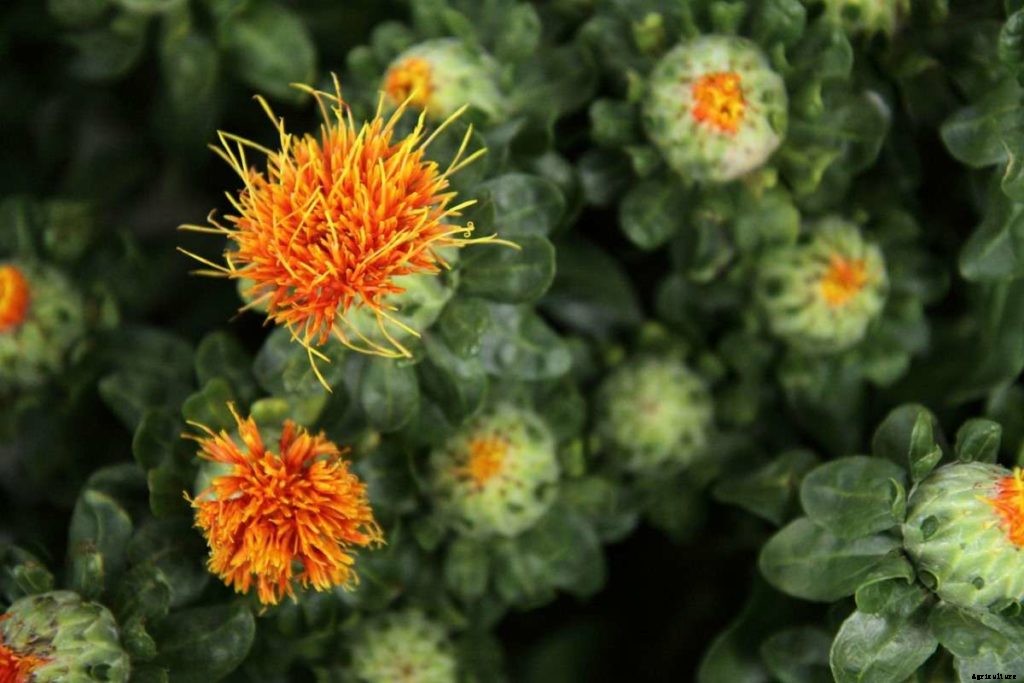 Guide to Organic Safflower Farming (Image credit: pixabay)
Conditions for Organic Safflower Farming
- Safflower plant was originally grown for the flowers that were used in making red and yellow dyes for clothing and food preparation. Today Safflower crop supplies oil, meal, birdseed for the food and industrial products markets, while this crop is now primarily grown for the oil.
- Safflower has a deep taproot capable of penetrating to a depth of 2 to 3 meters. While grown without irrigation over the major portion of its range, as a large-scale commercial crop highest yields are obtained only under some type of irrigation. The crop can use considerable amounts of soil moisture, but it cannot survive standing water for even a few hours in warm weather.
- Safflower crop is adapted to dryland or irrigated cropping systems. Each seed germinates and forms a central stem that does not elongate for 2 to 3 weeks, and develops leaves near the ground in a rosette, similar to a young thistle.
- Safflower is susceptible to fall frost injury during the flowering period and seed development.
Safflower Production in India
India has larger coverage but lower crop yield among the major Safflower producing countries. Maharashtra and Karnataka are major Safflower growing states in India, which contribute more than 90% of India’s production.
Safflower is mainly grown in Maharashtra, Karnataka, and parts of Andhra Pradesh, Madhya Pradesh, Orissa, and Bihar, etc. Maharashtra and Karnataka are the two most important Safflower growing states accounting for 72 and 23% of the area and 63 and 35% of production, respectively.
Safflower is mainly grown in India for its much-valued edible oil. Safflower produces oil rich in polyunsaturated fatty acids (linoleic acid 78%), which play an important role in reducing blood cholesterol levels and is considered a healthy cooking medium. Its oil is suitable where a high level of stability at low temperature is required as in frozen desserts. Also, it is used in infant foods and liquid nutrition formulations.
Safflower is one of the most important crops for marginal farmers. It is intercrop with cereals such as wheat and sorghum. Traditionally Safflower is grown as a rain-fed crop on residual soil moisture.
Key to Successful Safflower Production
- Safflower plant requires more water than canola to produce comparable yields; therefore, ensure that moisture is available to at least 1-meter soil depth at sowing.
- Always use quality Safflower seed and do not sow too deep (1.5–4.0 cm depth recommended).
- The main sowing time is from June to August. Early sowing is important to maximize crop yields in drier situations (June or July).
- Flowering starts in 85 to 140 days i.e. at the end of October and during November (depending on genotype, seed sowing date, and environment).
- Increase the sowing rate for very late sowing.
- Use moderate sowing rates particularly when sowing early in drier situations (9–18 kg/ha).
- Supply adequate nutrition or fertilizer.
Popular Safflower Varieties
Some popular Safflower varieties are DSH-129, MKH-11, Parbhani Kusuma(PBNS-12), and NARI-NH-1 (PH- 6). Other States Varieties are Phulekusum, NARI-6.
Soil Requirement for Organic Safflower Farming
- Soil should be deep, well-drained, and loamy for Safflower farming. Amend your soil before planting Safflower if it is heavy and clay-rich. If soil is sandy, mix peat moss and compost it. Safflower has fewer requirements regarding the pH, it prefers neutral soil.
- The dense subsoil, plough pan, or an impermeable layer retards root growth. The highest yields are obtained on sandy loams with good water holding capacity at depth.
- Safflower does poorly on light, sandy soils without good moisture reserves deeper down.
- On these soils, it quickly depletes the soil moisture and suffers moisture stress during the kernel filling period.
- On heavy, clay soils that are prone to crusting, emergence may be reduced and higher seeding rates will be needed.
Requirements for Organic Safflower Farming
- Safflower is tolerant to low temperatures at the seedling and vegetative stages.
- Safflower comes up better in drier areas.
- The optimum temperature level for flowering is between 24°C and 32°C; however, adequate soil moisture reduces the adverse effect of high temperature.
- A high-temperature level also tends to decrease seed weight.
- Safflower is a cool (Rabi) season crop. The optimum temperature for germination is about 15.5°C. The day temperature in the range of 24-32°C at flowering is congenial for higher yields.
- Safflower is cultivated from sea level to an elevation of 1000 m above sea level. At the seedling stage, however, the crop can tolerate much lower temperatures (-12 to –10°C).
- High-temperature levels at the time of flowering are harmful to the crop. At all the stages of plant growth, excessive rainfall or humidity increases the infestation of fungal diseases. It is a day-neutral plant. Though, temperatures are more important than photoperiod in Safflower.
- To bring soil to the fine tilth stage land must be ploughed several times so that all weeds are removed which would be present previously. Low-lying land should be eluded as a waterlogged situation is liable to destroy by wilts as well as root rots.
Safflower Growth Stages
- Plant Safflower seeds when the soil temperatures reach 40F. Safflower seeds will not germinate at lower temperatures. Sow Safflower seeds in moist soil about 1 to 1 1/2 inches deep and 6 to 10 inches apart.
- It may take up to 3 weeks for the seeds to germinate and sprout. Seeds can germinate faster with a warmer soil temperature, but the plants need at least 120 days to mature, so don’t wait too long to plant.
- After the seedling emerges and the days become warmer and longer, the Safflower plant will grow faster. When the main stem reaches about 8 to 15 inches tall, it will start to branch and form flower heads. Flowers bloom for about 10 days each summer about 4 to 6 weeks after the buds form. Safflower seeds can be harvested about 50 to 60 days after flowering.
Sowing Time and Sowing Method in Organic Safflower Farming
- The optimum time for sowing seeds is the last week of October to November first week.
- Sow seeds at depth of 5-7 cm and sowing are done through the drilling method.
- Healthy seeds of improved varieties must be selected for sowing.
- Sowing time varies from state to state. The optimum time of seed sowing is from the second week of September to the second week of November.
- In the State of Karnataka, the best time for Safflower seed sowing is the 2nd week of September for rain-fed and mid-September to early November for the irrigated area.
- For better germination and plant growth, seed treatment with Thiram, Captan, or Carbendizim by 3 g/kg is recommended.
Seed Rate and Spacing in Organic Safflower Farming
- Use Plant to Plant spacing of 15 cm and row to row spacing of about 45 cm. 10-15 g/ha is the normal seed rate for Safflower.
- In Chhattisgarh, 10 to 15 kg/ha seed rate and in Odisha 20 kg/ha seed rate is adopted in rice fallow areas.
- The seed rate varies from 7 to 20 kg/ha depending on the situation and growing conditions.
- Normal spacing in Safflower is about 45×20 cm. The Safflower plant spacing 60×30 cm is adopted in Karnataka. The plant spacing in Safflower is about 45×20 cm in Chhattisgarh and 30×15 cm spacing in Odisha is adopted.
Plant Care in Organic Safflower Farming
Safflower prefers full sun and loam soils that drain well. And, make sure soil is moist at least 1 meter, or about 3 1/4 feet, deep when you sow Safflower seeds. It does not need additional fertilization at least in the 1st year of planting. Sometimes a supplemental nitrogen-rich fertilizer will be used in Safflower. The disease is common during the rainy season when fungal diseases can be a problem. Many of these plant diseases can be managed through the use of disease-resistant seeds.
If you plant in moist, water-holding soil, rainfall will be sufficient to water Safflower. Deep clay loams are ideal. However, if the soil does not hold water well, or you experience high heat and drought, you need to provide additional irrigation.
Propagation and Planting Process in Organic Safflower Farming
- Safflower plants do not like cold weather conditions. The plants need a warm, arid climate, and a long growing season.
- Choose a location to grow Safflower that is in full sun. The soil must be deep, as the taproot can grow up to 10 feet deep, in search of moisture.
- For growing Safflower plant, propagate it from seeds. It needs direct seeding, as the plant doesn’t transplant well because of a long taproot. The optimum seed germination temperature level is around 15-20°C.
- Safflower plant prefers fertile soils with a balance of nitrogen, phosphate, and potassium, so test soil to determine nutrients deficiencies. If there is a major deficiency then apply potassium, and apply nitrogen fertilizer at a rate of 80 pounds per acre or 15 pounds per acre if using drill row application.
- If the soil has low phosphorus, supplement the soil at a rate of about 35 pounds per acre. Of course, most home gardeners will have much smaller gardens, so fertilizer rates will be about 1.6 teaspoons of nitrogen and 0.73 pounds of phosphorus per 10 square feet.
- Sow the seeds in rows, with a spacing of about 20 cm in the row and 30 cm between rows, so that each plant will have room to grow, this will limit the spreading of diseases between the plants. Bury each seed 2 to 3 cm deep.
- Keep the soil moist during germination and seedlings will germinate in 2 to 3 weeks.
- Safflower seeds are contained in a thick hull. As for all crops, planting seed mud be genetically pure, free from seed-borne diseases, have a high germination percentage (>80%), and be free from weeds and other seeds.
- Safflower crop is grown in rotation with small grains or fallow. Safflower plants can be severely injured by soil residues of broadleaf herbicides that were used on small grains earlier in the rotation. Caution should be used when growing Safflower after small grains.
- Generally, Safflower crop should not follow in close rotation with crops susceptible to Sclerotinia head rot (white mould) like Sunflower, Mustard, Canola (Oilseed Rape), or Dry Bean. Very little crop residue remains after harvesting Safflower. The production practices and equipment required for Safflower are similar to those used for small grains.
Irrigation Requirement in Organic Safflower Farming
About 3 to 5 irrigations must be given to Safflower crop in medium to a lighter type of soils for higher yields. Safflower must be irrigated twice i.e. at 35 and 55 days after seed sowing in medium to heavy soils for higher crop yields. If only one irrigation is available, it must be given at 55 days after sowing.
In dryland areas under scanty moisture conditions, crop yield can be boosted from 40% to 60% by providing one lifesaving irrigation (5 to 8 cm) at critical phases of crop growth (early stem elongation or flowering) or before soil moisture becomes a limiting factor for crop development.
Water is necessary during the flowering stage so once irrigation is required in 30 days for better crop yield. For the area where the soil is less moist, apply one heavy pre-sowing irrigation, it will be beneficial for better development.
Safflower Cultivation in Tamil Nadu
- Safflower grows well in both dryland and irrigated areas. In Tami Nadu, it is a drought-tolerant plant. It stands about 1 to 4 feet tall at maturity.
- The Safflower plant is adaptable to a wide range of soils, but the best for production is deep fertile well-drained soils.
- Cool and wet soil delays uniform emergence. The Safflower plant is more tolerant of soil salinity than small grains because of its deep roots.
- Safflower varieties suitable for Tamil Nadu are Co-1, K-1.
- Seeding to maturity takes about 120 to 150 days or longer. It is adaptable to a wide range of soils, but the best for production is deep fertile well-drained soils. Do not plant Safflower in poorly drained or cool and wet soils. Cool, wet soil delays uniform emergence.
- In Tamil Nadu, the seed rate required for Safflower is 10 kg/ha and row spacing is 45 cm
Safflower Cultivation in Karnataka
- Safflower has been under cultivation in India for its brilliantly colored florets and the orange-red dye extracted from them and seed.
- Safflower cultivated areas in Karnataka are Belgaum, Bidar, Dharwad, and Gulbarga.
Fertilizers Requirement for Organic Safflower Farming
Soil organic matters impose a direct and indirect effect on crop farming by providing nutrients and also soil physical condition improvement and stimulation of plant growth. It seems that plant production based on the application of organic fertilizers is more stable than the application of chemical fertilizers. Therefore, there has been lots of attention from agronomists, ecologists, and consumers toward organic fertilizers. In organic Safflower farming, the agricultural ecosystem is considered as a living thing and integrated totality, so in this system, soil, crop, microorganisms, and micro-climate affect each other and also are under the effect of each other. For better performance of the organic system, each component should be in its appropriate condition.
Safflower crop is favorable production in organic farming systems. This is mainly to evaluate the effect of organic and mineral fertilizers including urea nitrogen (N), FYM, and municipal waste compost on growth, the yield of Safflower.
Organic fertilizers ensure better availability of nutrients which produced better crop growth and also some pods per plant. The application of organic fertilizers caused a non-significant increase in soil organic carbon and a significant increase in soil nitrogen content.
In case if you miss this: Growing Carrots In Greenhouse.
Weed control in Organic Safflower Farming
Safflower plant competes poorly with weeds, especially from early growth through the rosette stage, when branching has not yet occurred. Depending on the species, weeds have reduced Safflower yields up to 75%. Pigweeds, lambs quarters, and chickweed can be a problem if not controlled early.
Control weeds emerging before or at the time of Safflower planting. Then, you can use a harrow, rotary hoe, or finger weeder. Do not harrow after Safflower is more than 8 inches tall, as it can cause severe damage to this crop.
Pests and Diseases Management in Organic Safflower Farming
Mature Safflower plants do not tolerate high humidity. Too much humidity can cause several diseases like Botrytis head rot, Alternaria leaf spot, and rust. Root rot disease is a problem with wet, poorly drained soils.
Insects and pests are not a problem for the Safflower plant. Some insects to watch out for include cutworm, aphids, and grasshoppers.
For controlling Alternaria Leaf Spot disease, seed treatment with Thiram or Captan 3g/kg seed is recommended and in field condition spraying with Dithane M-45, 25g in 10 liters of water is recommended.
In Safflower, for controlling root rot and wilt, seed treatment with Thiram or Captan by 3g/kg is recommended.
Early seed sowing in Safflower is recommended to escape from aphid infestation. Then, adopt plant protection measures against Safflower aphid.
For the management of aphids in safflower, carefully spray Fenthion 50 EC (10ml) or Dimethoate 30 EC (10ml), or Malathion 50 EC (20ml) or Methyl Parathion 2% dust or Phosalone 4 % dust by 20kg/ha are recommended.
Wilt and heat rot – In Safflower plant turn yellow later with brown and finally die.
Control – Use healthy and disease-free Safflower seeds.
To reduce disease severity in Safflower, do these two things;
- Plant certified seed
- Practice proper crop rotation
When and How to Harvest Safflower
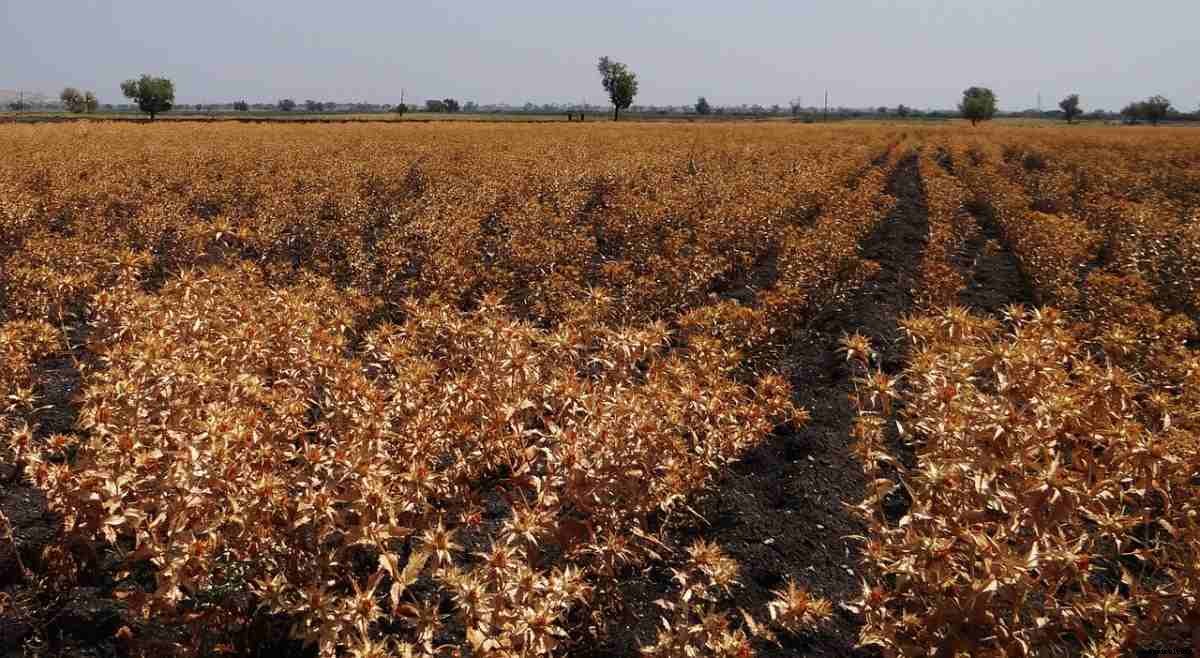 Ready to Harvest Safflower Crop (pic source: pixabay)
Harvest Safflower seeds when the plants begin to turn a brown color. Generally, harvest the Safflower petals when the flowers are fully open. Carefully, either remove the whole flower or pick off the petals.
Hand gloves can be used to protect legs and hands against spines. The effect of spines can also be minimized by harvesting crops before the rising of the sun. Multi-crop threshers and combine harvester can be used for harvesting and threshing.
Commonly Asked Questions about Organic Safflower Farming
How do you grow Safflower?
Safflower is seeded in the early to late spring season. Plant seeds ½ inch deep in rows that are 6 to 12 inches apart in a prepared firm bed. Safflower seed germination takes place in about 1 to 2 weeks.
Is Safflower a perennial?
Safflower crop is an annual species in the same plant family as the sunflower. Safflower crop is adapted to dryland or irrigated cropping systems.
How long does it take Safflower to grow?
Safflower seeding to maturity takes 120 to 150 days or longer.
What is Safflower seed used for?
Safflower seed oil is used as cooking oil in foods. Safflower flower is mainly used to color cosmetics and dye fabrics in manufacturing. Though, the Safflower seed oil is used as a paint solvent.
Is Safflower expensive?
Safflower is expensive because it consists of crocus stamens that must be extracted by hand. Generally, it can take well over 70,000 flowers just to get one pound of the spice. The petals of the Safflower are valuable as a spice and for producing a bright yellow color.


