Welcome to Modern Agriculture!

In Pakistan, it occupies 9,044 ha area and its production is 88,148 tonnes (FAO, 2015). Yield of brinjal in Pakistan has been reported to be 97,466 kg/ ha.

Bringal seeds are sown on nursery beds to raise seedlings for transplanting in the field. Raised beds are necessary to avoid problem of water logging in heavy soils. In sandy soils, however, sowing can be taken up in flat beds. Raised beds of size 7.2 x 1.2 m and 10-15 cm in height are prepared. Thus, ten such beds are sufficient to raise seedlings for planting one hectare area. About 70cm distance is kept between two beds to carry out operations of watering, weeding, etc. The surface of beds should be smooth and well levelled. Well-decomposed FYM or leaf mould may be mixed with the soil at the time of bed preparation. To avoid mortality of seedlings due to damping off, drenching of the beds with Bavistin (15-20 g/10 litres of water) is effective.
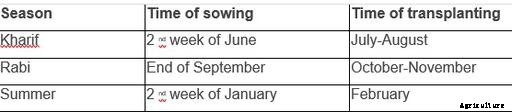
About 250-300 g of seed are sufficient for raising seedlings for one hectare of land. Prior to sowing seeds are treated with fungal culture of Trichoderma viride (4 g/ kg of seed) or Thiram (2g/ kg of seed) to avoid damage from damping-off disease. Sowing should be done thinly in lines spaced at 5-7 cm distance. Seeds are sown at a depth of 2-3 cm and covered with a fine layer of soil followed by light watering by water can. The beds should then be covered with dry straw or grass or sugarcane leaves to maintain required temperature and moisture. The watering should be done by water can as per the need till germination is completed. The cover of dry straw or grass is removed immediately after germination is complete. During the last week in nursery, the seedlings may be hardened by slightly withholding water. The seedlings are ready for transplanting within 4-6 weeks of planting when they attain a height of 15 cm with 2-3 true leaves. The sowing and transplanting time in different seasons are as follows.
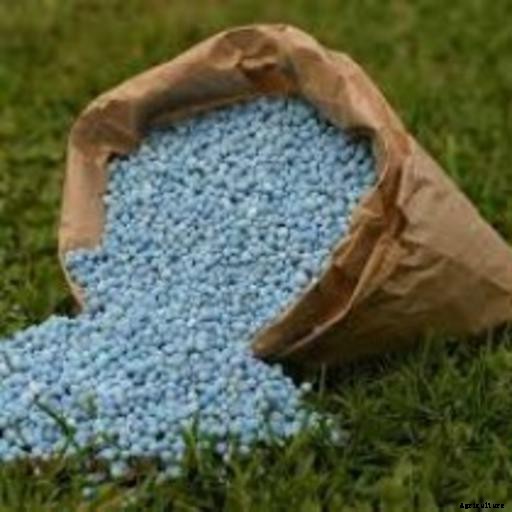
Brinjal being a long duration crop, requires a good amount of manures and fertilizers for high yield. The fertilizer dose depends upon the fertility of soil and amount of organic manure applied to the crop. For a good yield, 15-20 tonnes of well-decomposed FYM is incorporated into the soil. Generally, application of 150 kg N, 100 kg P O and 50 kg K O is recommended for optimum yield. Half dose of N and full dose of P and K is given at the time of planting. The balance half of N is given in 3 equal split doses. The first split dose is given one and half month after transplanting, the second dose one month after the first application and the final at three and half months after transplanting. For hybrid varieties, the recommended dose is 200 kg N, 100 kg P O and 100 Kg K O. Out of this dose, 25 % of N and 100 % of P & K is applied as basal dose. Remaining 75 % of P is applied in three equal split doses. The first split dose of N is applies 20 days after transplanting. The second dose is given just before the onset of flowering while the third after the first picking/harvesting.
In esatern India Application of 25 t/ha FYM along with 60 kg/ha each of P2O5 and K2O has been recommended. Nitrogen is applied @ 100 kg/ha in 5 to 6 split doses during the crop growing season through fertigation.
Major pest of national significance in Bringal
Shoot and fruit borer, Jassid , Aphid ,White fly,
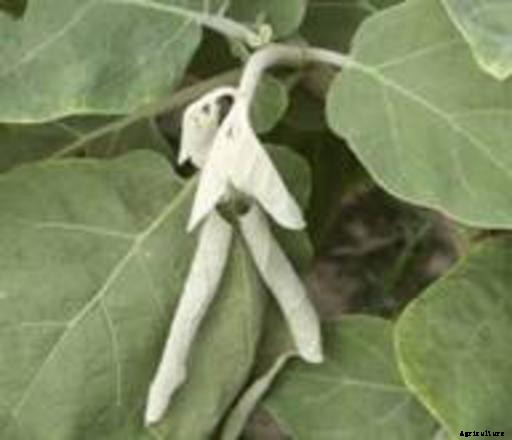
Damping off , Phomopsis blight, Little leaf,Bacterial wilt
Lamb square(Chenopodium album), Pimpernel (Anagalis arvensis), Sweet clover (Melilotus sp.), Fumitory (Fumaria indica), Compsperry (spergula arvensis), Blue grass(Poa anuna), Canary grass(Phalaris minor), Rabit foot grass(Dectyloctium aegyptium)
Apply Pendimethalin 1.0 kg a.i. / ha or Fluchloralin 1.0 kg a.i / ha as pre-emergence herbicide, followed by hand weeding once at 30 days after planting.
After establishment of seedlings, irrigate at weekly intervals.
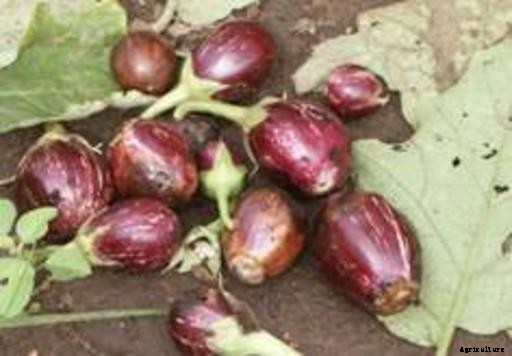
Seed treatment with antagonistic fungi viz. Trichoderma harzianum 4 g/kg seed and T. viride 4 g/kg seed along with application of press mud at 5 kg/m2 or Carbofuran 3 G 10 g/m2. Application of Carbofuran 3 G at 10 g/sq.m at the time of sowing.
Apply Pseudomonas fluorescens at 10 g/m2 at the time of sowing to control root knot nematode and damping off disease.
Monitor the whitefly with yellow sticky trap at 12 Nos./ha. Spray Neem oil 3% + Teepol (1 ml/lit) or spray Neem Seed Kernel Extract 5 %.
Apply Carbofuran 3 G at 15 kg/ha at 15 days after planting.
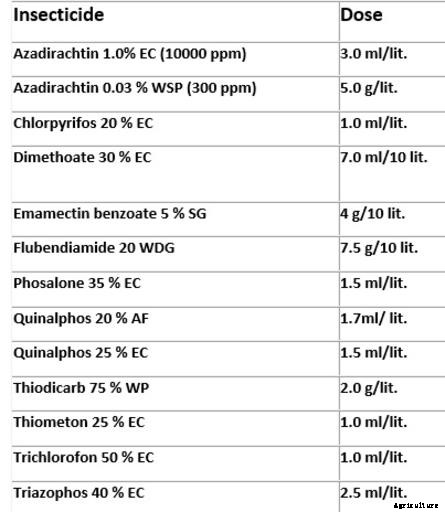
Release 1st instar larvae of Green lace wing bug (Chrysoperla carnea) @ 10,000 Nos./ha. Apply phorate 10 % G @ 15 kg /ha or spray Phosphamidon 40 % SL 1.5 ml/lit
Apply phorate 10 % G @15 kg /ha or spray Dicofol 18.5 % SC 2.0 ml/lit.
Treat the seeds with Trichoderma viride 4 g/kg or Pseudomonas fluorescens 10 g /kg of seed 24 hours before sowing. Apply Pseudomonas fluorescens as soil application @ 2.5 kg/ha mixed with 50 kg of FYM. Water stagnation should be avoided. Drench with Copper oxychloride at 2.5 g/lit at 4 lit/sq.m
Leaf spot can be controlled by spraying Mancozeb 2 g/lit.
Remove the affected plants in the early stages and spray Methyl demeton 30 EC @ 1.0 ml/lit. to control the vector.
Harvest can be done 55 – 60 days after transplanting. Fruits are harvested at tender stage at 4 – 5 days intervals.
Varieties:25 to 30 t/ha
Hybrids:60 – 80 t/ha