
Welcome to Modern Agriculture!

There are many different classes of insecticides, such as organophosphates, carbamates, pyrethroids, neonicotinoids, etc., which share a similar chemical structure and mode of action (MOA).
An insecticide kills an insect through a specific MOA, or inhibits the insects growth. A target site of action refers to the specific area where the inhibitor interferes with an enzyme’s activity within a metabolic pathway of an insect or a pest.
A number of factors contribute to the development of insecticide resistance in insects and pests, including genetics and intensive insecticide application.
As a result, insects with genes conferring resistance to a certain insecticide or group of insecticides survive their treatment and become “selected” to continue passing this resistance on to subsequent generations.
Aside from all the different types of pests, insects are known for exhibiting alarming rates of resistance to insecticides.
Approximately 500 species of insects and associated arthropods are resistant to insecticides worldwide.
It is possible for insect resistance to develop to only one insecticide. However, there is a tendency for insects that exhibit resistance to one insecticide, to also exhibit resistance to other insecticides with the same MOA.
Insecticide resistance example :
The house fly is a classic example of insecticide resistance . The populations of this insect that became resistant to DDT in the 1950s were also resistant to pyrethroid insecticides decades later, with no previous exposure. The MOA of DDT and pyrethroid insecticides is identical. This phenomenon is called cross resistance.
Multiple insecticide resistance occurs when a population of insects resists two or more insecticide classes with different modes of action (MOA). Multiple resistance mechanisms are expressed by insects that develop this type of resistance.
This process occurs when insects are exposed to one insecticide and they develop resistance to it. This is followed by halting the use of that insecticide and a new insecticide is used instead. Insect develop resistance to the second insecticide also. And hence the cycle continues.
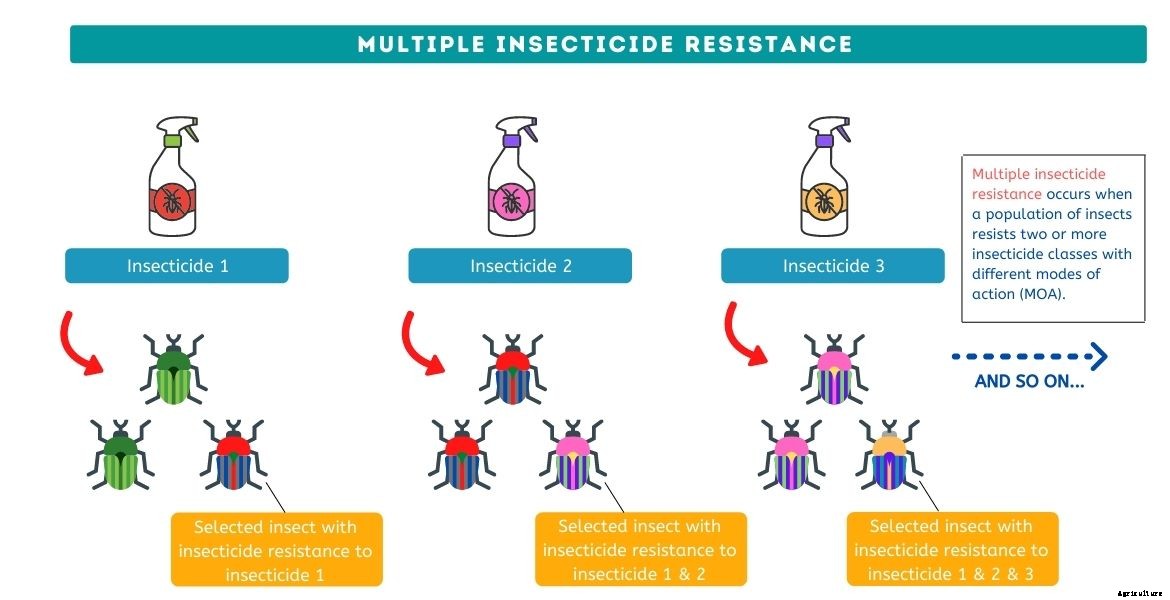
Multiple insecticide resistance example :
The Colorado potato beetle is notorious for resisting more than 50 insecticides with different modes of action.
Although multiple resistance is less common than cross resistance, it has a bigger consequence because it significantly decreases the number of insecticides that can be used to control a particular insect.
A natural tendency, insecticide tolerance is not a result of selection pressure, unlike insecticide resistance. Insecticide tolerance is not developed by exposure to the insecticide, rather it occurs naturally.
Insecticide tolerance example :
Due to differences in body size, exoskeleton thickness, and ability to metabolize poisons, mature caterpillars are more tolerant of insecticides than younger ones of the same species
Rather than true insecticide resistance, these differences are considered to be tolerance or natural resistance.
Insect populations can develop resistance to insecticides in a number of ways, and pests may or may not employ more than one mechanism concurrently.
1 . Metabolic resistance :
A toxin-resistant insect may be able to detoxify or destroy the toxin faster than a toxin-susceptible insect.
They can also bind the toxin to proteins in their bodies to prevent it from reaching the target site.
A common mechanism of resistance is metabolic resistance, which can pose the most difficult challenges.
Insects resistant to insecticides may develop higher levels or more potent forms of the enzyme(s) that break down insecticides into nontoxic by-products.
2 . Altered target-site resistance :
In this mechanism insecticide resistant insects alter the site where the toxins from the insecticide bind to their body. By this way the effect of insecticide is reduced or even nullified.
3 . Behavioral resistance :
In this mechanism, the insects change their behaviors such as traditional movement behavior or feeding behaviors. If the leaf is sprayed with insecticide, the insects may stop feeding or move to the underside of the leaf.
For example in Africa, malaria-transmitting mosquitoes evolved to rest outside, which prevented them from coming in contact with pesticides sprayed on interior walls.
4 . Penetration resistance :
The outer cuticle of an insect can develop barriers that can slow chemical absorption into its body, which is termed penetration resistance.
Insects that are resistant may absorb the toxin less gradually than insects that are susceptible.
This mechanism is frequently used in conjunction with other mechanisms.
It should always be kept in mind that failed attempts of insect control can not be just blamed on insect resistance to insecticides.
Before coming to a conclusion about insecticide resistance, the following steps should be covered to differentiate between poor pest control and insecticide resistance of insects:
Insecticide resistance can be delayed through integrated pest management (IPM) and pesticide management in the following ways:
1 . Identifying and monitoring the pest
Use research-based sampling techniques to determine whether pesticides are needed and if needed, when is the best time to apply them.
2 . Practicing suitable control measures
Insecticides, cultural practices, biological control (predators and parasites), mechanical control, and sanitation are all integral parts of an effective IPM program.
Insects are less likely to attack a healthy plant or crop.
3 . Using tank-mix
When two or more pesticides with different modes of action are combined in a tank-mix or pre-pack, the onset of existing pest resistance may be delayed or mitigated.
The ratio of pesticides can be adjusted based on local pests and environmental conditions with tank-mixing.
4 . Using globally standardized codes for selection and spraying of insecticide
A classification scheme based on group numbers was developed by the Insecticide Resistance Action Committee (IRAC) to make it easy to distinguish between different classes or mode of action (MOA).
IRAC is an industry-organized group of pest management experts who develop international guidelines on pest resistance management.
The U.S. Environmental Protection Agency has instructed agricultural chemical companies to prominently print the IRAC MOA group number on insecticide labels in a standard format
For example, the MOA of insecticides belonging to the same group number is the same. A premix label that indicates the group number/numbers makes it easy for a user to identify the modes of action included in the premix.
5 . Wise and educated selection of insecticide
In case, all the above steps and methods are practiced and still there seems to be a problem of pests and insects in the field, it is likely that insects have developed resistance to insecticides.
Following remedies can be practiced to fight insecticide resistance:


