
Welcome to Modern Agriculture!

The presence of weeds on farmland can result in significant loss of crop yields because weeds compete with field crops for essential resources. Tillage, manual weeding, crop diversification and crop rotation were the prior means of managing weeds before herbicides became commercially available. However, over the years it has become more and more common in many countries to use herbicides for weed control.
Farmers are able to avoid crop yield loss caused by unwanted weeds by using herbicides. Weed control with herbicides is extremely effective and economical, but if they are applied excessively, the development of herbicide resistance in weed plants will render the herbicides ineffective.
The most prominent disadvantage of these herbicides is the development of resistance in the targeted weeds.
Weed biotypes that are resistant to different herbicides have grown rapidly. There are currently 383 types of biotypes belonging to 208 weed species in 570,000 fields worldwide (122 dicots and 86 monocots).
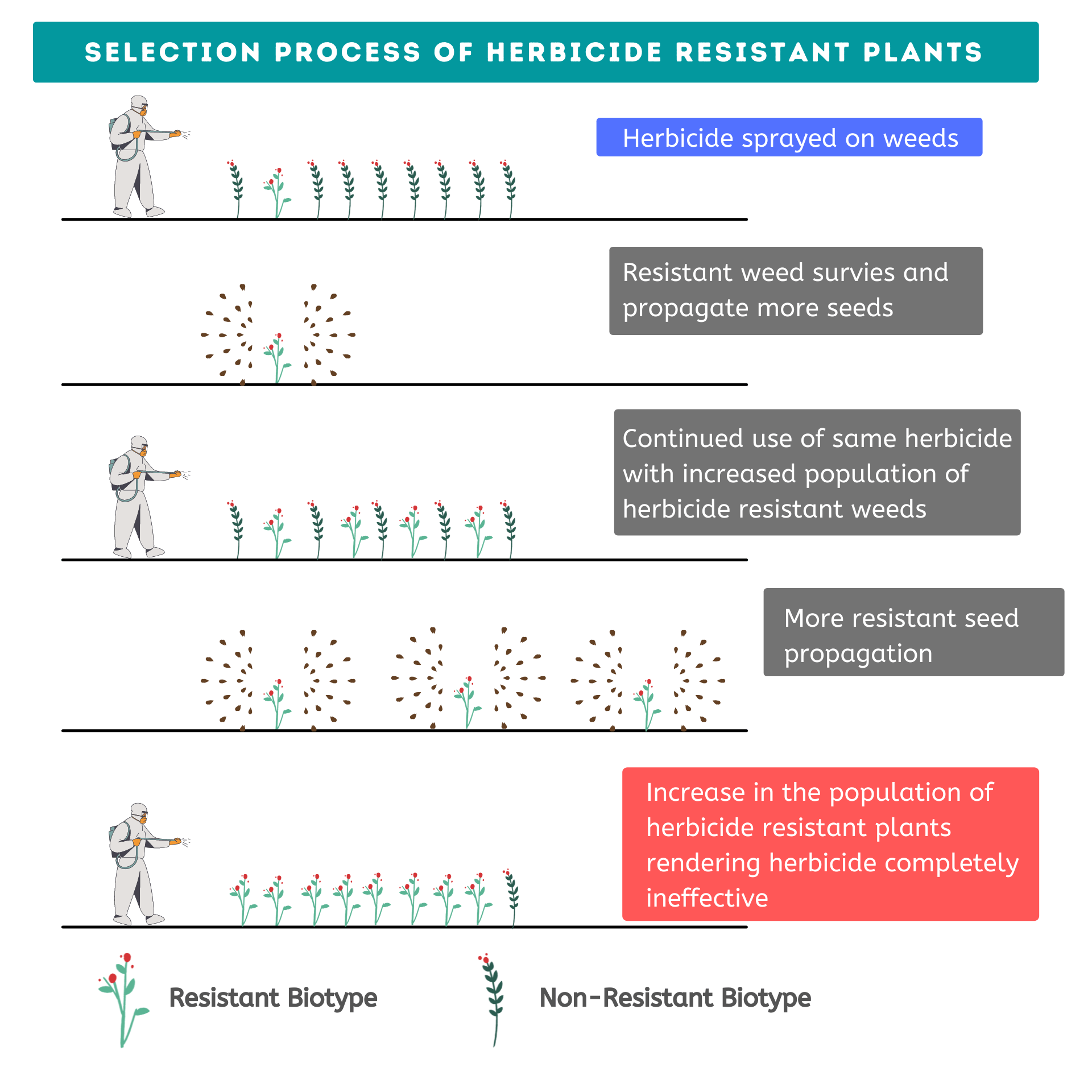
A weed plant’s ability to survive and reproduce even after exposure to a herbicide is known as herbicide resistance of weed plant. This quality is acquired by the weed when it is exposed to the same herbicide repeatedly. The weed develops “immunity” to the amount of dose that would normally kill it. Subsequently, the farmer increases to dose in an attempt to kill the weed and the vicious cycle continues.
Although herbicides provide cost-effective weed control and save labor, over- reliance on herbicides with a similar mode of action can rapidly lead to the development of herbicide resistance in weeds Shaw et al., 2012
Herbicide resistance in weeds develops in two ways. First, the weed evolves and alters the weed plant site which is affected by the herbicide. Second, the weed plant changes the processes in its growth cycle which is targeted by the herbicide to be effective.
Following are the ways with which plants become resistant to herbicides
According to Malik and Singh, 1995; Balyan and Malik, 2000; Yadav and Malik, 2005 : Over the last several decades, the weed flora in wheat farmlands has changed dramatically. As irrigated areas expanded, Carthamus oxycantha has almost disappeared from wheat production, where it was a major weed in 1960. P. minor and Avena ludoviciana have replaced several broadleaf weeds since the mid-1960s due to the introduction of high-yield dwarf wheat varieties, as well as increased fertilizer use and guaranteed irrigation.
Development of resistance to isopropturon in Phalaris minor (P. minor) in India due to heavy reliance on this substituted phenyl urea herbicide caused a significant reduction in wheat productivity in affected areas Malik and Singh, 1995
In rice-wheat cropping systems, P. minor became the dominant weed.
In other cropping systems, A. ludoviciana became the dominant weed on irrigated, well-drained, lighter textured soils.
Manual weed removal is difficult on wheat because of its close row spacing and its morphological resemblance to grass weeds.
In Northwest India, including Punjab, Haryana, Uttar Pradesh and Delhi, P. minor is still inflicting large yield losses in wheat crop, especially in rice-wheat growing systems.
Weeds such as P. minor are also posing major threats to wheat production in neighbouring states, such as Uttaranchal, Madhya Pradesh and parts of Bihar and Himachal Pradesh.
Phalaris minor is reported to be developing resistance to herbicides such as Isoproturon, Sulfosulfuron, Clodinafop, Fenoxaprop, Pinoxaden and Tralkoxydim.
Herbicide resistance can be explained by two theories: either the gene pool theory or the selection theory.
Mechanisms of herbicide resistance can be broadly grouped into two categories Dekker and Duke, 1995
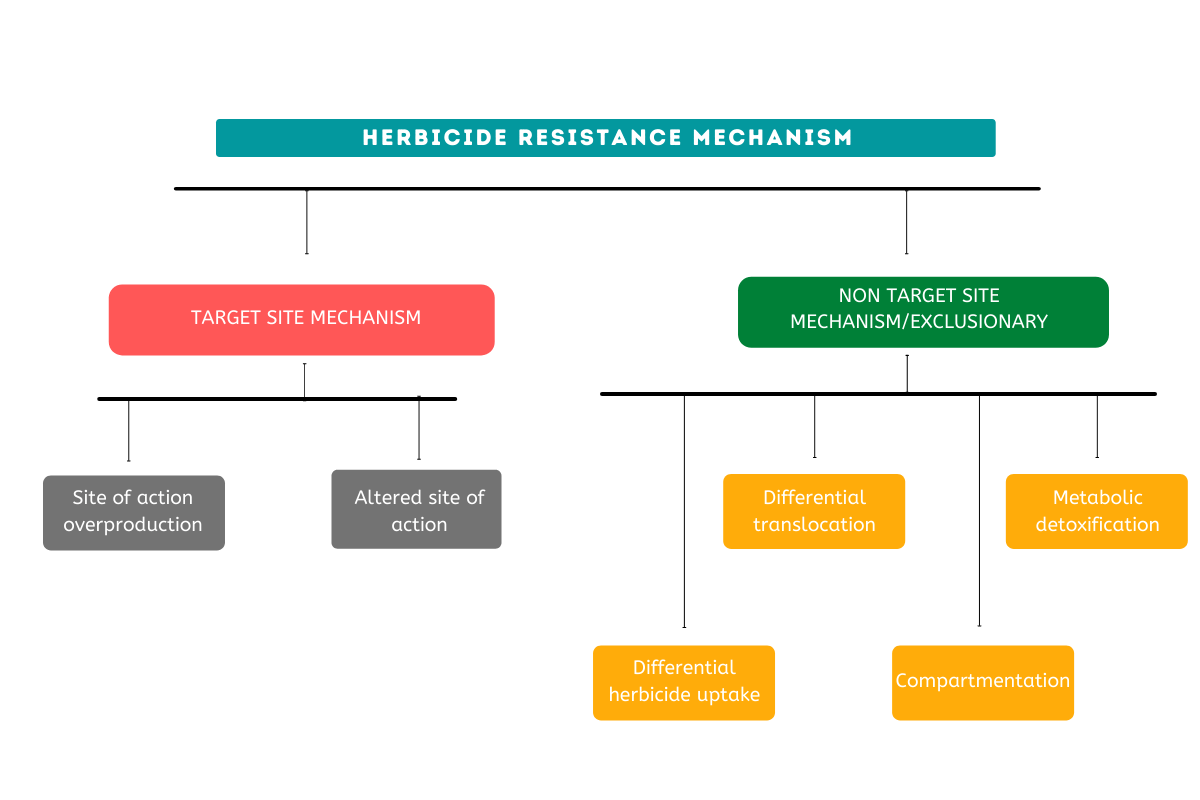
Weeds that prevent the herbicide molecule from reaching the site where it causes a toxic response in plants. The herbicide is excluded from the site of action in many ways through exclusionary resistance mechanisms.
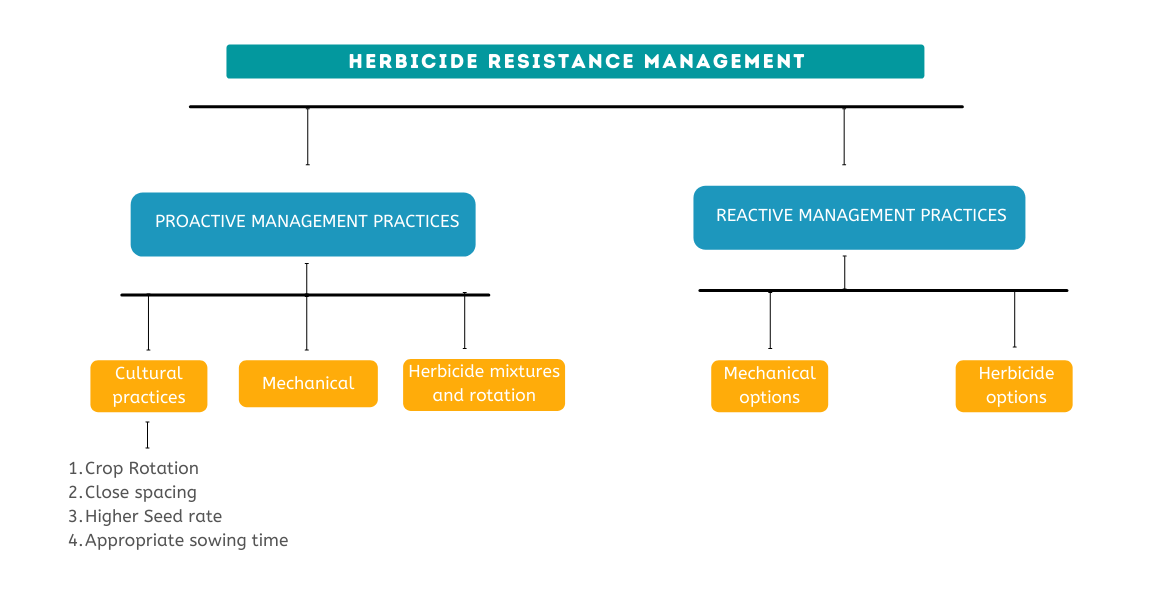
Herbicide resistance developing in weed can be controlled and managed by 2 ways : Proactive management practices and Reactive management practices
I. Cultural practices
II. Mechanical practice
Employing various mechanical practices such as manual rouging, preplant tillage and itterrow farming can also help in alleviating the problem of herbicide resistant weed.
Use of plastic mulches can also help in preventing the growth of weeds and eventual growth of herbicide resistant weed variety.
Weeds and crop plants are both provided with access to nutrients when fertilizers are broadcast. Trying to manually drill the fertilizer in the seed furrows will provide the nutrients only to the plant and not the weed plants
III. Herbicide rotation and herbicide mixing
Herbicide mixtures techniques work on the principle that if a weed possesses genes for resistance to one group of herbicides, another group of herbicides will kill it.
Using a variety of herbicides and not depending on use of just one herbicide is a good practice to prevent weed plants from developing resistance. Herbicide rotation should be practiced whenever possible.
Use the herbicide in the recommend dose range only and prefer a herbicide with low residual life span.
FAQ
How do you manage herbicide resistance?
Answer : Plant populations almost always exhibit genetic variation. As long as there are genetic variations, selection will likely lead to resistance if it is intensified and prolonged for enough time i.e. if the weed is exposed to the same pesticide for a long time. It is impossible to avoid herbicide resistance because it occurs at random. A key component of management strategies is the rotational use of herbicides and mixtures of herbicides. It would be helpful to manage weeds using a holistic approach to weed management such as integrated weed management.
Why is herbicide resistance a problem?
Answer : Weed herbicide resistance is a big problem in farming as weeds consume a significant proportion of the nutrients being supplied to the crop resulting in low yield of the crop. As the population of herbicide resistance weed increases in the farm, not only sustaining a good crop yield becomes difficult but also the farmer loses money spent on ineffective herbicide, spends more money in labour and reactive weed removal measures.
What is the difference between herbicide resistance and herbicide tolerance?
Answer : Herbicide resistance is the “acquired ability” of the weed plant which it develops after exposure to a specific herbicide for a long period of time.
On the other hand, Herbicide tolerance is the “inherent ability” of the weed to grow and reproduce even after being treated by a herbicide.


