
Welcome to Modern Agriculture!

Deriving its name from the Greek words for “mushroom” and fungus, mycorrhiza has played a crucial role in agriculture as a biofertilizer. The adoption of biofertilizers is increasing year- by -year in an attempt to move away from the traditional use of fertilizers and their harmful effects.
Plant roots are in contact with underground mycellium in a mycorrhizal association, but the roots are not harmed by this association. Mycorrhizal fungi are among the first microorganisms developed.
Mycorrhiza is the mutualistic symbiosis (non-pathogenic association) between soil borne fungi with the roots of higher plants Sieverding, 1991
Mycorrhiza can be classified into two types: ectomycorrhiza and endomycorrhiza.
Ectomycorrhizas have an extracellular fungal growth at the root cortex and are commonly found in temperate and boreal forest trees. In addition to tropical trees, ectomycorrhizal associations have also been found in pines and eucalyptus plants.
Endomycorrhizal fungi are characterized by inter- and intracellular fungal growth in root cortex, resulting in vesicles and arbuscles, respectively. Endomycorrhizas are also known as vesicular arbuscular mycorrhizas because of this characteristic growth. In plants, it is the most widely distributed association.
About 80% of all terrestrial plant species form this type of symbiosis ( vesicular arbuscular mycorrhizas ) Smith and Read, 1997
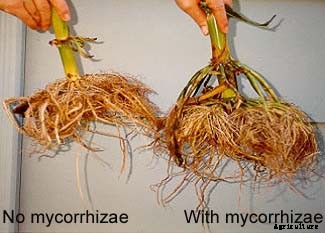
The root systems of vascular plants are penetrated by the VAM fungus. The fungus then assists the roots and plant to absorb the nutrients from the soil. VAM increases the uptake of nutrients by the plant from the soil.
*Must read: Complete guide to Types of Fertilizers : Their Classification and Use (For information on nutrients in the soil)

It has a prominent characteristic structure called arbuscules, which are intercellularly formed and possibly are there for the absorptive function. The intercellularly formed terminal swelling of the hyphae are called vesicles, which are preset for storage purposes.
Mycorrhizal associations have been observed in the following six genera of Endogonaceae: Glomus, Gigaspora, Acaulospora, Entrophospora, Sclerocystis, and Scutellospora.

In order to enhance soil fertility, certain naturally occurring substances are mixed and applied to the soil. These are called bio fertilizers. Both soil health and plant growth and development benefit greatly from these fertilizers.
The benefits of AMF on soil health and crop productivity have been documented by various studies conducted over the past two decades. There is a growing perception that AMF may eventually replace inorganic fertilizers. In mycorrhizal systems, chemical fertilizer input can be reduced, particularly that of phosphorus.


