Gir cow : History, characteristics and Management Practices
Introduction to Gir cow of India
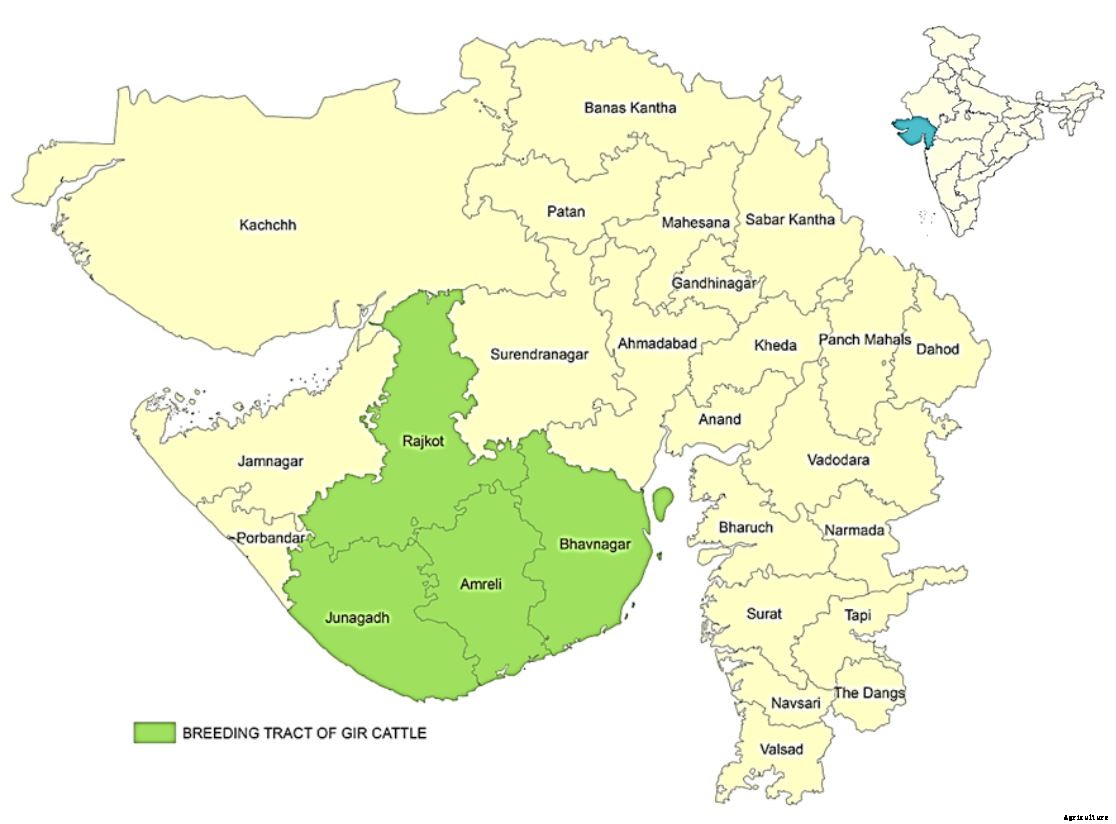
Gujarat has a very good milch cow breed called Gir that can be found in the Gir hills and forests of Kathiawar, which includes the districts of Junagarh, Bhavnagar, and Amreli. Gir cow is also knon as Bhodali, Desan, Gujarati, Kathiawari, Sorthi, and Surati. It is also sometime called as Gyr cow. The breed’s name is derived from its place of origin, the Gir forest of Gujarat.
Gir cows are considered as one of the best milk producing indigenous cows in the country.
Known for its tolerance to stress, the Gir cow is a world-renowned breed. This breed of cow has become resistant to many tropical conditions and can yield more milk with less feeding. Besides being used for milk, the Gir is also useful for draughts.
As with all cows in India, the Gir also occupies an important position in Indian culture, religion, and society. Due to the presence of A-2 beta-casein protein substance in the milk of the Gir cow, the milk is considered to be of premium quality. Gir cow has also played a major role in support and development of other related agrobusiness.
Although very inert due to their hanging sheath and heavy build, Gir bullocks are capable of moving heavy loads on all kinds of soils, including sandy, black, and rocky ones. Despite harsh conditions, they can thrive and reproduce. Brazil, the United States, Venezuela, and Mexico have imported it and successfully bred it.
The Saurashtra region is home to about 2.5 million cattle, and Gir cattle represent 37 per cent of the region’s total cattle population.
Location and Topography
The native tract stretches between 20°5′ and 22°6′ north latitude, and covers about 6,000-7,000 square kilometers. Approximately 70° to 72° east is the longitudinal position. For the most part, the area has an undulating surface. The altitude varies from 125 to 600 m above mean sea level. The low-lying valleys between the Gir ranges are prone to flooding. The Gir forest is largely used for pastures.
Climate
The climate, in general, is tropical monsoon. The maximum temperature in the area ranges from 30° to 36°C. The rainfall in the region ranges from 50 to 100 cm. Summers are usually dry and hot and winters are usually dry and pleasant. There are hot, humid monsoons in Junagarh, moderately damp temperatures in winter, and steamy, windy summers in this area.
Soil
Due to its volcanic origin, Gir hills contain basalt and trap. The texture, quality, and depth of the soil, in which the breed thrives, vary widely. In general, the soil is black, with some lighter soil patches scattered about. There are light or red soils in the Gir forests and adjacent areas. Although black soil is supposed to be fertile, lighter red soils respond well to irrigation.
Management Practices
Rabari, Bharwad, Maldhari, Ahirs, and Charan are all professional breeders of Gir cattle. As a nomad, they move their cattle around looking for green pastures. In July and December, there is plenty of pasture available. However, in the rest of the months when the pasture becomes scarce, the herds migrate to neighbouring districts.
During the first eight to twelve months after birth, a calf is allowed to feed on milk from its mother. Dry cows and young stock are usually sent for grazing, while milking cows are kept in the village. A concentrated mixture is made from wheat bran, crushed pulses, grain husk, oilcake, cottonseed, etc. and is fed to bullocks and milking cows only.
Weaning of the calves is not practiced. Cows, bullocks, and young calves are the only animals housed in the shelter. The farmers herd the animals in a field for three or four nights to provide manure in the form of dung and urine.
Local types of Gir cow based on coat colour pattern
There are ten local types of Gir cow bases on the colour and colour patter of Gir cow’s coat.
Gadakadi : A light red or red color with white spots on the brisket region and slight white shades on the abdomen.
Kabari : There are red or yellowish red spots or patches all over the white coloured body.
Makadi : Yellowish red
Bavadi : An even distribution of red and white patches with light red udders
Gauri : Dark red
Pingad : Golden patches
Suvarna Kapila : The body coat color is golden, and the hooves and horns are marble coloured in appearance.
Liladi : Greyish white with patches of light blue. Ears and udders are purple on the inside
Bagali : An off-white or greyish white with red or yellowish-red highlights
Telami/ Koyal/ Shamadi : The coat colour is reddish black, the udder is red, and the tail is black in colour.
Physical Characteristics of Gir cow
Gir has the widest range of coat colour patterns amongst all indigenous cattle breeds.
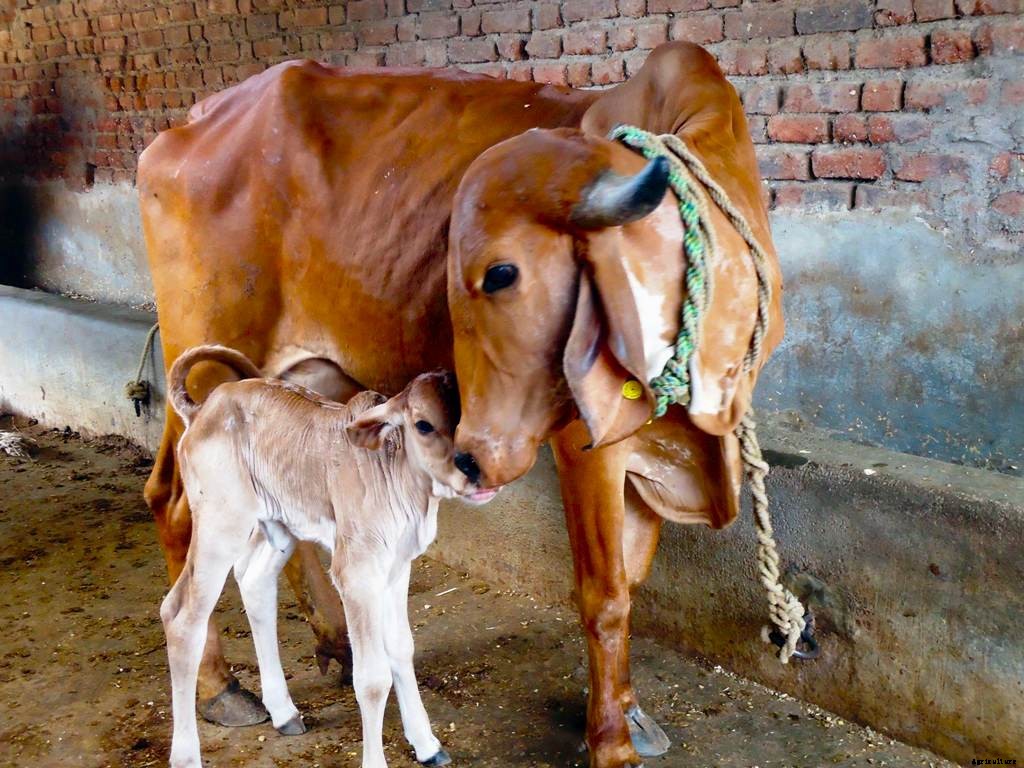
Girs have a very distinctive color pattern. A white coat with red or black patches is the basic characteristic of the gir cow’s skin. There are mostly pure red Gir cattles today, though some have speckled red spots.
Gir cattle have the largest hump of all indigenous cattle breeds.
Gir cattle have a broad convex forehead like a bony shield. As a result of this broad bony forehead overhanging the eyes, the eyes of the gir cow appear partially closed, giving the cow a sloppy appearance.
The forehead narrows distinctly and curves down at an angle on the nasal bone to end in a wide muzzle and big nostrils.
Long, dangling ears are folded like a leaf with a notch at the tip. An ear’s interior always faces forward and hangs from its base.
The length of ears is the longest amongst all cattle breeds (around 30 cm).
Gir cow’s dewlap is moderately developed.
Gir males have a large, pendulous sheath.
Gir cow has a long and whip-like tail.
It has a supple and loose and the hairs are short and glossy.
The hooves of a gir cow are medium in size and black in color.
Gir cattle are the only breed of cattle in which the horns grow below the head.
The horns of gir cows are curved in a peculiar way. The horns start at the base of the crown and take a downward and backward curve. The horns again twist a little upward and forward taking a spiral inward sweep, eventually terminating in a fine point. This gives the horns a unique half-moon appearance.
Morphometric and Performance Parameters Gir cow
Gir bull’s Hearts length = 150 cm, Gir bull’s Hearts height = 140, Gir bull’s Hearts girth = 180 cm.
Gir cow’s Hearts length = 125.5 cm, Gir cow’s Hearts height = 121.2, Gir cow’s Hearts girth = 160.4 cm.
Gir cows birth weight average = 23.9 Kg. ( Ranges from 20 – 27 Kg ).
Gir bull’s adult body weight = 544 Kg.
Gir cow’s adult body weight = 310 Kg.
Average age of first calving = 1552 days ( Ranges from 1200 – 1800 ).
Average Gir cow’s milk yield = 2110 Kg ( Ranges from 800 – 3300 Kg ).
Average Gir cow’s calving interval = 516 days ( Ranges from 400 – 600 days ).
Average Gir bull’s adult body Height = 159.84 cm.
Average Gir cow’s adult body Height = 130.79 cm.
Average Gir bull’s adult body Length = 137.51 cm.
Average Gir cow’s adult body Length = 131.40 cm.
Source : (NBAGR, 2015) and INDIAN COUNCIL OF AGRICULTURAL RESEARCH
Breeding Farms Gir cow
Following is the list of gir cow breeding fecilities in india.
Source of this article were papers from INDIAN COUNCIL OF AGRICULTURAL RESEARCH and National Dairy Development Board
FAQ on Gir cows
Why Gir cow milk is costly? Gir cow milk is a high source of protein and is considered under the type 2 milk catagory. It not only has whey protein but also A2 beta-casein protein. The type A2 protein is comparatively easily digested than A1 protein. Studies also show that A1 protein has been related to health conditions (vide supra).
How much milk does a Gir cow produce? Average Gir cow’s milk yield = 2110 Kg ( Ranges from 800 – 3300 Kg )
Is Gir cow milk good for health? Gir cow’s milk is very healthy. Gir cow milk is rich in calcium, phosphorus, fats, and potassium, all of which help keep blood pressure in check. Additionally, it contains Conjugated Linoleic Acid (CLA), an important acid that lowers bad cholesterol and improves heart health. The amino acids in Gir cows’ milk are beneficial for preventing health problems such as obesity, joint pain, and asthma. Gir milk has a high vitamin content, a high A2 protein content, calcium and magnesium content, and anti-oxidants.
What is special about Gir cow? Known for its tolerance to stress, the Gir cow is a world-renowned breed. This breed of cow has become resistant to many tropical conditions and can yield more milk with less feeding. Besides being used for milk, the Gir is also useful for draughts. Gir cow is one the best milk producing Indigenous cow breeds of India. Farming these Gir cows requires a low maintenance structure. The Gir breed has high fertility rate and can produce up to 10 calves during its lifespan.
What is the cost of Gir cow ? The price of Gir cow can range from 50000 INR to 200000 INR. The price of the gir cow depends on milk yeild, age, pedigree, Pregnant cow or dry cow. Gir bulls that are healthy and young cost approximately the same as Gir cows.